If you’re worried about missing the 31 January Self Assessment deadline, you’re not alone. Every year, thousands of UK taxpayers file late or struggle to pay on time.
The short answer is simple:
Missing 31 January triggers an automatic £100 penalty, even if you owe no tax.
Further penalties and interest can follow if the delay continues.
In this guide, we explain exactly what happens if you miss the deadline, how HMRC calculates penalties, and what practical steps you can take to reduce the impact.
Why 31 January Matters
The 31 January deadline covers three things:
- Online submission of yourSelf Assessment tax return
- Payment of any tax owed for the previous tax year
- First payment on account (if required)
The UK Self Assessment system is administered by HM Revenue and Customs (HMRC). Missing the deadline automatically activates a structured penalty process.
Official guidance is available on GOV.UK:https://www.gov.uk/self-assessment-tax-returns/deadlines
Let’s break down what happens next.
Immediate Penalty: £100 Automatic Fine
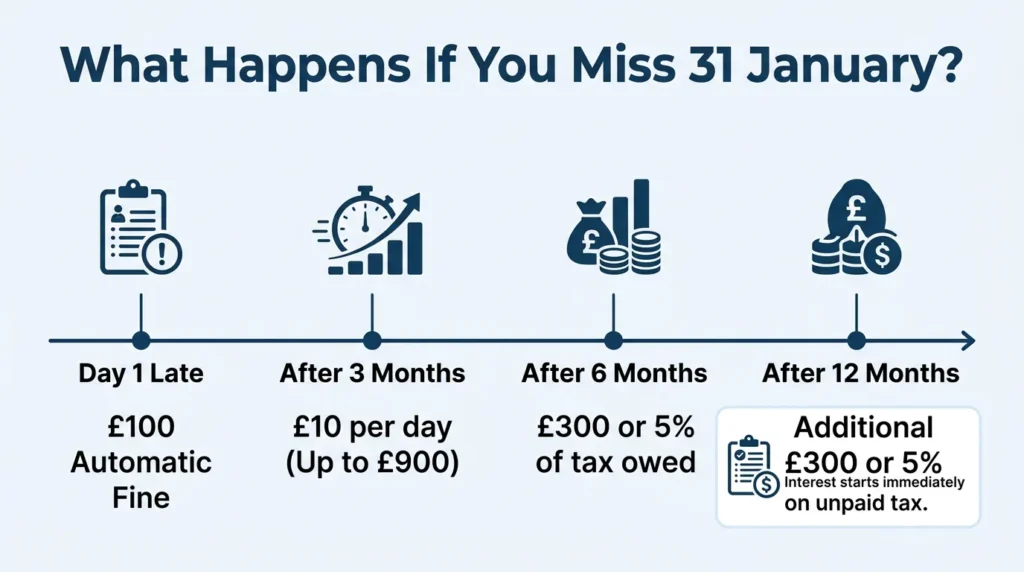
If your tax return is even one day late, HMRC issues a £100 fixed penalty.
Important details:
- The fine applies even if no tax is owed
- It is a fixed amount, not based on income
- You will receive a formal notice
This penalty applies simply for missing the filing deadline, not the payment deadline.
After 3 Months: Daily Penalties
If your return remains unfiled after 3 months, additional penalties apply:
- £10 per day
- Maximum of £900
At this stage, costs can rise quickly, especially if combined with unpaid tax.
After 6 Months: Further Charges
If still outstanding after 6 months, HMRC may charge:
- £300 or
- 5% of the tax owed (whichever is higher)
Even if no tax is due, the £300 minimum may still apply.
After 12 Months: Additional Penalty
At 12 months late, a further penalty may be added:
- £300 or
- 5% of the tax owed (whichever is higher)
In cases of deliberate withholding of information, penalties can increase significantly.
Late Payment Penalties and Interest
Filing late is one issue. Paying late is another.
If tax remains unpaid after 31 January:
Interest Charges
Interest accrues from the day after the deadline until payment is made.
5% Late Payment Penalty
A 5% surcharge applies if tax remains unpaid:
- 30 days after the deadline
- 6 months after the deadline
- 12 months after the deadline
For higher earners or landlords, these percentages can become substantial.
What if You Cannot Afford to Pay?
If you cannot pay in full, ignoring the problem makes it worse.
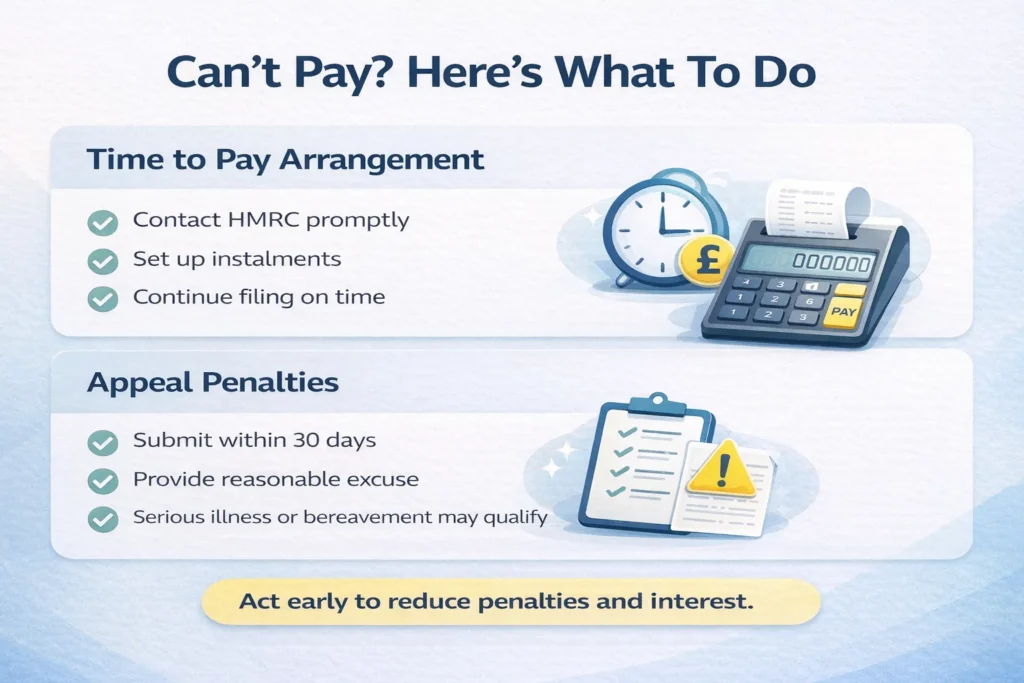
HMRC offers a Time to Pay arrangement, allowing instalments over time.
To qualify, you must:
- Contact HMRC promptly
- Propose a realistic payment plan
- Continue filing future returns on time
Setting up a payment plan can prevent additional escalation.
Can Penalties Be Cancelled?
HMRC may cancel penalties if you have a valid “reasonable excuse.”
Examples might include:
- Serious illness
- Bereavement
- Unexpected IT system failures
- Postal disruption is outside your control
Forgetting, being busy, or lacking funds are unlikely to qualify.
Appeals must usually be submitted within 30 days of receiving the penalty notice.
Why People Miss the 31 January Deadline
Common causes include:
- Underestimating preparation time
- Poor record keeping
- Waiting for missing documents
- Assuming no tax is owed
- Not realising filing was required
Many first-time freelancers and side-hustlers assume small profits mean no filing requirement. However, Self Assessment is triggered by income thresholds, not just profit.
How to Reduce the Risk of Self-Assessment Penalties
1. Register Early
If newly self-employed, register by 5 October following the tax year.
2. Keep Organised Records
Maintain clear records of income and allowable expenses throughout the year.
3. File Early
You can submit your return from 6 April onward. Filing early:
- Reduces stress
- Gives time to plan payments
- Avoids January system delays
4. Seek Advice if Your Situation Is Complex
If you have rental income, income above £100,000, or multiple income streams, a professional review can prevent mistakes.
Does Filing Late Affect Your Credit Rating?
In most cases, tax return penalties do not directly affect your credit score.
However:
- Continued non-payment may lead to debt collection
- Legal enforcement action can escalate if ignored
Early communication with HMRC reduces long-term risk.
Key Takeaways
If you miss 31 January:
- An automatic £100 penalty applies
- Daily penalties start after 3 months
- Further surcharges apply at 6 and 12 months
- Interest accrues on unpaid tax immediately
The longer the delay, the more expensive it becomes.
However, the system is structured and predictable. Acting quickly limits the financial impact.
Final Advice
If you have already missed the 31 January deadline:
- File your return as soon as possible, even if you cannot pay
- Contact HMRC about payment options
- Appeal penalties if you have a genuine, reasonable excuse
Tax deadlines are strict, but they are manageable with prompt action and accurate information.
Need Clarification?
If you are unsure about your Self Assessment obligations or concerned about penalties, structured guidance can help you understand your position clearly.
For further information, contact Protax Consultants

Muhammad Bilal is a Fellow Chartered Certified Accountant (FCCA) and Director of Protax Consultants, a London-based accounting firm specialising in tax advisory, compliance, and business accounting services.
Bilal qualified with the Association of Chartered Certified Accountants (ACCA) in 2009 and later achieved FCCA status after gaining extensive professional experience. With more than 13 years of experience in accounting, taxation, and auditing, he advises SMEs, landlords, contractors, and charities on tax planning, compliance, and financial management.
As a registered HMRC agent, Bilal assists clients with Self Assessment tax returns, corporation tax planning, VAT compliance, payroll services, and HMRC enquiries.
Bilal holds a BSc (Hons) in Applied Accounting and leads the audit and compliance function at Protax Consultants.
Company Verification:
Protax Consultants Ltd – Company Number 14701253
View Companies House Record