
For many sole traders and freelancers across the UK, one of the biggest financial mistakes made each year is failing to claim all their legitimate business costs.
HM Revenue & Customs (HMRC) only taxes your final profit, not your total income. This means every pound you spend on a genuine business cost is a pound that is safe from tax. However, small costs easily go unnoticed, or business owners simply do not realise they qualify for tax relief.
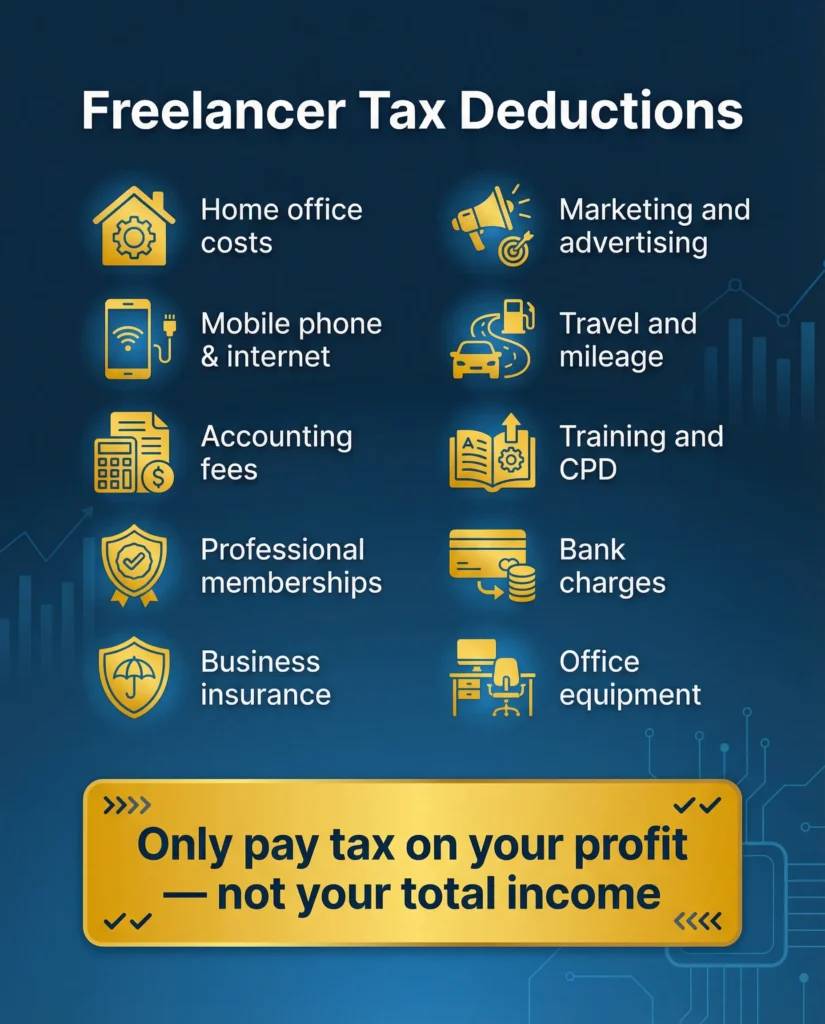
By tracking all your allowable expenses, you can legally reduce your 2025/26 tax bill. Here are 10 common expenses you should be claiming.
10 Allowable Expenses You Should Claim in 2025/26
1. Use of Home as an Office
If you work from home, you can claim a portion of your household bills. You have two simple ways to do this:
- Actual Costs: You calculate the exact percentage of your electricity, heating, and rent that is used purely for business.
- Simplified Expenses: This is a flat monthly rate based on your working hours. For example, if you work 101 hours or more a month from home, you can claim £26 per month without needing to keep receipts for your utility bills.
2. Mobile Phone and Internet
You can claim the business portion of your mobile phone and broadband bills. If you use your personal mobile for work 50% of the time, you can legally deduct half of your monthly bill as a business expense.
3. Accounting and Professional Fees
The cost of hiring an accountant or using digital bookkeeping software is a fully deductible business expense. Since you will need HMRC-compatible software for the upcoming Making Tax Digital switchover, ensure you are claiming the costs of platforms like Xero or QuickBooks right now.
4. Professional Subscriptions
Many freelancers forget to claim memberships to professional bodies, trade associations, or industry-specific magazines. As long as the membership is strictly necessary for your work, it is usually an allowable expense.
5. Business Insurance
Protecting your business is not just a smart move; it is also tax-deductible. This includes policies such as:
- Professional Indemnity insurance.
- Public Liability insurance.
- Equipment or “Cyber” insurance.
6. Marketing and Advertising
Everything you spend to find new clients or promote your services can be claimed. This includes:
- Website hosting and domain names.
- Google Ads or social media advertising.
- Business cards and professional branding services.
7. Travel and Mileage
If you travel for client meetings or site visits (excluding your regular daily commute), you can claim back the cost.
- Mileage: For the 2025/26 tax year, you can claim 45p per mile for the first 10,000 business miles driven in your own car or van.
- Public Transport: Keep your receipts for trains, buses, and taxis used exclusively for business trips.
8. Training and Skills Development
You can claim for training courses that help you improve your existing business skills. For example, a graphic designer can request a course on how to use new design software. However, you cannot claim for training to learn a completely new trade.
9. Bank Charges and Payment Fees
Those small transaction fees from your business bank account or payment platforms (like Stripe, PayPal, or SumUp) quickly add up. Because these are direct costs of doing business, they are fully allowable.
10. Small Equipment and Stationery
From printer ink and paper to external hard drives and office chairs—if it is used for your business, you should be claiming it. Under the “Cash Basis” (which is the default accounting method for most sole traders in 2025/26), you can usually deduct the full cost of equipment in the exact same year you buy it.
Why Claiming Expenses Matters
Claiming your expenses correctly ensures you only pay tax on your actual profit.
A Quick Example:
If you earned £50,000 this year but had £10,000 in allowable expenses, you only pay tax on £40,000. Failing to claim those legitimate expenses could cost you thousands of pounds in completely unnecessary tax payments.
Final Thoughts
The secret to lowering your tax bill is simple organisation. With the 2026 move to digital tax reporting fast approaching, now is the perfect time to start tracking every single expense electronically. Keeping clear records ensures you never pay a penny more to HMRC than you legally owe.
Frequently Asked Questions (FAQs)
1. Do I need to keep every single receipt?
Yes, you must follow the self-assessment record rules and keep evidence for at least five years after the tax deadline. However, if you use “Simplified Expenses” flat rates for your mileage or working from home, you do not need to keep every individual fuel or utility bill—just a clear log of your hours or miles.
2. Can I claim my morning coffee while I work?
Generally, no. HMRC considers everyday food and drink a “personal expense” because you need to eat to live. You can only claim for meals if you are travelling overnight for business or if the meal is part of a necessary business trip outside your normal routine.
3. I use the “Cash Basis”—can I still claim for a new laptop?
Yes. Under the new default Cash Basis rules, you can usually deduct the full cost of most equipment (like laptops or trade tools) from your income in the year you pay for them, rather than spreading the cost over several years.
4. Can I claim for my gym membership if it keeps me fit for work?
No. Even if your job is physically demanding (like a personal trainer or a builder), HMRC views gym memberships as having a “dual purpose” (health and fitness is a personal benefit). Therefore, it is never an allowable business expense.
5. What if I use my car for both business and personal trips?
You can only claim for your business miles. Most sole traders find it easiest to keep a simple mileage log and use the 45p-per-mile flat rate. This covers fuel, insurance, and wear and tear without the stress of having to split every single physical receipt. Ensure your log is ready before your next tax return deadline.
Muhammad Bilal is a Fellow Chartered Certified Accountant (FCCA) and Director of Protax Consultants, a London-based accounting firm specialising in tax advisory, compliance, and business accounting services.
Bilal qualified with the Association of Chartered Certified Accountants (ACCA) in 2009 and later achieved FCCA status after gaining extensive professional experience. With more than 13 years of experience in accounting, taxation, and auditing, he advises SMEs, landlords, contractors, and charities on tax planning, compliance, and financial management.
As a registered HMRC agent, Bilal assists clients with Self Assessment tax returns, corporation tax planning, VAT compliance, payroll services, and HMRC enquiries.
Bilal holds a BSc (Hons) in Applied Accounting and leads the audit and compliance function at Protax Consultants.
Company Verification:
Protax Consultants Ltd – Company Number 14701253
View Companies House Record