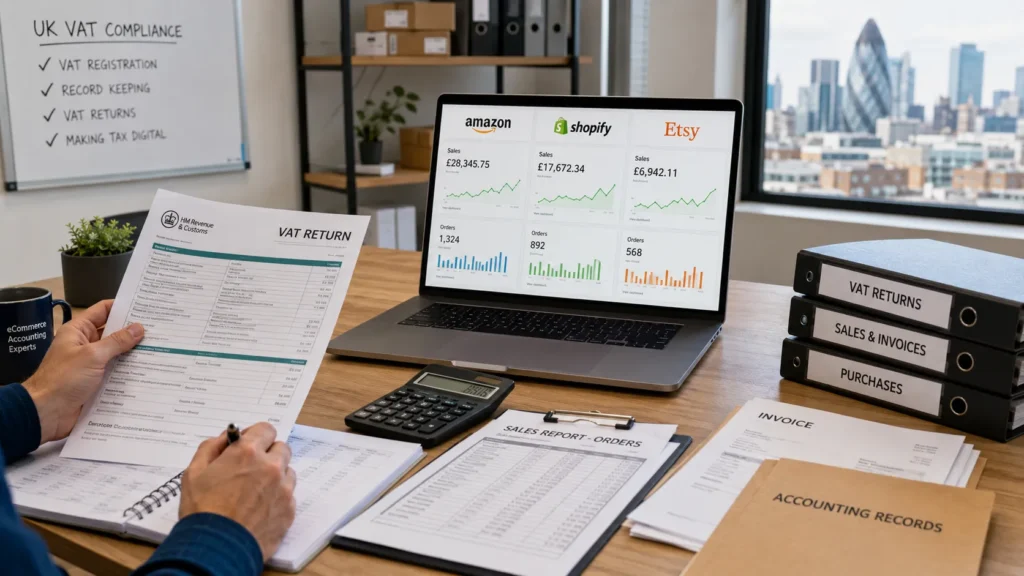
A practical 2026 VAT guide for UK sellers on Amazon, Shopify, and Etsy: when you must register, how each platform handles VAT differently, what deemed supplier rules mean for your returns, and how to stay compliant as HMRC increases data sharing with marketplaces.
Selling on Amazon, Shopify, or Etsy brings unique VAT complications that general accounting guidance does not always cover. Each platform handles VAT differently, marketplaces collect VAT on some transactions, but not others, and HMRC is increasing its use of marketplace data to identify sellers who are not compliant. This guide cuts through the complexity and gives you a clear picture of your obligations in 2026.
VAT Registration: When Does It Apply to Online Sellers?
The VAT registration rules for online sellers are the same as for any other UK business. If you are a UK-based seller, you must register for VAT once your total taxable turnover from all sales channels combined exceeds £90,000 in any rolling 12-month period. This includes sales through Amazon, Shopify, Etsy, eBay, your own website, and any other channel — all combined.
If you are an overseas seller storing goods in a UK warehouse, including through Amazon FBA, the threshold is £0. You must register for UK VAT before making your very first UK sale. HMRC has significantly increased its cooperation with online marketplaces to identify non-compliant overseas sellers, and penalties can be substantial.
Amazon VAT: What the Platform Does and What You Still Owe
Amazon is a deemed supplier for VAT purposes on certain transactions. This means Amazon collects and remits VAT to HMRC directly on those sales, rather than the seller doing so. The deemed supplier rules currently apply to:
- Sales of goods stored in the UK where the seller is based outside the UK
- Imports of low-value goods into the UK (consignments valued at £135 or less) where the seller is based outside the UK
For UK-based sellers selling goods from UK stock to UK customers, Amazon is not the deemed supplier. You remain responsible for charging and accounting for VAT on those sales.
⚠️ Amazon Collecting VAT Does Not Mean You Have No Obligations
This is one of the most common and expensive misunderstandings for Amazon sellers. Even where Amazon collects and remits VAT as deemed supplier, you must still report those sales on your VAT return as deemed sales. You must still maintain full digital records of all transactions. You remain responsible for correct VAT registration, for sales to which deemed supplier rules do not apply, and for all reporting under Making Tax Digital. Failing to report deemed sales correctly can make it appear to HMRC that you are under-reporting your business size.
Amazon FBA: The Nil VAT Threshold for Overseas Sellers
If you are a business based outside the UK that uses Amazon FBA to store goods in a UK fulfilment centre, you must register for UK VAT from your very first sale. There is no £90,000 threshold buffer for overseas sellers storing goods on UK soil. HMRC has intensified its cooperation with Amazon and other platforms, and non-compliance can result in your seller account being suspended as well as backdated VAT assessments.
Postponed VAT Accounting is available to FBA sellers who import goods into the UK. Rather than paying import VAT at the border, you declare it on your VAT return and reclaim it in the same return — a significant cash flow advantage. Your accountant or customs agent must select this option on your import declaration.
Shopify VAT: More Responsibility on the Seller
Shopify operates differently from Amazon. Shopify provides the platform and payment tools, but the seller is the merchant of record and carries full responsibility for VAT compliance. Unlike Amazon, Shopify does not act as a deemed supplier for UK domestic sales. This means:
- You are responsible for charging the correct rate of VAT on all UK sales
- You must set up VAT correctly in your Shopify store settings and apply the right rates by product type (standard 20%, reduced 5%, or zero-rated)
- All VAT records must be kept digitally and submitted to HMRC through MTD-compatible software
- Shopify fees, app subscriptions, and transaction costs may themselves carry VAT that you can reclaim as input tax
HMRC increasingly shares data with payment processors and platforms, and discrepancies between what Shopify reports and what you declare on your VAT return are a known trigger for enquiries. It is important that your accounting software is properly integrated with Shopify so your records reconcile automatically. Visit our e-commerce accounting page for more on how we help Shopify sellers stay compliant.
Etsy VAT: What the Platform Handles and What It Does Not
Etsy collects and remits VAT on behalf of sellers in certain situations, particularly for digital goods and for certain cross-border transactions. However, for UK-based sellers selling physical goods to UK buyers, the position is more nuanced:
- Etsy charges VAT on its seller fees (listing fees, transaction fees) and deducts this from your balance — you can reclaim this as input VAT if you are registered
- For sales of physical goods from a UK seller to UK buyers, Etsy is not the deemed supplier — you are responsible for accounting for VAT on those sales if you are VAT registered
- The £1,000 trading allowance applies only if you are not in business — once Etsy activity is a trading business (regular sales with a view to profit), income tax and potentially VAT obligations apply
VAT Rates on Products: Getting It Right
One of the most common VAT errors for online sellers is applying the wrong rate to products. Many product categories carry a zero or reduced rate that sellers miss, either over-charging customers or missing an opportunity to charge correctly.
| VAT Rate | Common Examples for Online Sellers |
|---|---|
| 20% (standard) | Most physical goods, clothing for adults, electronics, homeware, jewellery, cosmetics |
| 5% (reduced) | Most physical goods, clothing for adults, electronics, homeware, jewellery, and cosmetics |
| 0% (zero-rated) | Most food (but not confectionery, crisps, or alcohol), children’s clothing and footwear, printed books, and certain baby or children’s items where VAT relief applies |
| Exempt | Most financial services and insurance products — VAT cannot be charged or reclaimed |
ℹ️ Selling Across Multiple Channels? Your Turnover Is Combined
If you sell on Amazon, Shopify, and Etsy simultaneously, all three channels count toward your single £90,000 VAT registration threshold. Add up your total taxable sales across every platform each month. Many sellers hit the threshold without realising it because they are monitoring each channel in isolation rather than looking at the combined rolling total.
Making Tax Digital for Online Sellers in 2026
Making Tax Digital for VAT is mandatory for all VAT-registered businesses in 2026. You cannot manually enter figures into the HMRC portal. Digital records must be kept, and returns must be filed through MTD-compatible software. For online sellers, this means your accounting software must receive sales data directly from your platforms — whether through an integration, API connection, or approved data transfer tool — without manual re-entry.
From April 2026, MTD for Income Tax also applies to sole traders and landlords with qualifying income above £50,000. This means many growing online sellers face MTD obligations on two fronts simultaneously. Our e-commerce accounting service covers both VAT and Income Tax MTD compliance for UK marketplace sellers at a fixed monthly fee.

Selling to EU Customers After Brexit
If you sell physical goods to EU customers, the VAT rules depend on where your goods are shipped from and the value of the consignment. Key points for UK sellers in 2026:
- UK VAT is generally not charged on goods exported to EU customers — exports are zero-rated for UK VAT purposes
- The EU’s Import One-Stop Shop (IOSS) allows UK sellers to collect and remit VAT on goods valued at €150 or less at the point of sale, avoiding delays at EU customs
- From 1 July 2026, the EU will introduce an interim flat-rate customs duty of €3 per item category contained in small parcels entering the bloc, affecting low-value ecommerce imports that currently benefit from the customs duty exemption
- Goods valued above €150 are subject to full customs duty and import VAT in the destination country
Selling on Amazon, Shopify or Etsy?
Our ACCA-certified accountants specialise in ecommerce VAT — from initial registration and scheme selection to MTD-compliant quarterly returns and cross-border compliance. We work with UK marketplace sellers across all platforms at a fixed monthly fee.
View VAT ServicesFrequently Asked Questions
Do I need to charge VAT on Amazon or Etsy sales?
If you are VAT registered and selling physical goods to UK customers from UK stock, yes. Whether the sale is through your own website, Amazon, Etsy, or any other channel, you must charge VAT at the correct rate and account for it on your VAT return. The platform being the marketplace does not remove your obligation unless that specific transaction falls under the deemed supplier rules, which generally apply to overseas sellers, not UK-based sellers selling from UK stock.
Does Amazon collect VAT on my behalf?
Amazon acts as a deemed supplier and collects VAT directly for certain categories of transaction, primarily goods from overseas sellers and low-value imports (consignments of £135 or less) from non-UK sellers. For UK-based sellers selling goods from UK stock to UK customers, Amazon does not generally collect VAT on your behalf. You remain the supplier and are responsible for charging and accounting for VAT on those sales.
I sell on multiple platforms. Does each platform have its own VAT threshold?
No. There is one single £90,000 VAT threshold that applies to your total taxable turnover across all platforms and sales channels combined. If you sell on Amazon, Shopify, and Etsy simultaneously, all three are added together when calculating whether you have crossed the threshold. Monitor your combined rolling 12-month total each month, not each platform in isolation.
What is the VAT threshold for overseas sellers on Amazon FBA?
For overseas businesses storing goods in a UK warehouse, including through Amazon FBA, the VAT registration threshold is £0. You must register for UK VAT before making your very first UK sale. HMRC has significantly increased data sharing with Amazon and other marketplaces, and failure to register can result in backdated VAT assessments, penalties, and suspension of your seller account.
What is Making Tax Digital and does it apply to my ecommerce business?
Making Tax Digital for VAT requires all VAT-registered businesses to keep digital records and submit VAT returns through HMRC-approved software. It has been mandatory for all VAT-registered businesses since April 2022. If you are an online seller and VAT registered, you must use MTD-compatible software such as Xero or QuickBooks, and your sales data from Amazon, Shopify, or Etsy must feed into that software digitally — manual re-entry of figures is not compliant. From April 2026, MTD for Income Tax also applies to sole traders with income above £50,000.

Muhammad Bilal is a Fellow Chartered Certified Accountant (FCCA) and Director of Protax Consultants, a London-based accounting firm specialising in tax advisory, compliance, and business accounting services.
Bilal qualified with the Association of Chartered Certified Accountants (ACCA) in 2009 and later achieved FCCA status after gaining extensive professional experience. With more than 13 years of experience in accounting, taxation, and auditing, he advises SMEs, landlords, contractors, and charities on tax planning, compliance, and financial management.
As a registered HMRC agent, Bilal assists clients with Self Assessment tax returns, corporation tax planning, VAT compliance, payroll services, and HMRC enquiries.
Bilal holds a BSc (Hons) in Applied Accounting and leads the audit and compliance function at Protax Consultants.
Company Verification:
Protax Consultants Ltd – Company Number 14701253
View Companies House Record