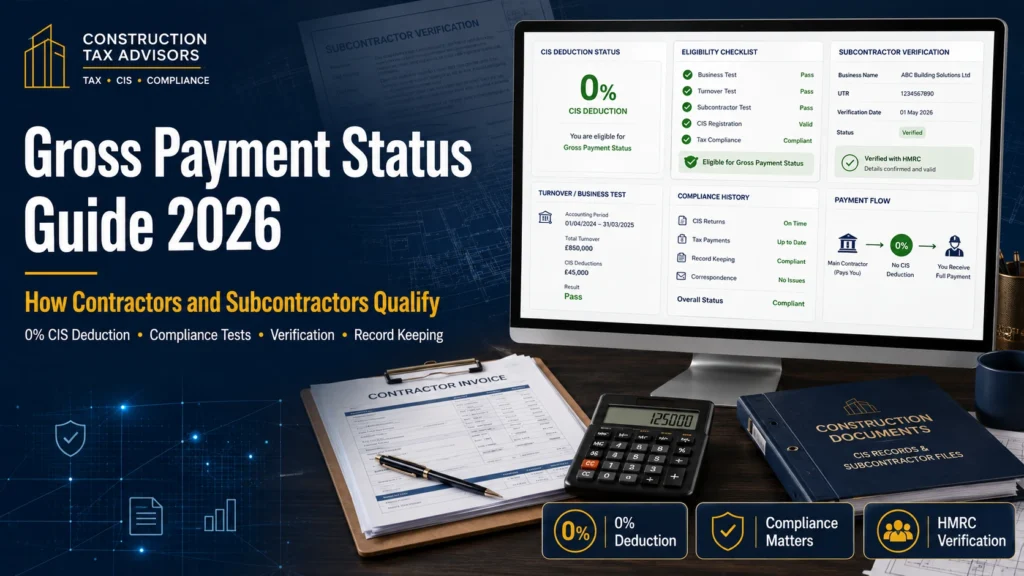
Every registered CIS subcontractor has 20% deducted from their labour invoices before they are paid. On a subcontractor billing £200,000 of construction labour per year, that is £40,000 held by HMRC for up to eighteen months. Gross payment status eliminates that deduction entirely.
Gross payment status (GPS) is one of the most effective cash flow tools available to CIS subcontractors — and one of the least understood. This guide from Muhammad Bilal FCCA covers the three qualifying tests, the current thresholds, the April 2024 change that added VAT to the compliance test, the April 2026 rule on immediate revocation, and the step-by-step application process. For the broader CIS context, see our CIS Scheme UK 2026 guide.
What Gross Payment Status Actually Does
Gross payment status is an HMRC designation that allows qualifying subcontractors to receive 100% of their labour invoices from contractors with no CIS deduction at source. Instead of having 20% withheld on every payment, the subcontractor receives the full amount and settles their own tax at year-end through Self Assessment or corporation tax.
GPS does not reduce your tax bill. The total liability is identical. What it changes is when you pay and how much working capital you control during the year. For a subcontractor billing £120,000 of labour annually, GPS means £24,000 that would otherwise sit with HMRC stays in the business throughout the year instead. That money funds materials, wages, equipment, and growth.
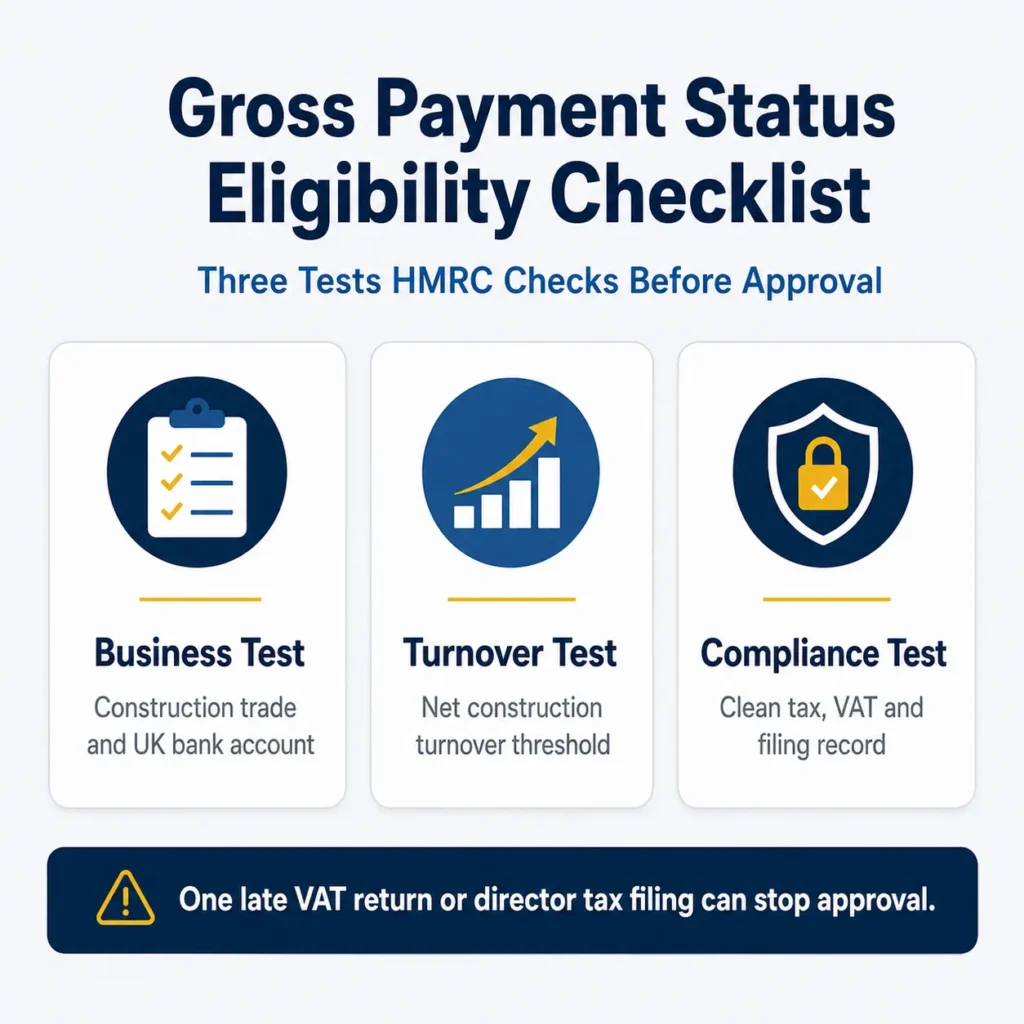
The Three Qualifying Tests
Test 1: The Business Test
The business must carry out construction operations in the UK or provide labour for construction operations, and must be run through a UK business bank account. HMRC requires a verifiable, traceable financial identity. The bank account ties the business to a regulated financial institution and makes the supply chain visible to HMRC.
Labour-only sole traders qualify. Pure plant hire without operators may not always qualify — whether it constitutes a construction operation under the Income Tax (Construction Industry Scheme) Regulations 2005 depends on the facts of the arrangement.
Test 2: The Turnover Test
Your net construction turnover in the twelve months before the date of your application must meet the threshold. Net construction turnover means gross construction income minus VAT minus the cost of materials. Labour, plant hire where you provide an operator, and travel costs remain in the figure.
| Business structure | Standard test | Alternative test |
| Sole trader | £30,000 net construction turnover | — |
| Partnership | £30,000 per partner | £100,000 for the whole partnership |
| Limited company (close — 5 or fewer directors/shareholders) | £30,000 per director | £100,000 for the whole company |
The most common error in GPS applications: including materials in the gross figure. Net turnover is gross construction income minus VAT and minus genuine materials costs. A subcontractor who bills £95,000 including £40,000 of materials has net construction turnover of £55,000 — above the sole trader threshold. But if they include the full £95,000 and then HMRC applies the correct calculation, the figure drops and the application may fail. Always calculate the net before comparing it to the threshold.
Test 3: The Compliance Test
All tax returns must have been filed on time, and all tax paid on time for the twelve months before your application date. HMRC looks back across every relevant obligation.
| Obligation | What does HMRC check (12 months before application) |
| Self Assessment (sole traders / partners) | Returns filed on time, income tax and Class 4 NIC paid on time |
| Corporation tax (companies) | CT returns filed on time, corporation tax paid on time |
| PAYE / NIC (companies with employees) | RTI submissions filed on time, employer NIC paid on time |
| VAT (VAT-registered businesses only) | Quarterly returns filed on time, VAT paid on time — added 6 April 2024 |
| Companies House (companies) | Confirmation statement filed on time |
| Director’s personal SA (limited companies) | Directors’ own Self Assessment — checked as part of the company application |
Competitor gap: most guides miss this. For limited company GPS applications, HMRC checks the directors’ personal Self Assessment records, not just the company’s filings. A director who is late with their own personal tax return can cause the company’s GPS application to fail. We see this regularly — it is the most commonly overlooked element of the company compliance test.
April 2024 Change: VAT Now Part of the Compliance Test
From 6 April 2024, VAT compliance was added to the statutory compliance test for obtaining and maintaining GPS. If you are VAT-registered, your VAT return filing history and payment record are now evaluated alongside your income tax, corporation tax, and PAYE records.
This is material. HMRC has refused GPS applications and revoked existing GPS over a single VAT return filed four to nine days late. HMRC has a statutory discretion to disregard minor failures where there is a reasonable excuse, but that discretion is applied narrowly and is not a substitute for a clean compliance record.
If you are not VAT-registered — because you are below the £90,000 registration threshold or have not registered voluntarily — the VAT element of the compliance test does not apply to you.
April 2026 Change: Immediate Revocation for Fraud
From 6 April 2026, HMRC can revoke GPS with immediate effect — without prior notice — where a business made or received a payment it knew, or should have known, was connected to tax fraud in its supply chain.
The ‘should have known’ standard is the critical one. HMRC does not need to show deliberate intent — only that a reasonable business should have identified red flags. Contractors holding GPS must exercise active supply chain due diligence: checking that subcontractors are genuinely CIS-registered, that pricing is commercially realistic, and that the chain does not include newly formed companies or businesses with no visible trading history.
| GPS revocation type | Prior position | From April 2026 |
| Compliance failure (late return, late VAT, etc.) | Annual review — revocation with notice | Annual review continues — immediate revocation possible for repeated/serious failure |
| Fraud or ‘should have known’ fraud | 1-year bar on reapplication | 5-year bar on reapplication; penalties up to 30% on business and officers |
| Turnover falls below threshold | Annual review — revocation with notice | No change |
How to Apply for Gross Payment Status
Apply through your Government Gateway account using the CIS online service. You will need your Unique Taxpayer Reference, net construction turnover for the preceding twelve months (split between labour and materials), and your business bank account details. The correct form depends on your structure:
- Sole traders: form CIS302
- Partnerships: form CIS304
- Limited companies: form CIS305
Before submitting, confirm your compliance position. Check that all returns are filed and payments made for the past twelve months. If you are a limited company director, check your personal Self Assessment too. If you are VAT-registered, verify that all quarterly returns and payments are clean.
Processing time for a complete application with no compliance flags is typically 21 to 60 days. Sole traders with three or more years of clean, on-time filings often receive a decision within 21 to 30 days. Limited companies with any compliance flag sit in review for 60 to 90 days while additional evidence is requested. If HMRC has not responded after ten weeks, chase via the CIS helpline on 0300 200 3210.
Maintaining Gross Payment Status Year Round
GPS has no fixed expiry, but HMRC reviews it annually and can run additional spot checks at any time. The most common reasons for withdrawal are:
- Late Self Assessment or corporation tax return — even one day late can be sufficient
- Late VAT return or payment (from April 2024 — this is a fully statutory test)
- Late PAYE or National Insurance payment for businesses with employees
- Net construction turnover falling below the qualifying threshold
- Being connected to a fraudulent supply chain (immediate revocation from April 2026)
- Director’s personal Self Assessment late — for limited company GPS holders
If GPS is withdrawn for compliance reasons, you must wait twelve months of full clean compliance before reapplying. For fraud-related withdrawals, the bar is five years.
GPS Cash Flow: A Worked Comparison
| Without GPS (20% deduction) | With GPS (0% deduction) | |
| Annual net labour invoiced | £120,000 | £120,000 |
| CIS deducted by contractors during year | £24,000 | £0 |
| Received in bank during year | £96,000 | £120,000 |
| Tax settlement | Self-assessment refund ~Feb/Mar following year | Self-Assessment payment due 31 Jan |
| Effective working capital advantage | — | ~£24,000 available throughout year |
Protax Consultants: GPS Applications for London Construction Businesses
Protax Consultants manages GPS applications for sole traders, partnerships, and limited companies across London and the UK. Muhammad Bilal FCCA and the team handle the pre-application compliance review, the turnover calculation (net, not gross), the CIS302/CIS304/CIS305 submission, and any HMRC follow-up requests. We also monitor annual compliance to ensure you never fail the review unexpectedly.
Based in Wimbledon, HMRC-authorised, ACCA-registered (5743262). Fixed fee. Call 020 8545 7451 or visit our CIS returns page.
Frequently Asked Questions
Does GPS mean I pay less tax?
No. The total tax liability is the same whether you have GPS or not. GPS changes the timing of when you pay and keeps your money in your bank account throughout the year rather than sitting with HMRC pending a refund.
Can a new business apply for GPS?
Yes, but you need twelve months of net construction turnover at or above the threshold and twelve months of clean compliance history. In practice, most new businesses need to wait around eighteen months from starting trading before the conditions are genuinely met.
Will one late VAT payment cost me GPS?
It can. Since April 2024, VAT compliance has been a statutory part of the compliance test. HMRC has refused applications over a single VAT return filed four days late. If you have any recent VAT issues, resolve them and establish a clean twelve-month record before applying.
What happens if HMRC revokes my GPS?
All contractors you work with must immediately switch you to the 20% deduction rate when they re-verify you. If the revocation was for fraud or being part of a fraudulent supply chain, you cannot reapply for five years. For other compliance failures, the minimum wait is twelve months of clean compliance.
How long does the application take?
For clean applications: 21 to 60 days. Sole traders with straightforward compliance histories are often faster — 21 to 30 days. Limited companies with any compliance flag may wait 60 to 90 days. If you have not heard after ten weeks, call the CIS helpline on 0300 200 3210.
Where can I get GPS application support in London?
Protax Consultants in Wimbledon handle GPS applications end to end — compliance review, turnover calculation, form submission, and HMRC follow-up. FCCA Chartered Certified Accountants, ACCA reg 5743262. Fixed fee. Visit our CIS returns page or call 020 8545 7451.

Muhammad Bilal is a Fellow Chartered Certified Accountant (FCCA) and Director of Protax Consultants, a London-based accounting firm specialising in tax advisory, compliance, and business accounting services.
Bilal qualified with the Association of Chartered Certified Accountants (ACCA) in 2009 and later achieved FCCA status after gaining extensive professional experience. With more than 13 years of experience in accounting, taxation, and auditing, he advises SMEs, landlords, contractors, and charities on tax planning, compliance, and financial management.
As a registered HMRC agent, Bilal assists clients with Self Assessment tax returns, corporation tax planning, VAT compliance, payroll services, and HMRC enquiries.
Bilal holds a BSc (Hons) in Applied Accounting and leads the audit and compliance function at Protax Consultants.
Company Verification:
Protax Consultants Ltd – Company Number 14701253
View Companies House Record