
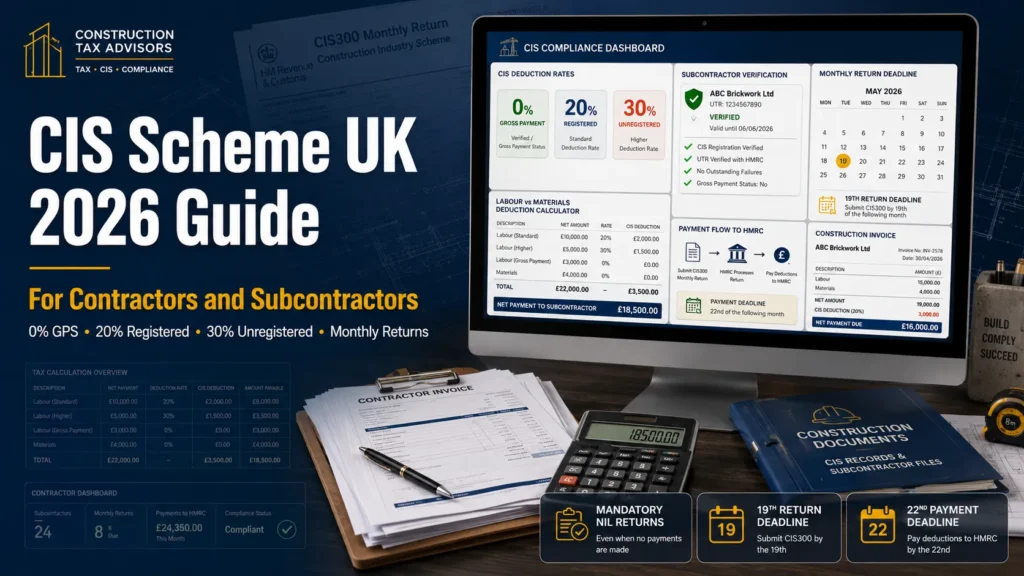
The Construction Industry Scheme requires every contractor in the UK to deduct tax from subcontractor payments, pass it to HMRC, and account for it on a monthly return. For subcontractors, those deductions reduce take-home pay by 20% or 30% every time an invoice is paid — until the year-end Self Assessment reconciles the position and, for most, triggers a refund.
In April 2026, HMRC introduced three substantive changes: mandatory nil returns, immediate gross payment status revocation powers, and a full CIS exemption for local authorities. This guide from Muhammad Bilal FCCA at Protax Consultants covers every aspect of the scheme for 2026/27, with confirmed rates, current deadlines, and the specific changes that took effect this April. For a detailed breakdown of gross payment status in particular, see our CIS Gross Payment Status guide.
What Is the Construction Industry Scheme?
The Construction Industry Scheme is an HMRC tax mechanism that applies to construction work in the UK. Contractors are required to deduct tax from the labour element of every payment made to a subcontractor, remit those deductions to HMRC monthly, and file a return confirming what was deducted and to whom. For subcontractors, those deductions are advance payments toward their income tax and National Insurance liability — not a separate tax charge.
The scheme was created because the construction industry presents a structurally high risk of tax non-compliance. Workforces are mobile, engagements are short-term, supply chains are complex, and the line between employment and self-employment is frequently blurred. CIS collects tax in real time rather than waiting for the subcontractor to self-report at year-end.
Who Does CIS Apply To?
Contractors
A contractor under CIS is any business that engages subcontractors for construction work. This includes main contractors on large commercial projects, small building firms paying occasional tradespeople, and sole traders who bring in other self-employed workers to help on a job. The deemed contractor rule also captures non-construction businesses that spend more than £3 million on construction in any rolling 12-month period — property developers, large retailers, and certain public bodies can all fall in here.
Subcontractors
A subcontractor is any individual or business hired by a contractor to carry out construction work, and who is not employed by that contractor. You can be both simultaneously. If you are a plumber hired by a main contractor to do first-fix work on a development, you are a subcontractor to them. If you then hire another plumber to help you finish, you become a contractor to that person and must operate CIS on your payments to them.
London contractors: if you regularly hire trades on short-term arrangements and you are not registered as a CIS contractor, you are exposed. HMRC can assess you for the deductions that should have been made, with interest and penalties. Our CIS returns service covers contractor registration, monthly returns, and subcontractor verification.
What Work Is Covered by CIS?
CIS applies to construction operations on permanent or temporary buildings, structures, and civil engineering works in the UK. In practice, this covers:
- Building, demolition, alteration, repair, and extension of permanent structures
- Site preparation — groundworks, drainage, groundworks, and enabling works
- Installation of heating, ventilation, air conditioning, lighting, power, water, and drainage systems
- Painting, decorating, and finishing of buildings
- Civil engineering — roads, bridges, tunnels, railways, harbours, and coastal works
CIS does not cover architecture, surveying, scaffolding hire without labour, carpet fitting, manufacturing of components off-site, or professional consulting work that is not integral to the construction operation itself.
CIS Deduction Rates 2026/27
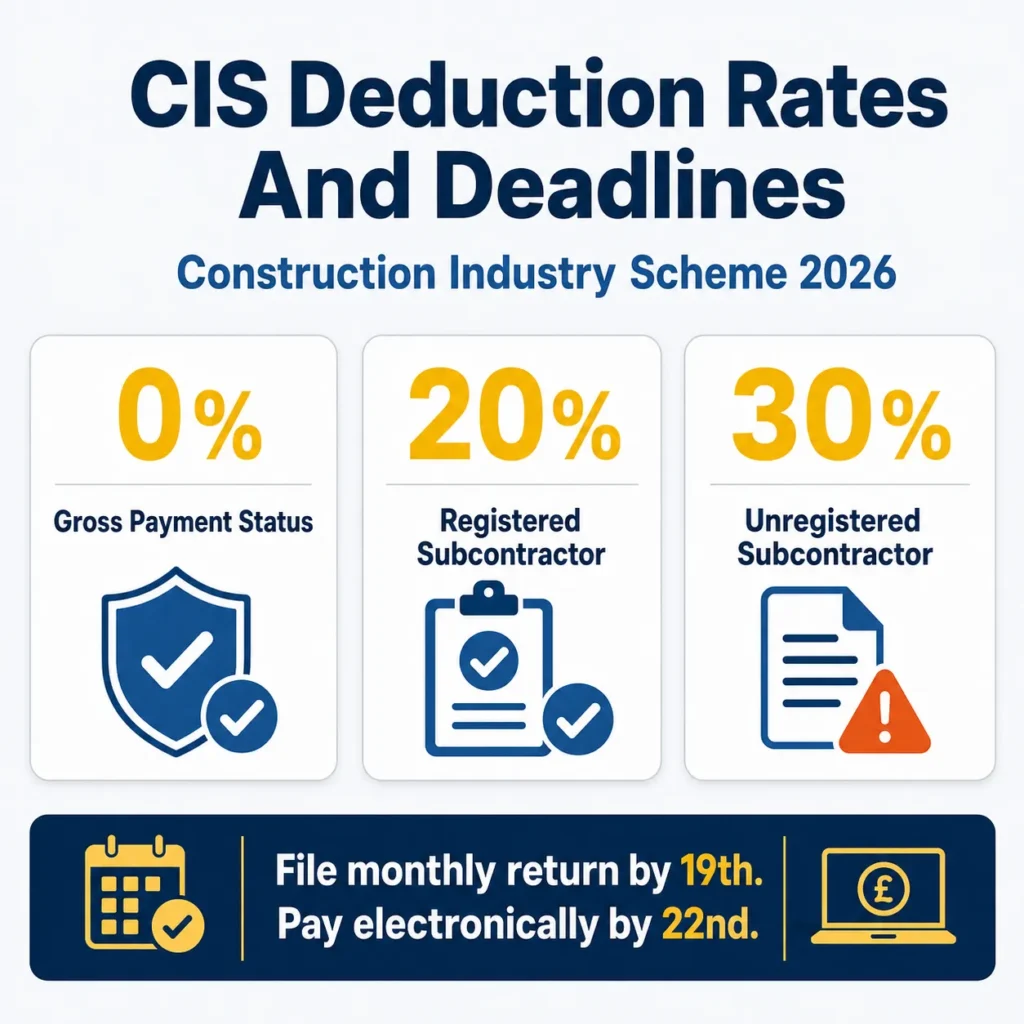
The deduction rates are unchanged for 2026/27. The rate applied to any particular subcontractor is determined by HMRC during the verification process, not by the contractor.
| Status | Rate | How it arises | Cash flow impact |
| Gross payment status | 0% | HMRC-approved — subcontractor passes three tests | Full invoice received; tax settled at year-end |
| Registered subcontractor | 20% | Standard rate — subcontractor verified as CIS-registered | 20% of labour withheld; refund via Self Assessment |
| Unregistered subcontractor | 30% | Penalty rate — HMRC cannot verify registration | 30% of labour withheld; higher refund but cash flow cost |
The deduction is applied only to the labour element of the invoice. Materials the subcontractor has genuinely purchased and invoices separately are excluded. VAT is also excluded. The contractor starts with the gross invoice amount, removes materials costs (which must be evidenced), and applies the rate to the remainder.
Worked Example: CIS Deduction Calculation
A registered subcontractor delivers groundworks on a commercial development and submits the following invoice:
| Invoice line | Amount | CIS treatment |
| Groundwork labour (3 weeks) | £9,400 | CIS deduction applies at 20% |
| Hired plant (evidenced receipts) | £1,200 | Excluded — plant hire treated as materials |
| Aggregates and fill (evidenced receipts) | £3,100 | Excluded — materials |
| Subtotal before VAT | £13,700 | |
| CIS deduction: 20% × £9,400 | £1,880 | Contractor remits to HMRC |
| Paid to subcontractor | £11,820 | Labour net + materials in full |
| Domestic reverse charge VAT (if applicable) | Separate — see Article 3 | Contractor accounts for VAT on own return |
Common error: some contractors deduct 20% from the full invoice, including plant hire and materials. This is incorrect and causes the subcontractor to be underpaid. Materials and evidence of plant hire must be removed before calculating the deduction.
Contractor Obligations: Verification
Before making the first payment to any subcontractor, the contractor must verify them with HMRC through the Government Gateway or approved software. HMRC confirms: the subcontractor’s name, their registration status, and the rate to apply. That rate is locked for the duration of the engagement.
Verification must be repeated if a new engagement begins after a gap of more than two years. Contractors who pay at the wrong rate — for example, applying 20% without verifying, when HMRC would have returned a 30% instruction — are liable for the under-deduction themselves.
Contractor Obligations: Monthly Returns and Payment Deadlines
| Obligation | Deadline | Penalty for failure |
| File CIS300 monthly return | 19th of the month following the tax month | £100 immediately; £200 at 2 months; £300 or 5% of deductions at 12 months |
| Pay deductions to HMRC (electronic) | 22nd of the following month | Surcharge interest from the due date |
| Pay deductions to HMRC (post/cheque) | 19th of the following month | Surcharge interest from the due date |
| Issue payment and deduction statement to subcontractor | Within 14 days of the end of the tax month | Up to £3,000 penalty for incorrect statements |
Tax months run from the 6th of one calendar month to the 5th of the next. For example, if you pay subcontractors between 6 June and 5 July, your return is due by 19 July and your payment by 22 July. The payment reference must include your Accounts Office reference followed by the correct month indicator — wrong references are the most common cause of CIS payments being misallocated.
April 2026 Changes: What Is Now Different
1. Nil Returns Are Now Mandatory
From 6 April 2026, contractors must either file a nil return or notify HMRC in advance for any tax month in which no subcontractor payments were made. Previously, contractors could simply take no action in quiet months, which caused HMRC to issue late-filing penalties incorrectly. The change corrects that but means contractors must act every month without exception.
If you do not expect to pay any subcontractors for a sustained period, tick the inactivity box on your next CIS return. This suspends the monthly filing obligation for up to six months.
2. Immediate GPS Revocation for Fraud
HMRC now has the power to revoke gross payment status with immediate effect where a business made or received a payment it knew, or should have known, was connected to tax fraud. The ‘should have known’ standard is significant — it means passive reliance on a subcontractor’s registration status is insufficient where other warning signs exist.
Alongside immediate revocation, HMRC can assess the business for the associated tax loss and impose a penalty of up to 30% on the business or its officers. The re-application bar for GPS has increased from one year to five years where fraud is involved.
3. Local Authorities Fully Exempt
From 6 April 2026, payments to local authorities and certain public bodies acting as subcontractors are fully outside the CIS. Previously, they relied on an Extra Statutory Concession to be treated as having GPS. They now fall outside the scheme altogether, removing the need for contractors who use local authorities in their supply chain to verify or deduct from those payments.
How Subcontractors Reclaim CIS Deductions
CIS deductions are advance payments — not a final tax bill. Most registered subcontractors overpay during the year because the 20% rate is applied to gross labour without allowing for the personal allowance or allowable business expenses. The reconciliation happens at Self Assessment.
On your SA103 self-employment pages, you enter your total gross income (including the deducted amounts — not the net received), your allowable expenses, and the total CIS deductions suffered. HMRC calculates the actual liability on the resulting profit and offsets what was already paid. Refunds typically arrive within four to six weeks of filing.
For limited company subcontractors, CIS deductions are offset monthly against the company’s PAYE and National Insurance via the Employer Payment Summary. The surplus carries forward month to month, and any year-end balance can be reclaimed — though processing can take 8 to 16 weeks. Our self-assessment service includes CIS deduction reconciliation for both sole traders and limited company directors.
MTD and CIS: The Qualifying Income Trap in 2026
Key point many CIS subcontractors get wrong: your MTD qualifying income is the gross amount invoiced before any CIS deductions are removed — not the net amount you receive. A subcontractor who invoices £55,000 but receives only £44,000 after 20% CIS deductions has a qualifying income of £55,000 and falls within the April 2026 MTD mandate.
MTD for Income Tax applies from 6 April 2026 for sole traders and landlords with qualifying gross income above £50,000, dropping to £30,000 in April 2027. See our full Making Tax Digital guide for setup requirements.
Protax Consultants: CIS Accounting for London Contractors and Subcontractors
Muhammad Bilal FCCA has been handling CIS returns, GPS applications, and subcontractor refund claims for London construction businesses for over 15 years. Protax Consultants is based in Wimbledon (G18 Lombard Business Park, SW19 3TZ), HMRC-authorised, ACCA-registered (reference 5743262), and serves contractors and subcontractors across all London boroughs and remotely throughout the UK.
Our CIS returns service covers contractor monthly returns and subcontractor verification, GPS applications (CIS302/CIS304/CIS305), year-end CIS deduction claims on Self Assessment, and limited company EPS offset and refund processing. Fixed fee, agreed before we start. Call 020 8545 7451 for a free initial conversation, or visit our London accountants page.
Frequently Asked Questions
What are the CIS deduction rates in 2026/27?
The rates are unchanged for 2026/27: 0% for subcontractors with gross payment status, 20% for registered subcontractors, and 30% for unregistered subcontractors. These rates apply to the labour element of invoices only — not to materials, VAT, or evidenced plant hire costs.
What changed in CIS from April 2026?
Three changes: (1) nil returns are now mandatory for months with no subcontractor payments; (2) HMRC can immediately revoke gross payment status where a business is connected to fraud, with a five-year reapplication bar; (3) local authorities are fully exempt from CIS as subcontractors.
Does CIS apply to materials?
No. CIS deductions apply only to the labour element. Materials the subcontractor genuinely purchased for the work — and can evidence with receipts — are excluded before the deduction is calculated. If the subcontractor cannot provide evidence, the contractor must estimate.
What happens if I do not verify a subcontractor?
If you pay without verifying and the subcontractor was unregistered, HMRC can hold you liable for the difference between the 20% you applied and the 30% that should have been applied. The contractor bears the under-deduction risk, not the subcontractor.
Do I need to file a CIS return if I had no subcontractor payments this month?
Yes, from 6 April 2026 you must either file a nil return or notify HMRC in advance. Previously, no action was required for quiet months. Missing this now triggers an automatic £100 penalty. Use the inactivity notification to suspend the obligation for up to six months if you will not be using subcontractors for a sustained period.
Where can I find CIS accounting support in London?
Protax Consultants are FCCA Chartered Certified Accountants in Wimbledon, London. Muhammad Bilal FCCA and the team handle contractor monthly returns, GPS applications, and subcontractor refund claims for construction businesses across London. Fixed fee. Call 020 8545 7451 or visit protax.org.uk/services/cis-returns.

Muhammad Bilal is a Fellow Chartered Certified Accountant (FCCA) and Director of Protax Consultants, a London-based accounting firm specialising in tax advisory, compliance, and business accounting services.
Bilal qualified with the Association of Chartered Certified Accountants (ACCA) in 2009 and later achieved FCCA status after gaining extensive professional experience. With more than 13 years of experience in accounting, taxation, and auditing, he advises SMEs, landlords, contractors, and charities on tax planning, compliance, and financial management.
As a registered HMRC agent, Bilal assists clients with Self Assessment tax returns, corporation tax planning, VAT compliance, payroll services, and HMRC enquiries.
Bilal holds a BSc (Hons) in Applied Accounting and leads the audit and compliance function at Protax Consultants.
Company Verification:
Protax Consultants Ltd – Company Number 14701253
View Companies House Record