
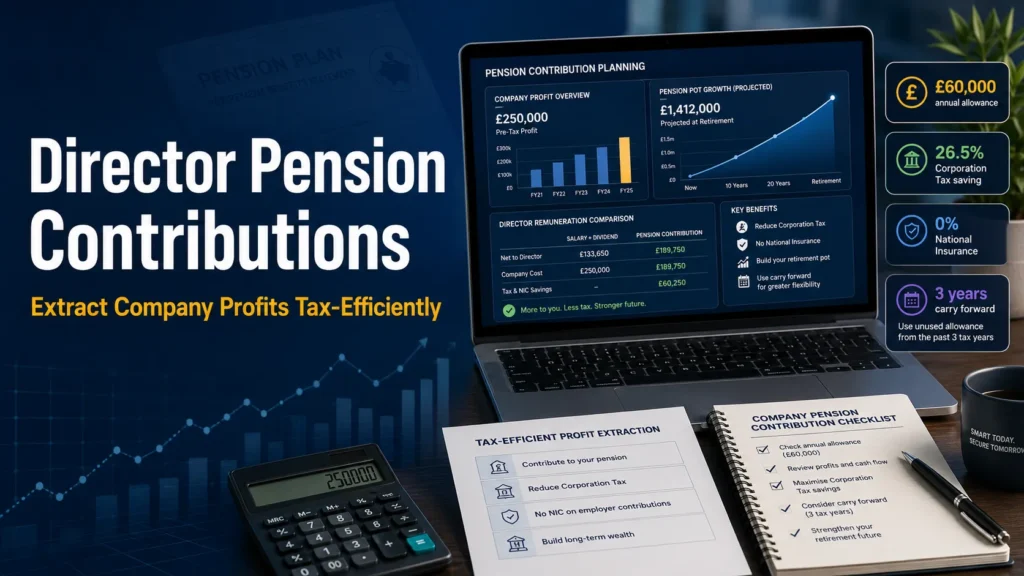
A practical 2026/27 guide for UK limited company directors on using employer pension contributions to extract profits from your company, saving Corporation Tax at up to 26.5%, avoiding all National Insurance, and building retirement wealth in the most tax-efficient way available.
For most limited company directors in 2026/27, employer pension contributions are the single most powerful tool for extracting value from a profitable business. Unlike salary and dividends, employer pension contributions reduce Corporation Tax, carry no National Insurance on either side, and allow profits to grow tax-free inside a pension wrapper until retirement. This guide explains how they work, how much you can contribute, and where the real tax savings come from.
How Employer Pension Contributions Work for Directors
As a director of your own limited company, you are both the employer and the employee. This means your company can make employer pension contributions directly into your personal pension on your behalf. These contributions come out of company profits before Corporation Tax, reducing your taxable profit and therefore your Corporation Tax bill in the same year the contribution is made.
Employer pension contributions are not subject to employer NIC or employee NIC. They do not count as employment income for Income Tax purposes at the time they are made. The money goes directly into your pension pot and grows tax-free until you draw it down in retirement, at which point it is taxed as income, typically at a lower rate than during your peak earning years.
The Tax Saving: How Much Can a Pension Contribution Save?
The Corporation Tax saving on an employer pension contribution depends on the rate your company pays:
| Company Profit Level | CT Rate / Effective Rate | CT Saving on £60,000 Contribution |
|---|---|---|
| Up to £50,000 (small profits rate) | 19% | £11,400 |
| £50,001–£250,000 (marginal relief band) | 26.5% effective marginal rate | Up to £15,900 |
| Above £250,000 (main rate) | 25% | £15,000 |
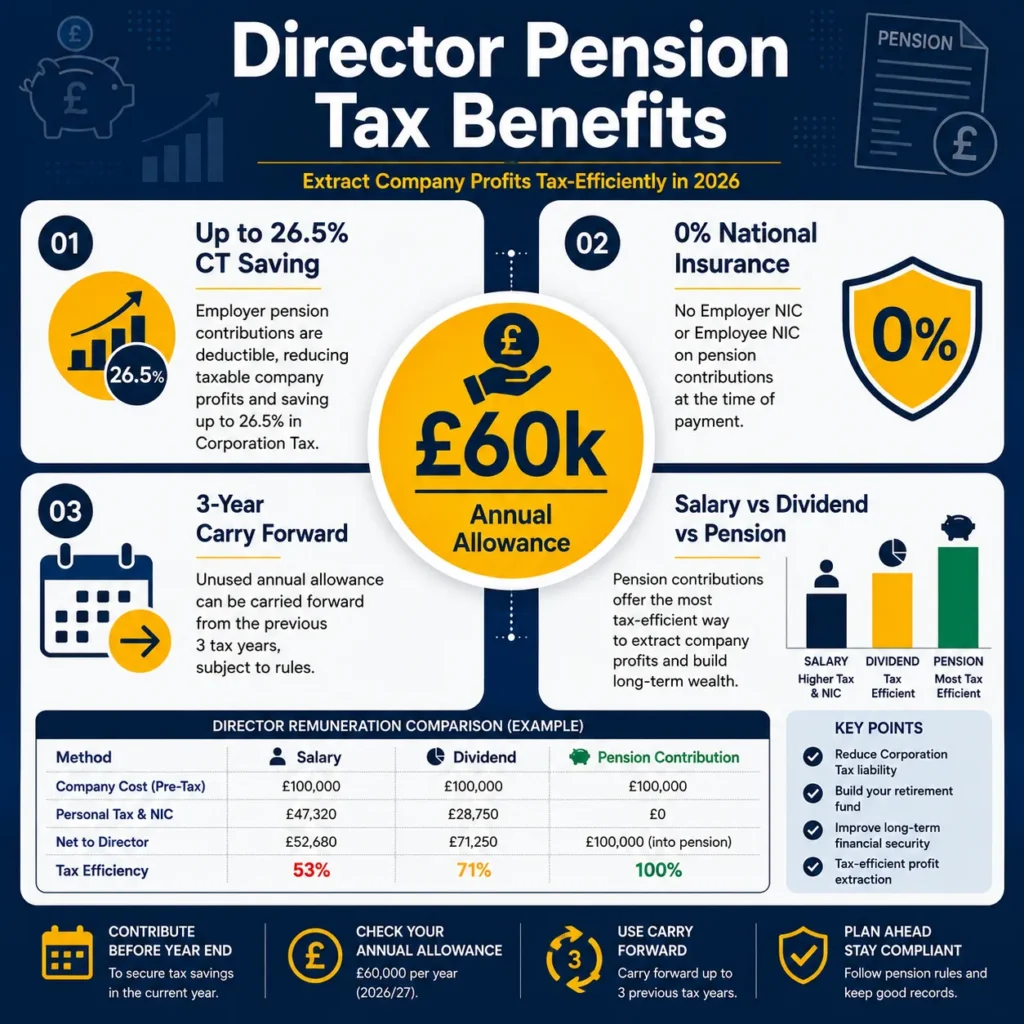
The highest tax saving comes when the pension contribution reduces profits through the marginal relief band (£50,000 to £250,000), where the effective marginal Corporation Tax rate is 26.5%. A £60,000 pension contribution that moves profits from £90,000 to £30,000 would save tax on £40,000 at 26.5% (the marginal band portion) and £20,000 at 19% (the small profits rate portion), significantly more than a flat 19% or 25% calculation suggests.
The Annual Allowance: How Much Can You Contribute?
The annual allowance for 2026/27 is £60,000. This is the maximum gross pension contribution (including employer contributions, personal contributions, and basic-rate tax relief) that can be made across all your pension arrangements in a tax year without triggering an annual allowance charge.
For employer contributions specifically, the salary restriction that limits personal contributions does not apply. Employees can only make personal pension contributions up to 100% of their earnings. But employer contributions are not restricted by the director’s salary level. The company can contribute up to the full annual allowance of £60,000 even if the director’s salary is only £5,000 or £12,570.
⚠️ Tapered Annual Allowance: Check If It Applies to You
High earners may face a tapered (reduced) annual allowance. Tapering applies if your adjusted income exceeds £260,000 and your threshold income exceeds £200,000. For every £2 of adjusted income above £260,000, the annual allowance reduces by £1, down to a minimum of £10,000. If your company is highly profitable and you take significant dividends and salary, check whether tapering applies before making a large contribution. The Money Purchase Annual Allowance (MPAA) of £10,000 also applies if you have already drawn flexibly from a defined contribution pension. This severely restricts further contributions.
Carry Forward: Catching Up on Unused Allowances
If you have not used your full annual allowance in the previous three tax years, you can carry forward the unused amounts and contribute more than £60,000 in a single year. This is one of the most powerful planning tools available to directors of profitable companies.
For example, if you had unused allowances of £20,000 in 2023/24, £30,000 in 2024/25, and £40,000 in 2025/26, you could potentially contribute up to £60,000 (current year) plus £90,000 (carried forward) = £150,000 in a single year, provided your company has sufficient profits to cover the contribution and it passes the wholly and exclusively test. The Corporation Tax saving on a contribution of this size could be substantial.
Carry forward rules are complex and depend on whether you were a member of a registered pension scheme in each of the earlier years. Professional advice is essential before making large contributions using carry-forward.
The Wholly and Exclusively Test: What HMRC Requires
Employer pension contributions are deductible against Corporation Tax only if they pass the “wholly and exclusively for the trade” test. In practice, HMRC applies this to ensure that the contribution is commercially justifiable as part of the director’s overall remuneration package and not simply an artificial extraction of company profits.
In most cases, the test is straightforward to satisfy for working directors taking a salary. The key considerations are:
- The contribution should be reasonable relative to the director’s role and the company’s profitability
- Very large contributions in a single year, especially those that significantly exceed the director’s total remuneration, may attract scrutiny
- Contributions to a pension for a non-working family member shareholder are more likely to be challenged
Employer Pension Contribution vs Salary vs Dividend: The Comparison
| Method of Extraction | Employer NIC | Employee NIC / Income Tax | Corporation Tax Saving | Access |
|---|---|---|---|---|
| Salary (above thresholds) | 15% above £5,000 | Income Tax + 8% employee NIC | Yes — deductible | Immediate |
| Dividend | None | Dividend tax (10.75%–39.35%) | No — paid from post-tax profit | Immediate |
| Employer pension contribution | None | None at point of contribution | Yes — deductible at 19%, 25%, or 26.5% | From age 55 (rising to 57 in 2028) |
ℹ️ Pension Contributions Must Be Made Before the Company’s Year End
To claim Corporation Tax relief in the current accounting period, the employer pension contribution must be paid before the company’s year end date. A contribution made after the year end will be deductible in the following accounting period. Many directors make a planned pension contribution in the weeks before their year end as part of an annual tax review. Our director salary and dividend service includes pension contribution planning at year end.
Want to Extract Profits More Tax-Efficiently?
Our ACCA-certified accountants model the optimal combination of salary, dividends, and pension contributions for your income level, profit position, and carry forward availability. Fixed fee, reviewed every year.
View Director Salary and Dividend ServiceFrequently Asked Questions
How much can my limited company contribute to my pension in 2026/27?
Your company can contribute up to the annual allowance of £60,000 per year in 2026/27 as an employer pension contribution. Unlike personal pension contributions, the company contribution is not restricted by your salary level. Even if your salary is £5,000 or £12,570, the company can still contribute up to £60,000. If you have unused allowances from the previous three tax years, you may be able to use carry forward to contribute more than £60,000 in a single year.
Are employer pension contributions tax-deductible?
Yes, employer pension contributions are deductible against Corporation Tax provided they pass the “wholly and exclusively for the purposes of the trade” test. This means the contribution must be commercially justifiable as part of the director’s remuneration package. For most working directors, this test is straightforward to satisfy. The Corporation Tax saving is 19%, 25%, or 26.5% (in the marginal relief band), depending on the company’s profit level, and applies in the accounting period in which the contribution is paid.
Is there National Insurance on employer pension contributions?
No. Employer pension contributions are not subject to employer NIC or employee NIC. This makes them more efficient than equivalent salary payments, which attract employer NIC at 15% above the £5,000 secondary threshold, plus employee NIC at 8% above the primary threshold. The NIC saving on a £60,000 employer pension contribution compared to the same amount taken as salary can be substantial, particularly at higher salary levels.
What is the carry-forward rule for pension contributions?
If you did not use your full annual allowance in any of the previous three tax years, you can carry forward the unused amounts and add them to the current year’s £60,000 allowance. To use carry forward, you must have been a member of a registered pension scheme in each year from which you are carrying forward, and the total contribution in the current year must not exceed your available annual allowance, including carry forward. Carry-forward calculations are complex and should be verified by an accountant before making large contributions.
When can I access money in my pension?
Under current rules, you can access your defined contribution pension from age 55. This minimum pension age is rising to 57 in April 2028. From that age, you can take up to 25% of your pension pot as a tax-free lump sum, with the remainder taxed as income when drawn. The tax on pension withdrawals at retirement is typically lower than the Income Tax and NIC that would have applied had the same money been taken as salary during your working years. This is the fundamental reason why pension contributions are such an efficient extraction method for company directors.

Muhammad Bilal is a Fellow Chartered Certified Accountant (FCCA) and Director of Protax Consultants, a London-based accounting firm specialising in tax advisory, compliance, and business accounting services.
Bilal qualified with the Association of Chartered Certified Accountants (ACCA) in 2009 and later achieved FCCA status after gaining extensive professional experience. With more than 13 years of experience in accounting, taxation, and auditing, he advises SMEs, landlords, contractors, and charities on tax planning, compliance, and financial management.
As a registered HMRC agent, Bilal assists clients with Self Assessment tax returns, corporation tax planning, VAT compliance, payroll services, and HMRC enquiries.
Bilal holds a BSc (Hons) in Applied Accounting and leads the audit and compliance function at Protax Consultants.
Company Verification:
Protax Consultants Ltd – Company Number 14701253
View Companies House Record