

The April 2025 small company threshold change has shifted IR35 responsibility back to thousands of PSCs. This guide explains the three tests HMRC uses, who determines your status in 2026, the April 2025 rule changes, and exactly what contractors need to do now to protect their income.
IR35 is UK tax legislation designed to prevent what HMRC calls “disguised employment,” where a contractor works like an employee but uses a limited company (Personal Service Company, or PSC) to pay less tax. A wrong determination can cost tens of thousands in backdated tax, National Insurance, interest, and penalties.
The off-payroll working rules have been in force for the private sector since April 2021. April 2025 brought a significant change that many contractors and their accountants missed: the small company thresholds were raised, reclassifying approximately 14,000 businesses. For contractors working with those clients, IR35 responsibility has shifted back to your PSC from April 2026. If you have not reviewed your contracts since this change, now is the time.
What Is IR35 and Who Does It Affect?
IR35 applies to contractors who work through an intermediary, usually a PSC or limited company, but who HMRC considers to be working like a direct employee of the end client. If IR35 applies to your contract, you pay income tax and National Insurance as though you were an employee — but receive none of the employment rights that an employee would have.
IR35 affects contractors across virtually all sectors. IT contractors, management consultants, interim managers, engineers, financial services contractors, healthcare locums, and creative freelancers working through their own limited companies can all be caught if the nature of their engagement resembles employment.
The Three Primary IR35 Tests
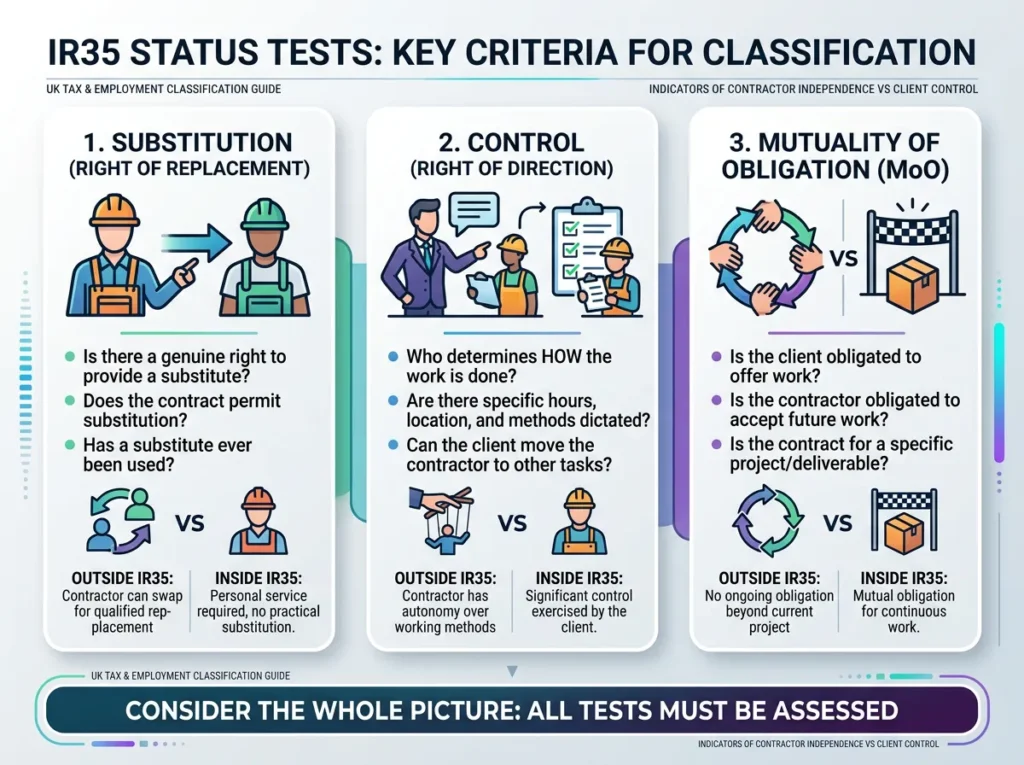
HMRC and employment tribunals assess IR35 status using three tests rooted in employment law case history. No single test is decisive. Status is determined by the overall picture of the working relationship.
1. Right of Substitution
Can you send a substitute in your place without the client vetoing the choice? A genuine, unfettered right to substitute another person is one of the strongest indicators of self-employment. The key word is genuine. A substitution clause buried in a contract that has never been exercised and would be refused in practice carries little weight with HMRC. To strengthen your position, the clause should not require client approval and, where possible, you should actually exercise the right at least once during a longer engagement.
2. Control and Direction
Does the client dictate how, when, and where you work? A high degree of client control over the method of working points toward employment. Contractors who determine their own hours, set their own methods, and choose their working location score better. Pure outcome-based contracting, where the client cares only about a deliverable and not how you produce it, is the strongest outside IR35 position on this test.
3. Mutuality of Obligation
Is the client obliged to offer work, and are you obliged to accept it? In genuine employment both sides carry ongoing obligations. Outside IR35 contractors have no obligation to accept every assignment, and clients need not offer continuous work. Project-by-project working with clear start and end dates scores well. Contractors who have been rolling at the same client for years with uninterrupted engagement face greater risk here.
⚠️ Additional Factors HMRC Examines
Beyond the three primary tests, HMRC also considers financial risk, provision of your own equipment, working for multiple clients, and your overall financial exposure as a business. A contract can pass the primary tests and still be found inside IR35 if the overall arrangement looks like employment.
Who Determines Your IR35 Status in 2026?
The off-payroll working rules assign responsibility based on the size of the end client. From April 2025, the small company definition changed, and this has material consequences for thousands of UK contractors.
| Client Size | Who Determines IR35? | What They Must Do |
|---|---|---|
| Medium or large company | The end client | Issue a Status Determination Statement (SDS) with reasons to the contractor and fee-payer |
| Small company — from April 2025: turnover under £15m, balance sheet under £7.5m, fewer than 50 employees (meeting at least two) | The contractor’s PSC | Assess their own IR35 status per contract and maintain records of the determination |
| Public sector bodies | The public authority | Issue an SDS and operate PAYE if the contract is inside IR35 |
The April 2025 Small Company Threshold Change
From April 2025, the turnover limit defining a small company rose from £10.2m to £15m, and the balance sheet limit from £5.1m to £7.5m. The employee count remains fewer than 50. A company qualifies as small if it meets at least two of these three criteria.
This reclassified approximately 14,000 UK businesses from medium to small. Any contractor working for a business that was medium-sized in 2024/25 but is now newly small needs to check its current status. If the client is now small, IR35 determination responsibility returns to your PSC from the point of reclassification, and you must assess your own status for that engagement from April 2026.
If you were previously assessed as inside IR35 by a medium-sized client who is now small, that determination no longer applies to future work. You must make a fresh assessment. This is both an opportunity to review your position and a compliance obligation you now own entirely. An incorrect self-assessment carries the same penalties as any other IR35 error. Our IR35 advice service includes reviewing which of your clients have been reclassified and confirming your obligations going forward.
Inside vs Outside IR35: What Actually Changes?
| Factor | Outside IR35 | Inside IR35 |
|---|---|---|
| Income tax treatment | Self-employed rates through PSC | Deemed salary, taxed at PAYE rates |
| National Insurance | Class 4 on profits only | Class 1 Employer and Employee NIC |
| Dividend planning | Available, typically tax-efficient | Not available on contract income |
| Business expenses | Full deduction of allowable expenses | Very limited deductions permitted |
| Estimated net income impact | Full take-home on fee income | Typically 20-30% less take-home |
| Employment rights | None | None, despite paying employee tax |
The financial impact is substantial. A contractor billing £500 per day for 220 days a year earns £110,000 gross. Outside IR35, with an optimal salary and dividend structure, take-home might be roughly £75,000. Inside IR35, the same income processed as a deemed salary typically results in take-home closer to £62,000 after all taxes and NIC. That is a difference of over £13,000 per year on the same fee income.
The April 2024 PAYE Offset Mechanism
Before April 2024, one of the most damaging aspects of IR35 investigations was the risk of double taxation. If HMRC found a contract was inside IR35 and the PSC had already paid corporation tax on that income, both the PSC and the fee-payer could be assessed for the same liability.
The PAYE Offset Mechanism introduced in April 2024 allows tax already paid by the PSC to be offset against the liability arising from an inside IR35 finding. This significantly reduces the maximum financial exposure from an investigation and makes formal challenges more viable, since the worst-case outcome is less severe than before. The offset does not eliminate risk entirely. Interest, penalties, and the administrative burden of an investigation remain significant costs. Early professional involvement is the most effective protection.
How to Challenge a Status Determination Statement
If a medium or large client issues an inside IR35 SDS that you believe is incorrect, you have a formal right to challenge it:
- Submit a written disagreement to the client, explaining why the determination is wrong and referencing the specific IR35 tests.
- The client must respond within 45 days, either confirming the original determination with reasons or issuing a revised finding.
- If the client fails to respond within 45 days, the liability for the assessment shifts back to the client during that period.
- If the client upholds the determination and you still disagree, resolution through the employment courts is available, though rare in practice.
A well-evidenced challenge supported by a professional IR35 review opinion from an accountant significantly increases the likelihood of reconsideration. Many inside determinations are made cautiously rather than on the specific facts of your engagement. Clients do not want the liability either, and will often reconsider when presented with a properly evidenced position.
How to Protect Your Outside IR35 Position
Review Every Contract Before Signing
A contract should be reviewed against the IR35 criteria before it is signed, not after. Key clauses to check: substitution (genuine right with no client veto), control (deliverable-based, not time-based), and mutuality (fixed term with no expectation of renewal). A written review opinion from an ACCA accountant creates documented evidence of due diligence that protects you if HMRC asks questions years later.
Operate in a Way That Reflects Self-Employment
HMRC and tribunals look at working practices, not just contract wording. In practice: set your own hours where possible, exercise your substitution right at least once per engagement, work for multiple clients, submit invoices rather than timesheets, use your own equipment, and avoid being included in client team communications that treat you as a permanent employee.
Keep a Contemporaneous Working Practice Log
Maintain a monthly record of how you actually work on each engagement: hours, working location, equipment used, and any instances of exercising independence from the client. If HMRC raises an enquiry two years after a contract ends, a log made at the time is far more useful than a well-worded contract alone.
Inside IR35: Umbrella Company vs Keeping Your Limited Company
If a contract is genuinely inside IR35, many contractors assume they should immediately move to an umbrella company. The decision depends on your specific circumstances.
An umbrella makes sense if all your contracts are inside IR35 and you have no other business income through your PSC. The administrative burden of running a limited company produces no tax benefit in that scenario. However, if you have mixed contracts, investment income, rental income, or accumulated retained profits, a limited company structure can still provide planning opportunities. We model the numbers for each client before advising on the right structure.
IR35 Action Checklist for Contractors in 2026
- Check whether each of your clients has been reclassified as small following the April 2025 threshold changes
- Review every active contract against the three primary IR35 tests
- Commission a professional written contract review before each new renewal or extension
- Document your working practices for each engagement in a monthly log
- Challenge any SDS you disagree with using the formal 45-day process
- Review your PSC structure annually — mixed portfolios, retained profits, and investment income all affect whether your limited company remains the right vehicle
Not Sure About Your IR35 Status?
Our ACCA-certified accountants provide written IR35 contract reviews, working practice assessments, and HMRC investigation support. Fixed fee, practical advice, no jargon.
Get a Free IR35 AssessmentFrequently Asked Questions
Who determines my IR35 status in 2026?
It depends on the size of your end client. Medium and large businesses must issue a Status Determination Statement. Small businesses — now defined as meeting at least two of: turnover under £15m, balance sheet under £7.5m, fewer than 50 employees — pass responsibility back to your PSC. The definition of small changed in April 2025, reclassifying approximately 14,000 businesses. If your client is newly small, you are responsible for your own determination from April 2026.
What happens if HMRC finds my contract was wrongly treated as outside IR35?
For small company engagements where your PSC made the determination, the liability falls on your company. HMRC can assess up to 20 years of back taxes and NIC in cases of deliberate non-compliance, plus interest and penalties. The April 2024 PAYE Offset Mechanism reduced the double taxation risk, but the financial exposure from a wrong determination remains very significant. Early professional advice and documented reviews are the best protection available.
Can I challenge a Status Determination Statement I disagree with?
Yes. You can use the client’s formal disagreement process. The client must respond within 45 days. We assist clients in preparing evidence-backed challenges supported by contract review documentation. A strong, well-documented challenge significantly increases the likelihood of reconsideration, particularly where the original determination was made cautiously rather than on the specific facts of your engagement.
Does IR35 apply to sole traders?
IR35 strictly targets personal service companies and similar intermediaries. Sole traders are not subject to IR35 legislation specifically, but HMRC can challenge employment status under general rules with similar tax consequences through a different legislative route. Our self-assessment service covers sole trader obligations in full.
I have contracts at multiple clients with different IR35 statuses. Can you help?
Yes. We review each contract individually, advise on the appropriate IR35 treatment for each engagement, and structure your overall remuneration to be as efficient as possible across a mixed-status portfolio. Each engagement is assessed independently on its own facts. For contractors with both inside and outside IR35 work, keeping your limited company active is often the right answer. We model the numbers before advising on the best structure for your situation.

Muhammad Bilal is a Fellow Chartered Certified Accountant (FCCA) and Director of Protax Consultants, a London-based accounting firm specialising in tax advisory, compliance, and business accounting services.
Bilal qualified with the Association of Chartered Certified Accountants (ACCA) in 2009 and later achieved FCCA status after gaining extensive professional experience. With more than 13 years of experience in accounting, taxation, and auditing, he advises SMEs, landlords, contractors, and charities on tax planning, compliance, and financial management.
As a registered HMRC agent, Bilal assists clients with Self Assessment tax returns, corporation tax planning, VAT compliance, payroll services, and HMRC enquiries.
Bilal holds a BSc (Hons) in Applied Accounting and leads the audit and compliance function at Protax Consultants.
Company Verification:
Protax Consultants Ltd – Company Number 14701253
View Companies House Record