

The Furnished Holiday Lettings regime was abolished from 6 April 2025. In 2025/26 and 2026/27, holiday property income is taxed as standard residential property income. This guide explains what changed, which reliefs you have lost, and what you can do now to manage your tax position.
The Furnished Holiday Lettings (FHL) regime was abolished with effect from 6 April 2025. From that date, income from short-term holiday letting, whether through Airbnb, direct bookings, or any other channel, is taxed as standard UK property income under the same rules that apply to long-term residential landlords. There are no transitional provisions for income tax purposes.
The 2025/26 tax return, due 31 January 2027, is the first return filed entirely under the post-FHL rules. For many holiday let owners, particularly those with mortgage debt on their properties, the tax bill for 2025/26 will be materially higher than 2024/25. If you or your accountant have not yet reviewed how your holiday let is now being treated, this guide covers every change you need to know.
What Was the Furnished Holiday Let Regime?
Before April 2025, a residential property qualified as a Furnished Holiday Let if it was available for letting for at least 210 days per year and was actually let commercially for at least 105 days, with no single occupant staying more than 31 consecutive days. Properties meeting these conditions were treated as a trading business, not an investment property, and received significant tax advantages not available to ordinary residential landlords.
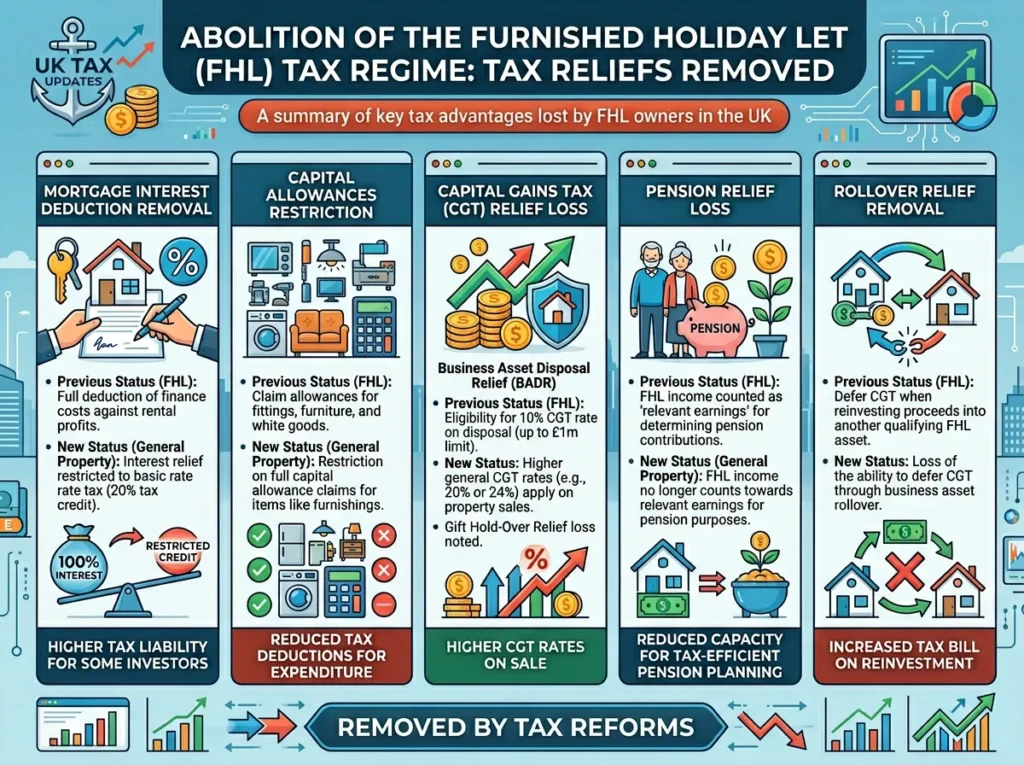
The Five Tax Reliefs That Have Been Removed
| FHL Advantage | Available Up to 2024/25? | Available From April 2025? |
|---|---|---|
| Full mortgage interest deduction | Yes | No — Section 24 tax credit applies instead |
| Capital allowances on furniture and equipment | Yes (including 100% AIA) | No — Replacement Domestic Items Relief only |
| Business Asset Disposal Relief on sale (10% CGT) | Yes | No — standard residential CGT rates apply (18% / 24%) |
| Rollover and holdover relief on disposal | Yes | No |
| Pension contribution relief (FHL profits as relevant earnings) | Yes | No — FHL income no longer qualifies as earnings |
1. Full Mortgage Interest — Now Subject to Section 24
This is the most financially significant change for leveraged holiday let owners. Under Section 24, mortgage interest is no longer deductible as a business expense. Instead, you receive a 20% tax credit on mortgage interest costs. FHL landlords were completely exempt from Section 24 until April 2025. Long-term residential landlords have been subject to it since 2017. Short-term landlords converted from FHL status in April 2025 face this restriction for the first time in their 2025/26 returns.
⚠️ Section 24 Example: Higher Rate Taxpayer
Rental income: £18,000. Mortgage interest: £8,000. Under FHL rules (2024/25): net profit = £10,000, taxed at 40% = £4,000 tax. Under Section 24 (from 2025/26): gross profit = £18,000, taxed at 40% = £7,200, minus 20% credit on interest (£1,600). Actual tax = £5,600. Additional tax per year: £1,600.
2. Capital Allowances on Furniture and Equipment
Under the old FHL regime, you could claim capital allowances on the original purchase of furniture, beds, kitchen equipment, and other furnishings, including 100% relief in the year of purchase through the Annual Investment Allowance. From April 2025, new purchases cannot be added to a capital allowances pool. Instead, the standard residential landlord rules apply: Replacement Domestic Items Relief covers only the cost of replacing like-for-like items, not the original purchase of furnishings when a property is first let or refurnished entirely.
3. Business Asset Disposal Relief on Sale
When an FHL owner sold a qualifying property, they could access Business Asset Disposal Relief (BADR), reducing CGT to 10% on gains up to the £1 million lifetime limit. From April 2025, former FHL properties are standard residential investment properties for CGT purposes, and gains are taxed at 18% or 24% depending on the seller’s income in the year of disposal.
There is no transitional relief. A property that was an FHL for fifteen years and ceased to qualify in April 2025 loses all BADR eligibility on any future disposal. For a property with a £200,000 gain, the CGT difference is £20,000 under BADR versus £48,000 at the 24% higher rate — an additional £28,000 tax cost. Our capital gains tax service covers CGT planning and the 60-day reporting requirement for property disposals.
4. Rollover and Holdover Relief
FHL owners could defer CGT by reinvesting gains into another qualifying business asset (rollover relief) or by gifting the property to a family member at no CGT cost (holdover relief). These reliefs applied because FHL properties were treated as business assets. From April 2025, neither rollover nor holdover relief is available on disposals of former FHL properties. They are now standard residential investment assets for all disposal purposes.
5. Pension Contribution Relief
FHL income was treated as relevant earnings for pension purposes, allowing FHL owners to make personal pension contributions based on their FHL profits and receive full tax relief. Ordinary rental income is not treated as earnings. If you relied on FHL profits to support a larger pension contribution strategy, you need to review your pension planning for 2025/26 onward, as your maximum relievable contribution may now be limited to £3,600 per year unless you have other qualifying earned income.
How Your Former FHL Is Taxed From 2025/26
From 2025/26, your holiday property income is reported on the UK property pages of your self-assessment return (SA105 supplement), in the same way as any standard residential rental property. The allowable expenses remain broadly the same but note these key changes:
- Mortgage interest goes in the finance costs box for the 20% tax credit — not as a direct expense deduction
- Letting agent fees, cleaning, insurance, utilities during void periods, repairs, and professional fees remain allowable
- New furniture and equipment: only replacement of existing items qualifies under Replacement Domestic Items Relief
- Any remaining capital allowances pool balances from prior years: continue to claim writing-down allowances on these
- FHL losses brought forward: apply against this property’s income where available
⚠️ File the 2025/26 Return Correctly
The FHL-specific SA pages no longer exist for 2025/26. Verify that your accountant is applying the post-April 2025 standard residential property rules. Filing under the old regime could trigger an HMRC inquiry or incorrect tax calculation.
Transitional Rules: What Still Applies After April 2025
Capital Allowances Pool Balances Retained
Any unrelieved capital allowances pool balances from your FHL at 5 April 2025 are retained. You can continue to claim writing-down allowances on the existing pool balance in future years. The pool does not disappear — it simply stops receiving new additions from April 2025 onward. Do not lose this entitlement by failing to track and claim it.
BADR on Sales Contracted Before 6 April 2025
If you exchanged contracts to sell an FHL before 6 April 2025 but completion took place after that date, HMRC may allow BADR to apply to the gain. The rules here require careful examination of the specific dates and facts. If you are in this situation, take professional advice promptly as the window to benefit is narrow.
FHL Losses Carried Forward
FHL losses accumulated in prior tax years can be offset against future profits from the same property, now treated as standard rental income. They cannot be offset against profits from other unrelated rental properties. If you have significant FHL losses carried forward, ensure these are properly tracked and applied in your 2025/26 return to reduce your tax liability where available.
Tax Planning Options for Former FHL Owners
Review Whether Short-Term Letting Remains Viable
For FHL owners with significant mortgage debt, Section 24 materially increases the income tax cost of short-term letting compared to the position before April 2025. It is worth modelling whether short-term holiday letting remains more profitable than a long-term assured shorthold tenancy, which carries the same tax treatment but lower operating costs and management complexity.
Consider Whether Incorporation Makes Sense
Incorporating a property into a limited company allows full mortgage interest deduction as a business expense, because Section 24 does not apply to companies. However, incorporation of an existing property typically triggers a stamp duty land tax charge and a CGT disposal at market value unless relief applies, making it unsuitable for many landlords with significant equity. The numbers need to be modelled carefully for each property before any decision is made. Our landlord tax service covers this analysis in detail.
Plan Future Disposals Carefully
The loss of BADR means CGT planning on any future disposal is more important than ever. The timing of a sale within a tax year, use of the annual CGT exemption (£3,000 in 2025/26), transferring a share to a spouse or civil partner before sale to use their exemption and lower rate band, and any available principal private residence relief if you have ever lived in the property should all be considered well before exchange of contracts. Do not complete a sale without having the CGT position reviewed first.
FHL Abolition Checklist for 2025/26 and 2026/27
- Confirm your 2025/26 return is being filed on the UK property (SA105) pages, not any FHL-specific section
- Apply Section 24 correctly — mortgage interest as a finance cost credit, not an expense deduction
- Continue claiming writing-down allowances on any capital allowances pool balances from prior years
- Apply FHL losses brought forward against the same property’s income where available
- Model the Section 24 impact for 2025/26 — especially if you are a higher rate taxpayer with a mortgage
- Seek CGT advice before selling any former FHL property — BADR is no longer available
- Review your pension contribution strategy if you previously relied on FHL profits as relevant earnings
- Declare all platform income, including Airbnb, which is reported directly to HMRC under DAC7 rules
FHL Abolition Affecting Your Tax Position?
Our ACCA-certified accountants specialise in landlord and property tax. We help former FHL owners understand the April 2025 changes, review CGT planning, and file accurate returns.
View Landlord Tax ServiceFrequently Asked Questions
Was there any transitional relief when the FHL regime was abolished?
There are no income tax transitional provisions. From 6 April 2025, all properties previously qualifying as FHLs are treated as standard residential lettings regardless of occupancy. The only limited transitional rules relate to capital allowances pool balances (which are retained) and properties where contracts were exchanged before 6 April 2025. FHL losses carried forward can be offset against the same property’s future income.
What does Section 24 mean for my holiday let mortgage interest?
Section 24 replaced the full mortgage interest deduction with a 20% basic rate tax credit on finance costs. For a higher-rate taxpayer, this significantly increases the effective income tax rate on rental profits. A property with £18,000 rental income and £8,000 mortgage interest previously generated a £4,000 tax bill on a £10,000 net profit. Under Section 24, the same figures produce a £5,600 tax bill — £1,600 more per year on the same property, with no change to income or costs. Our landlord tax team can model the exact impact for your specific property.
Can I still claim capital allowances on my existing furniture?
You cannot add new items to a capital allowances pool from April 2025. However, any unrelieved pool balances at 5 April 2025 are retained and you can continue claiming writing-down allowances on them in future years. For replacements of existing furniture, Replacement Domestic Items Relief applies — this covers the cost of replacing a like-for-like item, but not upgrades or the original furnishing of a property.
Does the FHL abolition affect my CGT if I sell the property?
Yes, significantly. Former FHL properties no longer qualify for Business Asset Disposal Relief, which previously reduced CGT to 10% on qualifying gains. From April 2025, gains on disposal are taxed at the standard residential CGT rates: 18% for basic rate taxpayers and 24% for higher rate taxpayers. For a £200,000 gain, that is an additional £28,000 CGT for a higher rate taxpayer compared to the pre-abolition BADR position. Take professional advice before the exchange of contracts, and ensure the 60-day CGT reporting obligation is managed correctly after completion.
My property still meets all the old FHL occupancy conditions. Does it matter?
No. The FHL regime has been abolished entirely. Even if your property is available 210 days, actually let for 105 days, and has no single occupant exceeding 31 consecutive days, it cannot be treated as an FHL for tax purposes from 2025/26 onward. The occupancy conditions are irrelevant because the regime itself no longer exists. Your property is now a standard residential letting for all income tax, CGT, and pension purposes.

Muhammad Bilal is a Fellow Chartered Certified Accountant (FCCA) and Director of Protax Consultants, a London-based accounting firm specialising in tax advisory, compliance, and business accounting services.
Bilal qualified with the Association of Chartered Certified Accountants (ACCA) in 2009 and later achieved FCCA status after gaining extensive professional experience. With more than 13 years of experience in accounting, taxation, and auditing, he advises SMEs, landlords, contractors, and charities on tax planning, compliance, and financial management.
As a registered HMRC agent, Bilal assists clients with Self Assessment tax returns, corporation tax planning, VAT compliance, payroll services, and HMRC enquiries.
Bilal holds a BSc (Hons) in Applied Accounting and leads the audit and compliance function at Protax Consultants.
Company Verification:
Protax Consultants Ltd – Company Number 14701253
View Companies House Record