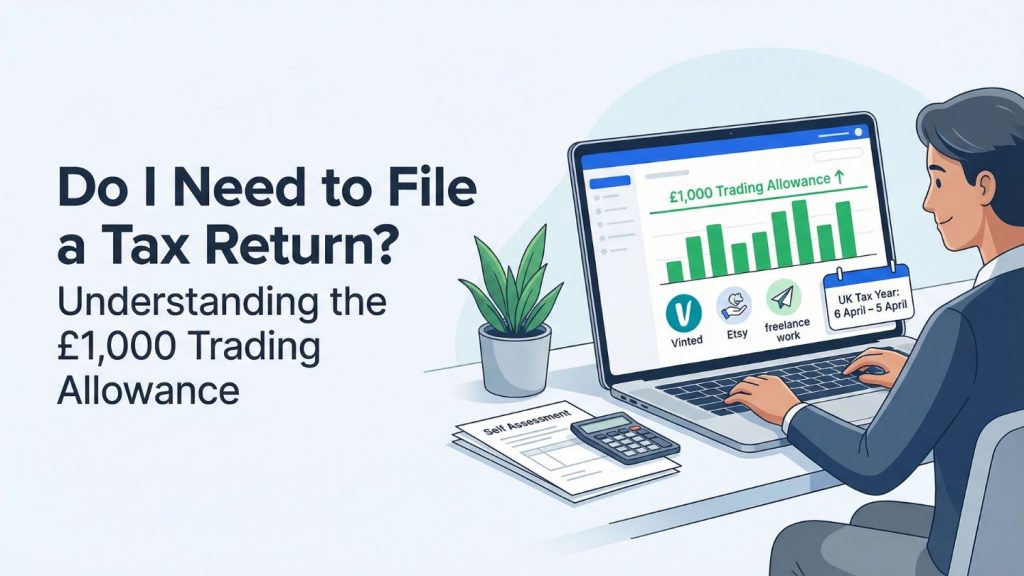
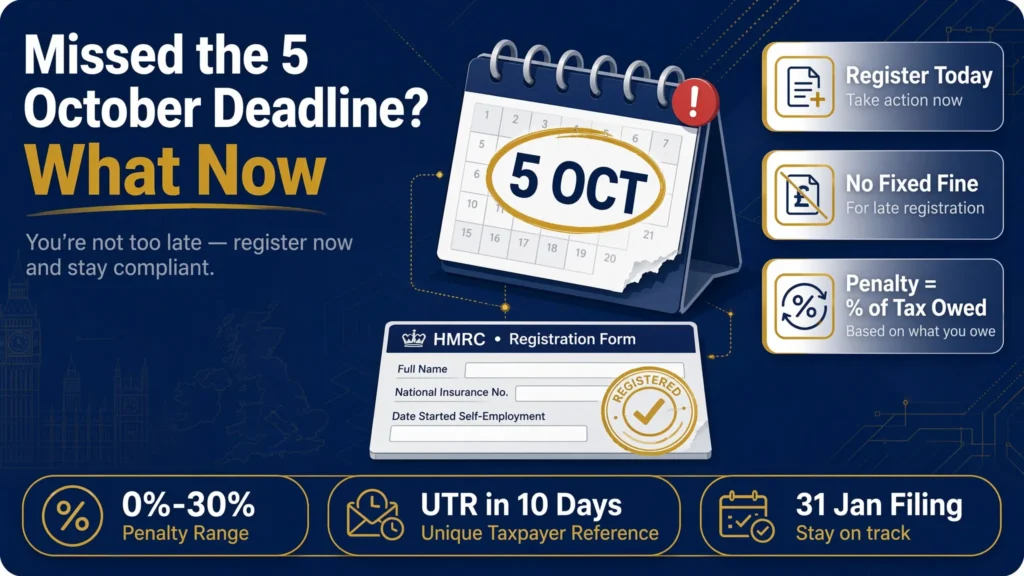
Quick answer: If you’ve missed the 5 October 2026 deadline to register for Self Assessment, register with HMRC today. Don’t wait for a better moment. Missing the date itself doesn’t carry a fixed fine. HMRC can charge a ‘failure to notify’ penalty, but only if you actually owe tax for the year, and for a genuine, non-deliberate oversight it can be reduced to as little as 0% if you come forward before HMRC contacts you. The one thing that reliably makes the penalty worse is waiting longer.
What was the 5 October deadline, and have I actually missed it?
5 October 2026 was the deadline to tell HMRC you need to complete a Self Assessment tax return for the 2025/26 tax year (6 April 2025 to 5 April 2026), if this is the first time you’ve needed to. That covers people who, during that tax year:
- Became self-employed or started a side business earning over £1,000
- Started receiving rental income
- Received dividends or investment income above your allowances
- Made a capital gain above the annual exempt amount
- Became a partner in a business partnership
- Need to pay the High Income Child Benefit Charge for the first time
Not sure whether any of this actually applies to you? Our guide on whether you need to file a tax return at all covers the full criteria. If none of it applies, this deadline doesn’t either: your date is simply 31 January 2027 to file and pay.
If it does apply and you haven’t registered yet, you’ve missed it. Here’s what actually happens next.
What to do right now, in order
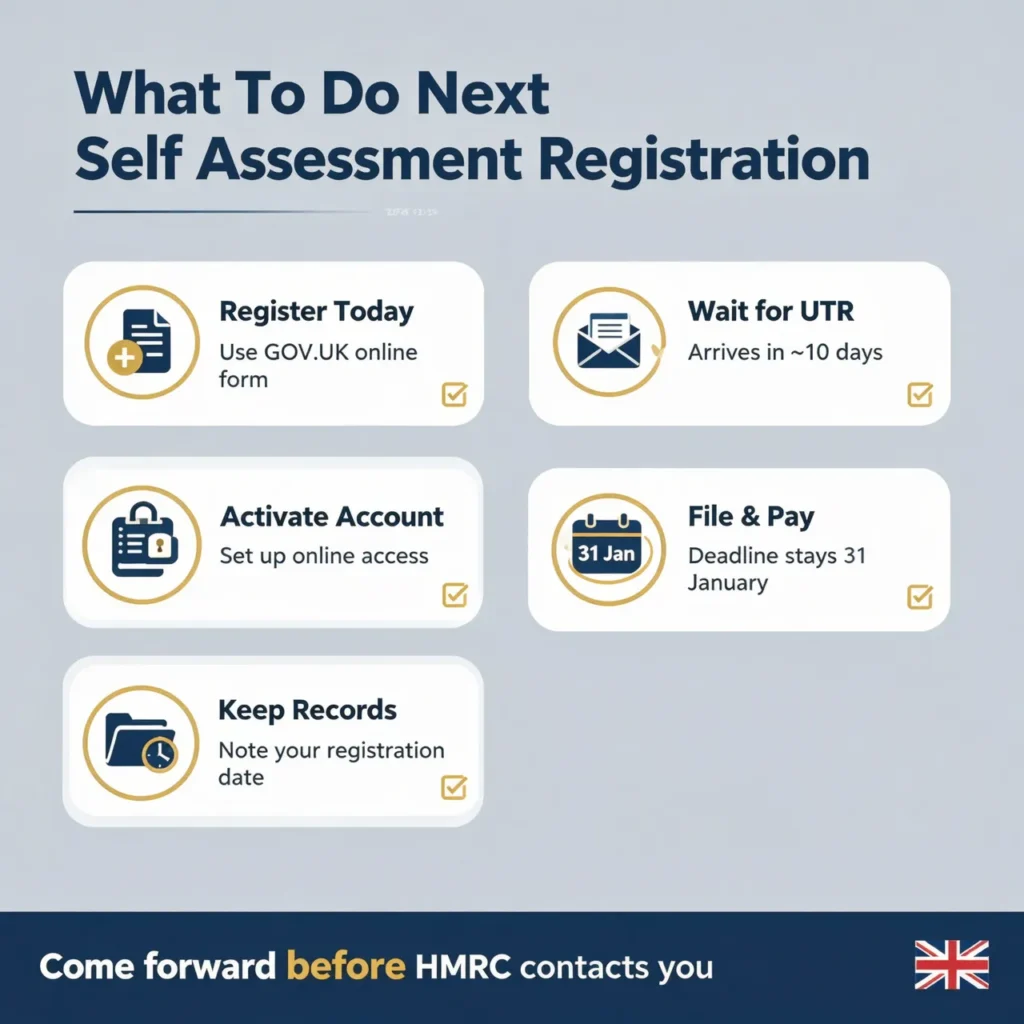
- Register for Self Assessment today. Don’t wait until closer to January. Go to GOV.UK’s Register for Self Assessment service and complete the online form. You’ll need your National Insurance number and basic details about the income that triggered the requirement. If this is genuinely your first return, our first-time tax return guide walks through the whole process from here.
- Wait for your Unique Taxpayer Reference (UTR). HMRC typically posts this within about 10 working days (longer if you’re abroad). You cannot file a return without it, so this step has its own lead time, which is another reason not to delay.
- Activate your online account once your UTR and activation code arrive, so you’re ready to file.
- File and pay by 31 January 2027. Registering late doesn’t move this deadline. You still need to file your return and pay what you owe by 31 January, even if your UTR arrives in November or December.
- Keep a record of when you registered. If a penalty is ever queried, the date you came forward, before or after any contact from HMRC, is the single biggest factor in how much you’ll pay. See our guide on which records HMRC expects you to keep and what to hold onto.
Will I actually get a penalty?
This is where most guidance oversimplifies. Missing 5 October does not, by itself, trigger a fine. What it can trigger is a ‘failure to notify’ penalty, and critically, that penalty is calculated as a percentage of the tax you owed and hadn’t paid by 31 January, not a flat fee. Two things follow from that:
- If you don’t owe any tax for the year, for instance your income from the new source was small, or it’s already covered by PAYE, there’s nothing for the penalty to be a percentage of, so in practice there’s nothing to pay.
- If you do owe tax, the percentage depends on your behaviour and how quickly you come forward, not on the fact that you missed 5 October specifically.
The failure-to-notify penalty, in plain terms
For a genuine, non-deliberate oversight, which covers the vast majority of people reading this, HMRC’s published penalty bands (GOV.UK internal manual CH73200) work like this:
| How you come forward | HMRC finds out within 12 months | HMRC finds out after 12 months |
|---|---|---|
| You tell HMRC yourself (unprompted) | 0% to 30% of tax owed | 10% to 30% of tax owed |
| HMRC contacts you first (prompted) | 10% to 50% of tax owed | 20% to 50% of tax owed |
The practical takeaway: an honest mistake, disclosed by you before HMRC ever asks, can genuinely come down to a 0% penalty. Waiting for HMRC to catch it roughly doubles the minimum you’re exposed to.
Deliberately hiding income sits in a far more serious category. The maximum failure-to-notify penalty where the failure is deliberate and concealed is 100% of the tax owed, but that’s not what’s happening if you simply missed a date on a calendar.
“But I also think I’ll miss 31 January,” what then?
Registering late and filing late are two separate deadlines with two separate penalty regimes. Filing late carries an automatic £100 fixed penalty the moment you’re even one day late, regardless of whether you owe tax. See our guide on avoiding Self Assessment penalties, or our more detailed breakdown of late filing penalties specifically, for how that one works and what counts as a reasonable excuse. The good news: registering now, even in October, still gives you until 31 January to prepare and file, which is normally enough time if you start promptly.
How Protax can take this off your hands
If you’d rather not navigate the registration form, the UTR wait, and the January filing deadline on your own, our Self Assessment service handles the whole process end to end. Get a free, no-obligation quote and we can usually tell you the same day what we’d need from you to get this sorted before January.
Frequently Asked Questions
What happens if I miss the 5 October Self Assessment deadline?
You should register with HMRC as soon as possible. There’s no fixed fine simply for registering late, but if you owe tax for the year, HMRC can charge a ‘failure to notify’ penalty calculated as a percentage of that tax: between 0% and 30% for an honest mistake disclosed before HMRC contacts you.
Is there a fine just for registering late?
Not a fixed one. The failure-to-notify penalty only applies if tax is actually owed and unpaid by 31 January. If you don’t owe tax, there’s effectively nothing to penalise.
Can I still file my tax return if I register after 5 October?
Yes. Registering late doesn’t change your filing deadline: you still need to file and pay by 31 January 2027. Your Unique Taxpayer Reference can take around 10 working days to arrive, so register as early as possible to leave enough time.
What if I don’t owe any tax?
If there’s no tax outstanding at 31 January, there’s no failure-to-notify penalty to calculate, because it’s based on a percentage of unpaid tax. You should still register, as it may be needed for your records or if your circumstances change.
How do I register for Self Assessment now?
Complete the registration form on GOV.UK with your National Insurance number and details of the income that requires you to file. HMRC will post your Unique Taxpayer Reference, typically within about 10 working days.
Does coming forward myself actually reduce the penalty?
Yes, this is the single most effective thing you can do. HMRC’s own penalty bands set a materially lower range for an unprompted disclosure (you telling them) than a prompted one (them finding out and contacting you first).

Muhammad Bilal is a Fellow Chartered Certified Accountant (FCCA) and Director of Protax Consultants, a London-based accounting firm specialising in tax advisory, compliance, and business accounting services.
Bilal qualified with the Association of Chartered Certified Accountants (ACCA) in 2009 and later achieved FCCA status after gaining extensive professional experience. With more than 13 years of experience in accounting, taxation, and auditing, he advises SMEs, landlords, contractors, and charities on tax planning, compliance, and financial management.
As a registered HMRC agent, Bilal assists clients with Self Assessment tax returns, corporation tax planning, VAT compliance, payroll services, and HMRC enquiries.
Bilal holds a BSc (Hons) in Applied Accounting and leads the audit and compliance function at Protax Consultants.
Company Verification:
Protax Consultants Ltd – Company Number 14701253
View Companies House Record