
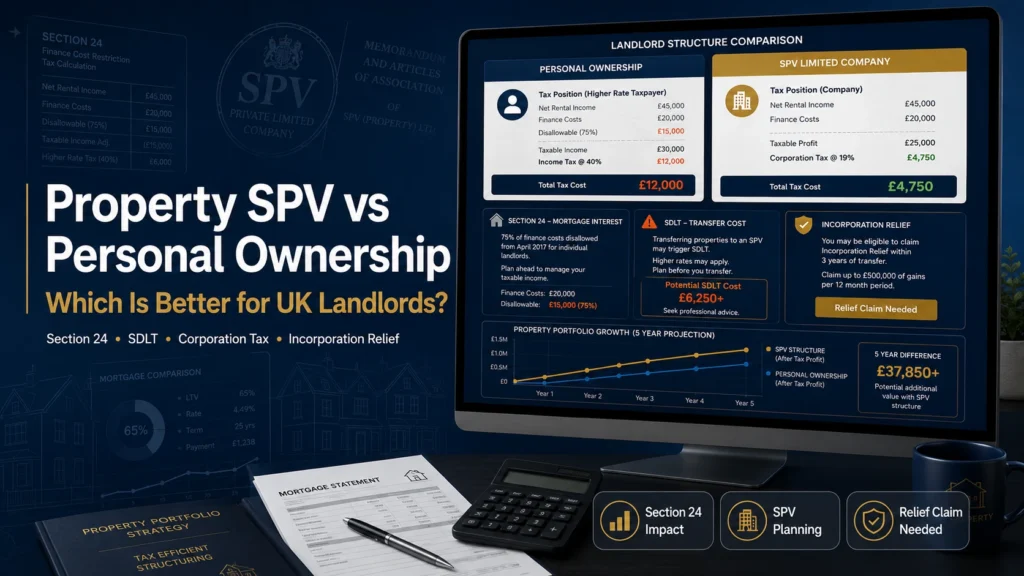
Since Section 24 removed full mortgage interest relief for individual landlords, transferring a property portfolio into a Special Purpose Vehicle (SPV) limited company has become one of the most searched decisions in UK property tax. It is not a decision with a single right answer. This guide from Muhammad Bilal FCCA at Protax Consultants sets out the tax, mortgage, and cost differences between the two structures for 2026/27, including the incorporation relief change that makes the timing of any transfer more consequential than before.
What Is an SPV in Property Investing?
A Special Purpose Vehicle is a limited company set up for a single defined purpose, in this context holding and letting residential property. Most buy-to-let mortgage lenders require an SPV registered under SIC code 68209 (letting and operating of own or leased real estate) rather than a general trading company, because it keeps the property activity separate from any other business risk.
Section 24: The Reason This Decision Exists
Section 24 of the Finance Act 2015 removed the ability of individual landlords to deduct mortgage interest as an expense before calculating taxable rental profit. Since full implementation from the 2020/21 tax year, individual landlords have instead received a 20% basic-rate tax credit on finance costs, regardless of their actual tax rate.
This change has no impact inside a limited company. A company deducts mortgage interest as a normal business expense before calculating taxable profit, exactly as personal landlords could before 2017. This single difference is the reason so many landlords have incorporated portfolios since 2017, particularly higher and additional rate taxpayers.
Section 24 remains fully in force for 2026/27 with no announced repeal. The Furnished Holiday Lettings regime, which was previously exempt from Section 24, was abolished from 6 April 2025 — holiday lets are now caught by the same restriction as standard buy-to-let.
Tax Comparison: Personal Ownership vs SPV
| Personal ownership | SPV limited company | |
| Mortgage interest treatment | Not deductible — 20% tax credit only | Fully deductible as a business expense |
| Tax on rental profit | Income tax at 20% / 40% / 45% | Corporation tax at 19% (up to £50k profit) to 25% (above £250k), with marginal relief between |
| Tax on extracting profit | None — profit is already personal income | Dividend tax at 10.75% / 35.75% / 39.35% above the £500 allowance, on top of corporation tax already paid |
| CGT on eventual sale | 18% / 24% personally, £3,000 annual exemption | Corporation tax on the gain inside the company (19–25%), then dividend or liquidation tax to extract proceeds |
| Mortgage interest relief on purchase (incorporation) | N/A | SDLT and possible CGT triggered on the transfer — see below |
Worked Example: £24,000 Annual Rental Profit, Higher Rate Taxpayer
| Personal ownership | SPV company | |
| Gross rental income | £24,000 | £24,000 |
| Mortgage interest (assume £10,000) | Not deductible | £10,000 deducted |
| Taxable profit | £24,000 (before 20% tax credit on £10,000 interest) | £14,000 |
| Tax on profit | 40% × £24,000 = £9,600, less 20% × £10,000 credit = £2,000 → net tax £7,600 | 19% × £14,000 = £2,660 (corporation tax) |
| Net profit after tax (before extraction) | £16,400 | £11,340 |
| Tax to extract as dividend (higher rate, above allowance) | N/A — already personal income | 35.75% × £11,340 ≈ £4,054 |
| Net in your pocket if fully extracted | £16,400 | £7,286 |
This example shows a common misconception: the company route looks far more tax-efficient at the corporation tax stage, but that advantage shrinks or reverses once profit is actually extracted as dividends. Many incorporated landlords retain profit inside the company to reinvest, rather than extracting it every year, which is where the real advantage of the SPV structure often lies for portfolio growth rather than for landlords who need the rental income to live on.
The Cost of Transferring Existing Property Into a Company
Transferring an already-owned property into a limited company is treated by HMRC as a sale at market value, even though no money changes hands with a third party. This can trigger two separate tax charges.
Stamp Duty Land Tax on the Transfer
The company must pay SDLT on the transfer as if it were buying the property. Companies always pay the higher rates for additional dwellings — the 5% surcharge applies with no exception for companies, even on a first company purchase. Companies purchasing residential property above £500,000 face a flat 17% SDLT rate rather than the standard banded rates.
Capital Gains Tax on the Transfer
If the property has increased in value since you bought it, transferring it to a company can crystallise a CGT liability on that unrealised gain, taxed at 18% or 24% personally, exactly as if you had sold to an unconnected buyer.
Critical 2026 change: Incorporation Relief under Section 162 TCGA 1992 can defer this CGT charge by rolling the gain into the base cost of the shares you receive in the company, avoiding an immediate tax bill. Until 5 April 2026, this relief applied automatically wherever the qualifying conditions were met. From 6 April 2026, it must be actively claimed on your Self Assessment return for the tax year of transfer, with supporting details of the transaction, valuations, and tax computations. If you miss the claim, or the claim is incomplete, the CGT becomes payable in full with no automatic fallback.

Does Incorporation Relief Actually Apply to Buy-to-Let Portfolios?
This is the single most contested question in landlord incorporation, and it existed long before the April 2026 claim change. Incorporation Relief requires the transfer of a genuine business, not simply a collection of investment assets. HMRC’s long-standing position, tested in cases such as Ramsay v HMRC, is that a property letting activity can qualify as a business for this purpose, but only where the owner is genuinely and substantially involved in its active management, typically evidenced by time spent (commonly cited around 20 hours per week), the range of activities undertaken (finding tenants, arranging repairs, managing rent collection, dealing with disputes), and the number of properties involved.
A landlord with one or two properties on a fully managed letting agreement, doing very little personally, is at real risk of HMRC successfully arguing that no qualifying business was transferred, meaning Incorporation Relief does not apply regardless of whether a claim is made. This makes the eligibility assessment, not just the claim mechanics, the critical first step before any transfer.
The ATED Charge on Company-Owned Property
Companies owning UK residential property valued above £500,000 are within the scope of the Annual Tax on Enveloped Dwellings (ATED), an annual charge payable by 30 April each year, with rates currently ranging from roughly £4,600 to £303,450 depending on the property’s value band. Reliefs are available for property that is genuinely let on a commercial basis to unconnected tenants, which covers most standard buy-to-let arrangements, but the ATED return must still be filed every year to claim the relief, even where no tax is ultimately due.
Mortgage Availability and Cost
The mortgage market for SPV buy-to-let has matured considerably. Rates for limited company mortgages sit roughly 0.2 to 0.5 percentage points above equivalent personal buy-to-let products in 2026, a gap that has narrowed significantly compared to several years ago as lender competition in the space has increased.
| Factor | Personal buy-to-let | SPV buy-to-let |
| Typical rate premium | Baseline | 0.2–0.5 percentage points higher |
| Rental income stress test | Around 125% for basic-rate taxpayers, higher for higher-rate | Around 145%, reflecting different lender risk assessment |
| Lender panel size | Very wide — most mainstream lenders | Narrower — specialist and buy-to-let focused lenders |
| Personal guarantee required | N/A | Usually yes, from all company directors |
Decision Framework: When Each Structure Tends to Work Better
Personal Ownership Tends to Suit
- Basic-rate taxpayers with one or two properties, where Section 24’s impact is limited
- Landlords who need the rental income as personal income now, rather than reinvesting it
- Anyone planning to sell within a few years, where SDLT and CGT on incorporation would outweigh the benefit
SPV Ownership Tends to Suit
- Higher and additional rate taxpayers with meaningfully geared portfolios, where mortgage interest is a large expense
- Landlords building a portfolio over the long term and reinvesting profit rather than extracting it annually
- Landlords with succession or inheritance planning objectives, where shares can be more straightforward to pass down than direct property
- New purchases, where none of the incorporation transfer costs (SDLT, CGT) apply, since the company is buying the property fresh rather than receiving an existing asset
New purchases through a company avoid the entire incorporation cost problem, because there is no existing asset being transferred. Many landlords who conclude that a company structure suits their long-term strategy choose to buy all future properties through an SPV while leaving existing personally-owned properties where they are, rather than incurring SDLT and CGT to move existing assets across.
Protax Consultants: Property Structuring Advice for London Landlords
Deciding between personal ownership and an SPV is highly individual and depends on your tax rate, portfolio size, gearing, and long-term plans. Muhammad Bilal FCCA and the Protax team model both structures side by side for London landlords and property investors, including the incorporation transfer costs and the April 2026 Incorporation Relief claim requirements.
Based in Wimbledon, HMRC-authorised, ACCA-registered (5743262). Visit our Landlord & Property Tax service or Business Accounting service, or call 020 8545 7451.
Frequently Asked Questions
Is it better to hold buy-to-let personally or through a limited company in 2026?
It depends primarily on your income tax rate, how geared the portfolio is, and whether you extract profit or reinvest it. Higher-rate taxpayers with significant mortgage interest often benefit from a company structure, but the answer changes considerably if profit needs to be extracted as income rather than retained.
Does Section 24 apply to limited companies?
No. Section 24 only restricts mortgage interest relief for individual landlords, including those in partnerships. Limited companies continue to deduct mortgage interest as a normal business expense before calculating taxable profit.
What changed with Incorporation Relief in April 2026?
From 6 April 2026, Incorporation Relief under Section 162 TCGA 1992 is no longer automatic. It must be actively claimed on your Self Assessment return for the tax year of transfer, with supporting valuations and tax computations. Previously, the relief applied automatically wherever the qualifying conditions were met, with no claim required.
Does my letting activity actually count as a business for Incorporation Relief?
This depends on your level of active involvement. HMRC’s tested position is that genuine, substantial personal management of the portfolio (commonly evidenced by around 20 hours per week and a broad range of management activities) is required. A small portfolio on a fully managed letting agreement with minimal personal involvement is at real risk of not qualifying, regardless of whether a claim is made.
Do companies pay more Stamp Duty than individuals on buy-to-let?
Companies always pay the higher rates for additional dwellings, including the 5% surcharge, with no exception even for a first company purchase. Companies buying residential property above £500,000 face a flat 17% rate rather than the standard banded structure.
Where can I get advice on structuring a property portfolio in London?
Protax Consultants in Wimbledon, London. Muhammad Bilal FCCA models personal versus company ownership for landlords and property investors, including incorporation costs and the current Incorporation Relief claim rules. Fixed fee. Visit protax.org.uk/services/landlord-property-tax or call 020 8545 7451.

Muhammad Bilal is a Fellow Chartered Certified Accountant (FCCA) and Director of Protax Consultants, a London-based accounting firm specialising in tax advisory, compliance, and business accounting services.
Bilal qualified with the Association of Chartered Certified Accountants (ACCA) in 2009 and later achieved FCCA status after gaining extensive professional experience. With more than 13 years of experience in accounting, taxation, and auditing, he advises SMEs, landlords, contractors, and charities on tax planning, compliance, and financial management.
As a registered HMRC agent, Bilal assists clients with Self Assessment tax returns, corporation tax planning, VAT compliance, payroll services, and HMRC enquiries.
Bilal holds a BSc (Hons) in Applied Accounting and leads the audit and compliance function at Protax Consultants.
Company Verification:
Protax Consultants Ltd – Company Number 14701253
View Companies House Record