A Christmas party is a great way to thank employees, celebrate the year’s achievements and bring the team together. However, before booking a restaurant or arranging a company event, employers should understand the tax rules.
HMRC allows certain annual staff events to be provided without employees paying tax or National Insurance on the benefit. This exemption is commonly known as the £150 annual function exemption.
It can make a Christmas party tax-free for employees, but there are specific conditions. The event must meet HMRC’s requirements, and the £150 limit is not a general allowance that employers can spend on every employee.
This guide explains how the £150 staff party tax exemption works, what costs count towards the limit and what employers should consider before organising their Christmas celebrations.
What Is the HMRC £150 Annual Staff Party Exemption?
The £150 exemption allows employers to provide qualifying annual social events without employees being taxed on the benefit.
For an event to qualify, it must:
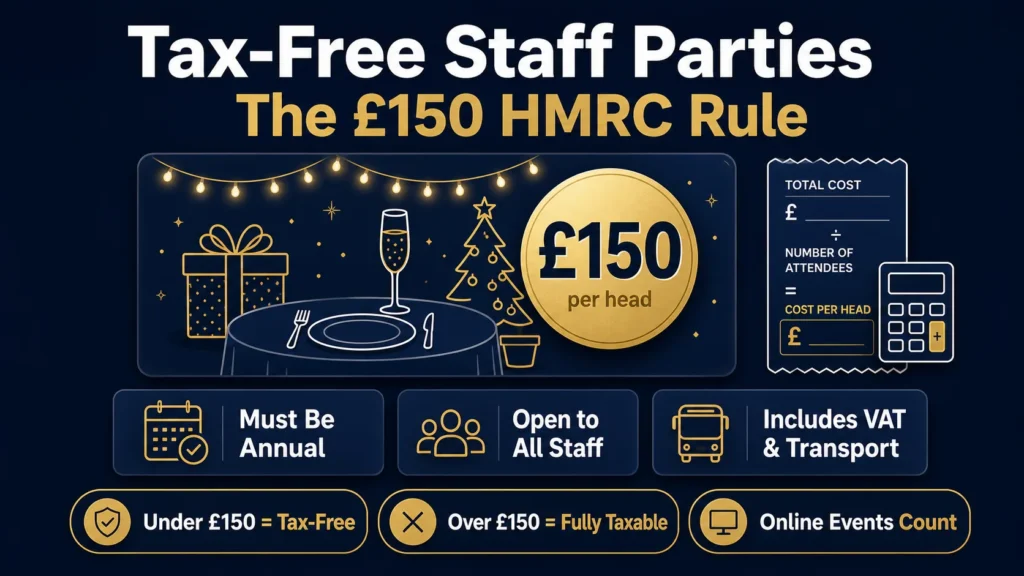
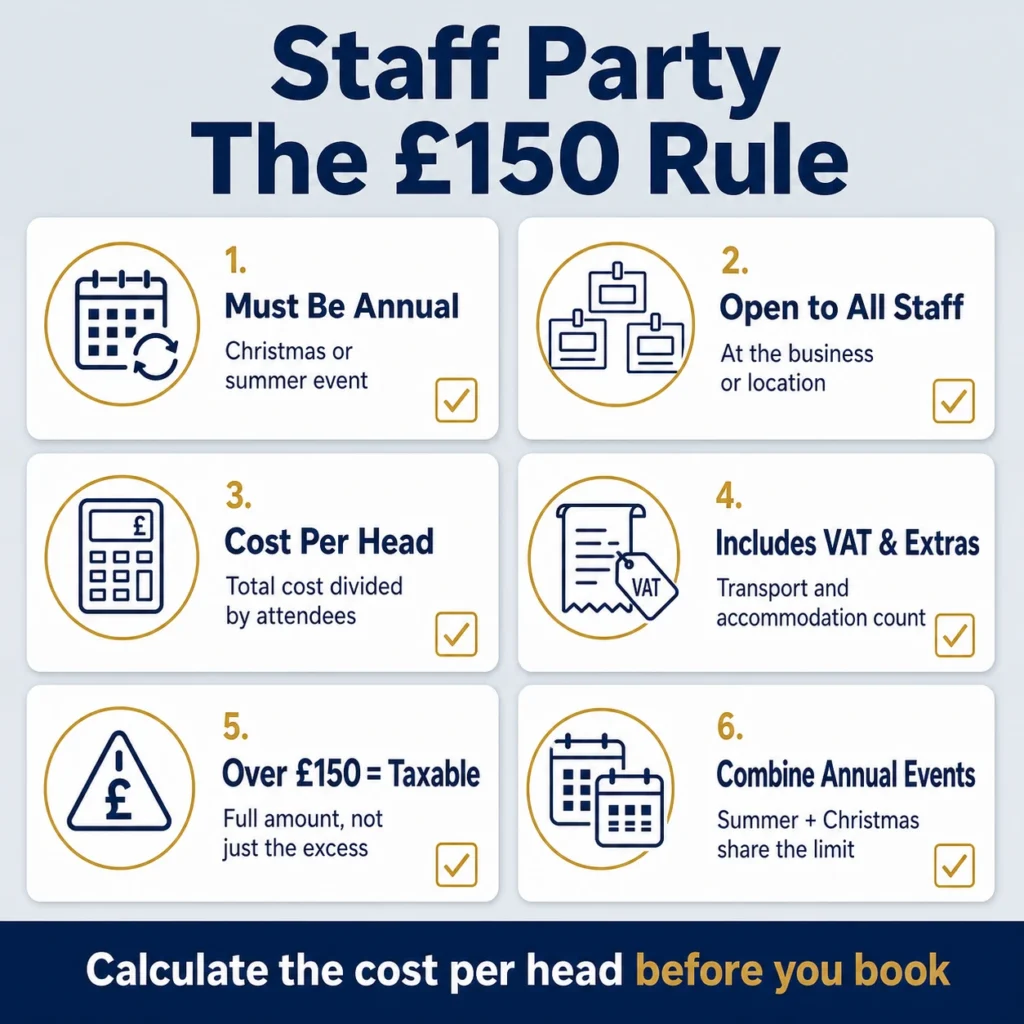
- Be an annual event, such as a Christmas party or summer celebration.
- Be open to all employees, or all employees at a particular workplace or location.
- Cost no more than £150 per head, including VAT and relevant additional costs.
The exemption can also apply to online or virtual events, provided the other conditions are met.
For many small businesses, this means they can organise a Christmas party without creating an additional taxable benefit for employees, as long as the event meets HMRC’s requirements.
How Does the £150 Christmas Party Tax Exemption Work?
The £150 limit is calculated per person attending the event. It is not a total company budget or an automatic £150 allowance for each employee.
Is the £150 Limit Per Employee or Per Event?
The limit applies to the cost per head of the event.
For example, if a business has 10 employees and organises a qualifying Christmas party costing £100 per person, the total event cost would be £1,000.
If the event meets all the other conditions, it can qualify for the exemption.
However, the cost per head must be calculated carefully. It is not simply the amount spent on food and drinks.
What Costs Are Included in the £150 Limit?
The cost per head includes the total cost of providing the event, including:
- Venue hire
- Food and drinks
- Entertainment
- Decorations and event arrangements
- VAT on the expenses
- Transport provided for attendees
- Overnight accommodation provided to enable employees to attend
The total cost is divided by the number of people attending the event. This includes non-employees who attend, such as partners or guests.
Example: A company organises a Christmas party with the following costs:
- Venue and food: £2,000
- Entertainment: £500
- Transport: £300
- Total event cost: £2,800
If 20 people attend, including employees and guests, the cost per head is £140.
As long as the event meets the other HMRC conditions, it may qualify for the exemption.
What Happens If a Christmas Party Costs More Than £150 Per Person?
This is one of the most important points for employers to understand.
The £150 figure is a limit, not a tax-free allowance that can be deducted from a more expensive event.
If the cost of a qualifying annual function exceeds £150 per head, the exemption does not apply to that event. The full cost per head becomes taxable, not just the amount above £150.
Example:
- Party cost per head: £175
- HMRC exemption limit: £150
- Amount above the limit: £25
- Potential taxable benefit: £175 per person
The taxable benefit is not simply the £25 excess. The full £175 per head may need to be reported and taxed under the relevant rules.
This is why checking the event budget before confirming a booking is important.
Can Employers Organise More Than One Tax-Free Staff Event?
Yes. A business can organise more than one annual event during the tax year.
However, the combined cost per head of the events covered by the exemption must not exceed £150.
Example 1: Both events are within the limit
- Summer event: £60 per head
- Christmas party: £80 per head
- Combined cost: £140 per head
The combined cost is within the £150 limit, provided both events meet the other qualifying conditions.
Example 2: Combined cost exceeds the limit
- Summer event: £90 per head
- Christmas party: £100 per head
- Combined cost: £190 per head
The combined cost exceeds £150. The employer cannot treat both events as exempt in full. It may choose which qualifying event or events to cover with the exemption, while any event not covered by the exemption will be taxable under the relevant rules.
Employers should therefore consider the whole year’s planned staff events rather than looking at the Christmas party in isolation.
Which Employees Must Be Invited to Qualify for the Exemption?
The event must be available to all employees generally, or to all employees at a particular location.
For example, a company with offices in London and Manchester may organise separate Christmas parties for each office. The exemption can still apply if all employees at the relevant location are invited.
A business can also organise separate events for different departments, provided the availability condition is met.
An event arranged only for selected employees, directors or senior managers may not qualify.
Can Company Directors Attend a Tax-Free Christmas Party?
Yes. Directors can attend qualifying annual staff functions under the same general rules.
However, the event must meet the requirements, including the condition that it is open to all employees or the relevant group of employees.
A company should not assume that a directors-only dinner qualifies as an exempt annual staff function simply because it is described as a Christmas party.
What Are the Tax and Reporting Rules If a Staff Party Is Not Exempt?
If the event does not qualify for the exemption, the employer may need to report the benefit to HMRC and pay Class 1A National Insurance on the relevant cost.
The employer may need to:
- Report the benefit on each employee’s P11D.
- Use an applicable PAYE Settlement Agreement where appropriate.
- Pay Class 1A National Insurance.
- Keep records of the event costs and the employees or guests who attended.
The correct reporting method depends on the circumstances and the arrangements used by the employer.
Common HMRC Staff Party Tax Mistakes Employers Should Avoid
Employers should watch out for these common mistakes when arranging Christmas celebrations:
- Treating £150 as a tax-free allowance: The exemption is subject to a strict limit. If an event exceeds £150 per head, the full cost may become taxable.
- Forgetting transport and accommodation: These costs can count towards the total event cost if they are provided to enable people to attend.
- Ignoring other annual events: A summer party and Christmas party may share the same £150 annual limit.
- Inviting only selected employees: The event must be open to all employees generally or all employees at a particular location.
- Calculating the cost using invited guests: The actual attendance figures matter when working out the final cost per head.
- Forgetting the reporting requirements: If an event does not qualify, the employer should not simply treat it as a normal business expense without considering the employee benefit and National Insurance rules.
Christmas Party Tax Checklist: What Employers Should Check Before Booking
Before confirming your event, check the following:
- Is the event an annual function?
- Is it open to all employees or all employees at the relevant location?
- What is the estimated total cost, including VAT?
- Are transport or accommodation costs included?
- How many people are expected to attend?
- Have other annual staff events already used part of the £150 limit?
- Will the final cost per head remain within the exemption?
- Will you keep invoices, attendance records and cost calculations?
A little planning can help avoid unexpected tax costs after the event.
How Does the £150 Staff Party Exemption Differ From Trivial Benefits?
The £150 annual function exemption is different from the £50-per-gift trivial benefits exemption.
The trivial benefits rules allow qualifying small gifts of £50 or less to be provided without tax or National Insurance. A separate £300 annual cap applies specifically to directors of close companies.
These are two different tax exemptions, with separate qualifying conditions. Our guide on trivial benefits for directors explains the rules in more detail, including how the exemptions can be used separately.
How Protax Consultants Can Help With Staff Party Tax Rules
Staff events are a valuable way to recognise employees, but employers need to understand how the tax rules apply.
Protax Consultants supports small businesses with accounting, bookkeeping, payroll and tax compliance. We can help you understand employee benefit reporting requirements, review business expenses and keep your records organised through our bookkeeping services and payroll support.
If you are planning a Christmas event and want to check the tax treatment, contact our team.
Frequently Asked Questions About the £150 Staff Party Tax Exemption
Can I Spend £150 Per Employee on a Christmas Party Tax-Free?
Potentially, yes. The event must be an annual function, open to all employees or all employees at a particular location, and the total cost must not exceed £150 per head.
Does the £150 Christmas Party Limit Include VAT?
Yes. VAT forms part of the total cost when calculating the cost per head.
Does the £150 Limit Include Partners and Guests?
The total event cost is divided by the number of people attending, including non-employee guests.
Can a Business Have Both a Summer Party and a Christmas Party?
Yes, but the combined cost per head of the annual events covered by the exemption must not exceed £150.
What Happens If My Christmas Party Costs £180 Per Person?
The event will not qualify for the exemption. The full cost per head, rather than only the £30 excess, may be taxable.
Can Directors Attend a Staff Christmas Party Tax-Free?
Yes, provided the event meets the qualifying conditions. A directors-only event should not automatically be treated as an exempt annual staff function.

Muhammad Bilal is a Fellow Chartered Certified Accountant (FCCA) and Director of Protax Consultants, a London-based accounting firm specialising in tax advisory, compliance, and business accounting services.
Bilal qualified with the Association of Chartered Certified Accountants (ACCA) in 2009 and later achieved FCCA status after gaining extensive professional experience. With more than 13 years of experience in accounting, taxation, and auditing, he advises SMEs, landlords, contractors, and charities on tax planning, compliance, and financial management.
As a registered HMRC agent, Bilal assists clients with Self Assessment tax returns, corporation tax planning, VAT compliance, payroll services, and HMRC enquiries.
Bilal holds a BSc (Hons) in Applied Accounting and leads the audit and compliance function at Protax Consultants.
Company Verification:
Protax Consultants Ltd – Company Number 14701253
View Companies House Record