
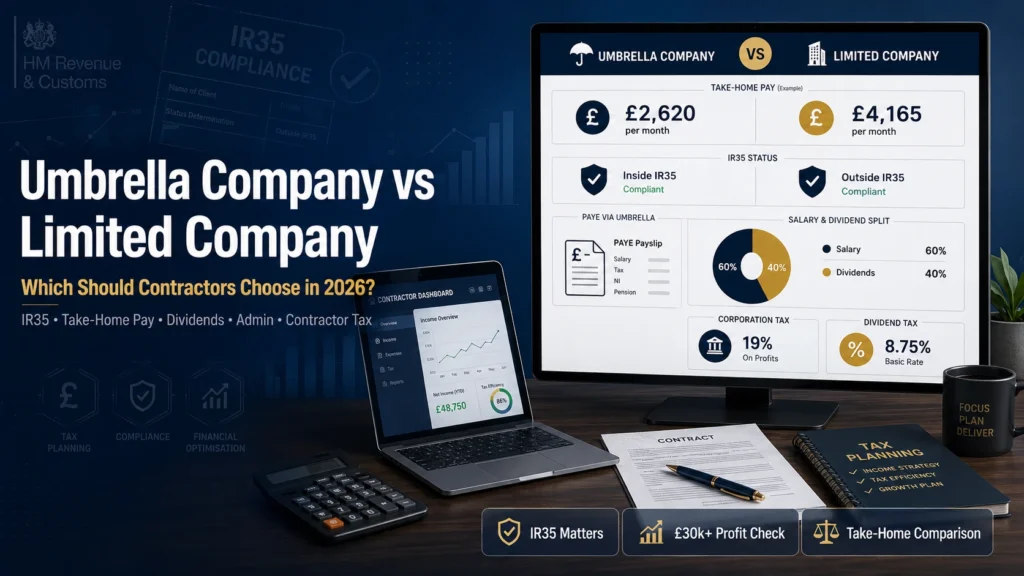
Every contractor entering the market faces the same decision early on: operate through an umbrella company, or set up your own limited company? The answer is not universal. It depends on your expected income, the IR35 status of your contracts, how long you plan to contract, and how much administrative involvement you are willing to take on.
Making the wrong choice costs money. A contractor earning £500 a day outside IR35 who uses an umbrella when a limited company would be more appropriate can lose thousands of pounds in unnecessary tax each year. Equally, a contractor with a short-term, inside IR35 engagement who pays to set up a PSC and then earns no meaningful tax saving has spent time and money for nothing.
This guide from the contractor specialists at Protax Consultants explains both structures clearly, shows how the tax treatment differs, and gives you a framework for making the right decision for your situation.
How an Umbrella Company Works
An umbrella company employs you as a PAYE worker. When you complete work for an end client, the client or agency pays the umbrella. The umbrella deducts its margin, employer National Insurance, and any other costs, then pays you a salary with income tax and employee NIC deducted through PAYE. You receive a payslip, and the umbrella handles all compliance and HMRC submissions.
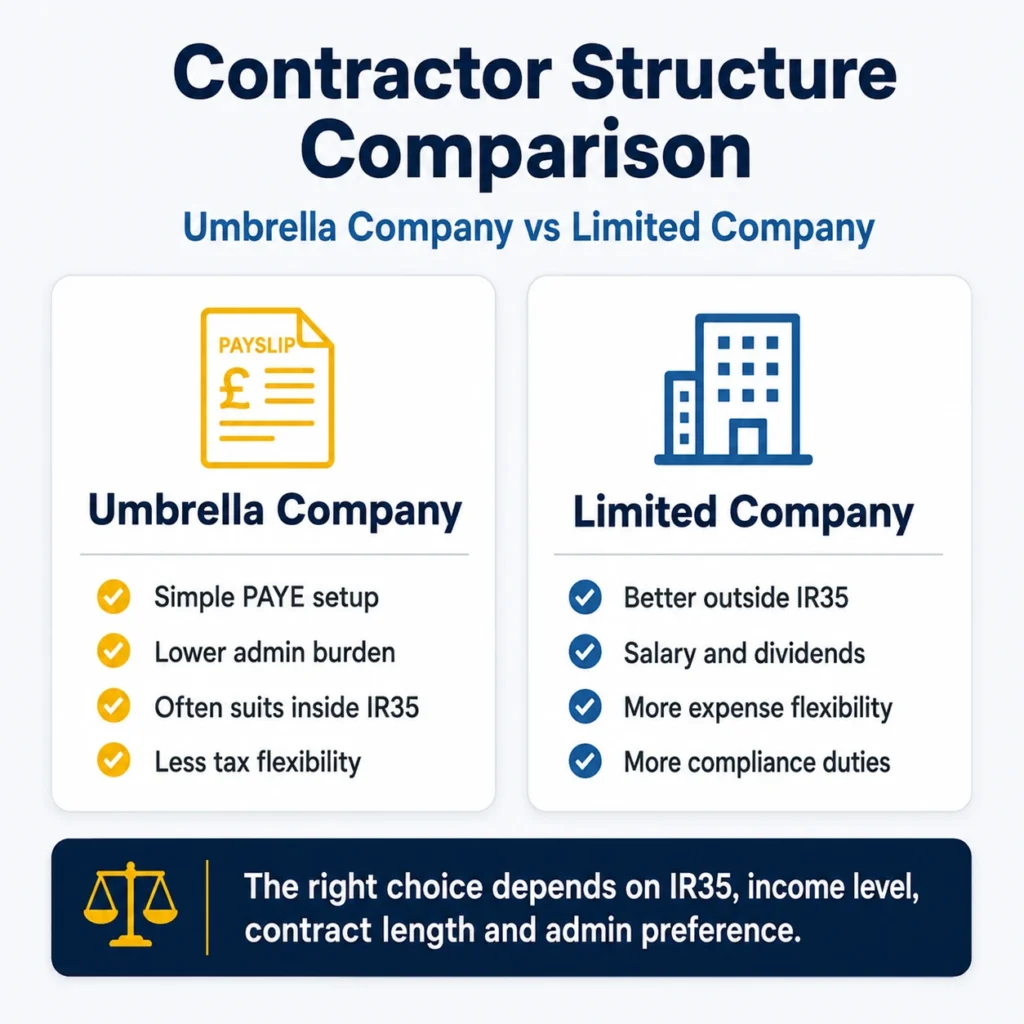
From a tax perspective, working through an umbrella is straightforward but expensive. Your income is treated entirely as employment income and taxed at the standard income tax rates. There is no scope for the salary and dividend split that makes a limited company tax-efficient, and no access to the broader range of company expenses that reduce a PSC’s taxable profit.
The main advantages of an umbrella are simplicity and speed. You can start working on day one without any company formation, no Companies House filings, no corporation tax returns, and no director responsibilities. When the contract ends, you simply stop using the umbrella.
How a Limited Company (PSC) Works
A Personal Service Company is a limited company you own and direct. You contract through the company: the company invoices the client or agency, and the company is paid. You then extract money from the company in the most tax-efficient way available to you, typically a combination of a small salary paid through PAYE and dividends taken from the company’s profits after corporation tax.
Corporation tax in 2026/27 is charged at 25% on profits above £250,000, with marginal relief between £50,000 and £250,000, and a 19% small profits rate up to £50,000. Most contractor PSCs with a single director pay corporation tax at 19% because their profits after salary and expenses typically fall below the £50,000 threshold.
The tax advantage comes from dividends. Following the Autumn 2025 Budget, dividend tax rates increased from 6 April 2026. For 2026/27 the rates are 10.75% for basic-rate taxpayers, 35.75% for higher-rate taxpayers, and 39.35% for additional-rate taxpayers, above the £500 dividend allowance. Dividends do not attract National Insurance on either side. We cover the optimal salary and dividend split for 2026/27 in our director salary and dividend planning guide.
For most contractors earning above approximately £30,000 to £35,000 a year in profit outside IR35, the combination of a low salary, dividends and corporation tax still results in meaningfully higher take-home than umbrella, though the gap is narrower in 2026/27 than in previous years due to the dividend rate increase.
Side-by-Side Comparison
| Factor | Limited Company (PSC) | Umbrella Company |
| Tax efficiency | Higher take-home above roughly £30,000 profit per year | All income taxed as employment at full income tax and NIC rates |
| IR35 impact | Outside IR35: tax-efficient. Inside IR35: most advantage eliminated | All contracts treated as inside IR35 by default |
| Admin burden | Annual accounts, CT600, director self-assessment, Companies House filings | None: umbrella handles all compliance |
| Expenses | Wide range including travel, IT, training and pension | Very limited: mainly expenses a deemed employee could claim |
| Employment rights | None as a director | Statutory rights including SSP, holiday pay and auto-enrolment |
| Setup | Company formation required. Accountant needed | Zero setup. Operational within hours |
| Short contracts | Less suitable unless you plan to continue contracting | Yes. No ongoing obligations when work stops |
| Pension | Employer contributions deductible and highly tax-efficient | Auto-enrolment at statutory minimum unless separately negotiated |
How IR35 Changes the Calculation
IR35 is the single most important variable in this decision. Outside IR35, a limited company gives you substantial tax advantages. Inside IR35, those advantages largely disappear because your income is treated as a deemed salary, taxed at employment rates, regardless of whether you actually take it as a salary or dividend.
A contractor whose contract is inside IR35 gets most of the administrative burden of a limited company without the tax benefit. In that scenario, umbrella is often the pragmatic choice for that specific engagement.
The 2025 change to the small company threshold is worth noting. From April 2025, the turnover threshold for a small company was raised to £15m, reclassifying approximately 14,000 businesses as small. For contractors working with those clients, IR35 status determination responsibility shifted back to the contractor’s PSC from April 2026. If you have not reviewed your contracts since this change, read our IR35 guide for contractors 2026 for a full breakdown of the three HMRC tests and your obligations.
Inside IR35 does not automatically mean umbrella is cheaper. Where a contractor has genuine mixed engagements, some inside and some outside IR35, keeping a limited company active and handling inside IR35 work through a salary payment within the PSC can still be more efficient than umbrella in some cases. For a written IR35 contract review, contact our specialist team.
Illustrative Take-Home Comparison
The figures below are illustrative only, based on a contractor earning approximately £80,000 gross invoiced income per year outside IR35 in 2026/27, with no other income. Your actual figures will depend on your income level, expenses, pension contributions, IR35 status and personal circumstances. For a personalised calculation, contact our contractor accounting team.
| Annual take-home | |
| Umbrella (after all deductions) | approximately £53,000 |
| Limited company, optimal salary and dividend split | approximately £57,000 to £60,000 |
| Approximate annual difference | £4,000 to £7,000 more via limited company |
The gap is narrower in 2026/27 than in previous years because the Autumn 2025 Budget raised dividend tax rates by 2 percentage points from April 2026, with the basic rate rising from 8.75% to 10.75% and the higher rate from 33.75% to 35.75%. The advantage remains real and material for most contractors, but the case for limited company is stronger when profits are retained in the company rather than immediately extracted.
The limited company advantage increases with income where profits are retained, because money left in the company is taxed only at corporation tax rates until drawn. Employer pension contributions paid by the company are one of the most effective ways to restore the advantage, as they reduce corporation tax and carry no NIC on either side. For a full list of what you can claim through your PSC, see our guide to contractor expenses through a limited company.
Which Structure Is Right for You?
Umbrella is likely better when:
- Your contract is inside IR35 and you have no outside IR35 work.
- You are testing contracting for the first time with a short engagement.
- Your annual income is below approximately £30,000.
- You want zero administration and no director responsibilities.
- You want statutory employment rights including sick pay and holiday pay.
- Your agency or client only accepts umbrella workers.
Limited company is likely better when:
- Your contracts are outside IR35.
- Your annual profit exceeds approximately £30,000.
- You plan to contract for more than one year.
- You want to make employer pension contributions tax-efficiently.
- You want to retain profits in the company and draw them at a time that suits you.
- You have genuine business expenses that reduce your taxable profit.
The Hidden Costs of an Umbrella That Contractors Often Miss
Umbrella companies charge a weekly or monthly margin, typically between £15 and £30 per week, deducted before your pay is calculated. Over a year that is between £780 and £1,560 in fees alone, before any tax disadvantage is counted.
Additionally, the employer NIC on your earnings (15% above the secondary threshold) is usually deducted from the assignment rate before your pay is calculated, effectively reducing your take-home by the employer NIC amount even though it is nominally the employer’s cost. Not all umbrella companies make this transparent in their initial calculations.
Some umbrella companies have also been used in disguised remuneration schemes that HMRC considers non-compliant. Contractors caught up in these arrangements have faced significant retrospective tax bills years later, even when they believed they were operating compliantly at the time. If an umbrella arrangement produces take-home pay that seems unusually high relative to what straightforward PAYE rates would generate, treat that as a warning sign and take independent advice before proceeding.
Frequently Asked Questions
Can I switch from an umbrella to a limited company mid-contract?
Yes, though the timing and practicalities depend on your contract and agency terms. You would need to form the limited company, open a business bank account, and notify the agency or client that invoices will now come from your PSC. Some agencies have preferences or restrictions, so check the terms of your engagement contract first.
Does inside IR35 mean I should always use an umbrella?
Not necessarily. If all your work is inside IR35, umbrella often makes more sense because you get a similar tax outcome with none of the limited company admin. However, if you have a mix of inside and outside IR35 contracts, keeping a limited company active can still be worthwhile. See our IR35 guide for contractors 2026 for a full breakdown.
What is a Personal Service Company (PSC)?
A PSC is an ordinary UK limited company, usually with a single director-shareholder, through which a contractor provides their services to clients. The term is used in HMRC’s IR35 guidance to describe the intermediary through which the contractor works.
How much does it cost to run a limited company as a contractor?
The main recurring costs are accountancy fees covering annual accounts, CT600, VAT if registered, and director self-assessment, plus the Companies House confirmation statement at £34 per year in 2026. Our contractor accounting service provides a fixed-fee quote covering the full scope of your PSC accounting needs before any work begins.
Can my client insist I use an umbrella company?
Yes. Some clients and agencies only engage contractors via an umbrella, particularly in the public sector. However, many private sector clients do engage PSC contractors directly, especially following the April 2025 small company threshold change that shifted IR35 responsibility back to contractors with those newly reclassified clients.
Where can I get contractor structure advice in London?
Protax Consultants are FCCA Chartered Certified accountants based in Wimbledon, London. We advise contractors on PSC structure, IR35 compliance, and tax-efficient remuneration planning. We model your actual take-home under both structures based on your day rate, IR35 status and personal circumstances. Fixed fee and no obligation. Call 020 8545 7451.

Muhammad Bilal is a Fellow Chartered Certified Accountant (FCCA) and Director of Protax Consultants, a London-based accounting firm specialising in tax advisory, compliance, and business accounting services.
Bilal qualified with the Association of Chartered Certified Accountants (ACCA) in 2009 and later achieved FCCA status after gaining extensive professional experience. With more than 13 years of experience in accounting, taxation, and auditing, he advises SMEs, landlords, contractors, and charities on tax planning, compliance, and financial management.
As a registered HMRC agent, Bilal assists clients with Self Assessment tax returns, corporation tax planning, VAT compliance, payroll services, and HMRC enquiries.
Bilal holds a BSc (Hons) in Applied Accounting and leads the audit and compliance function at Protax Consultants.
Company Verification:
Protax Consultants Ltd – Company Number 14701253
View Companies House Record