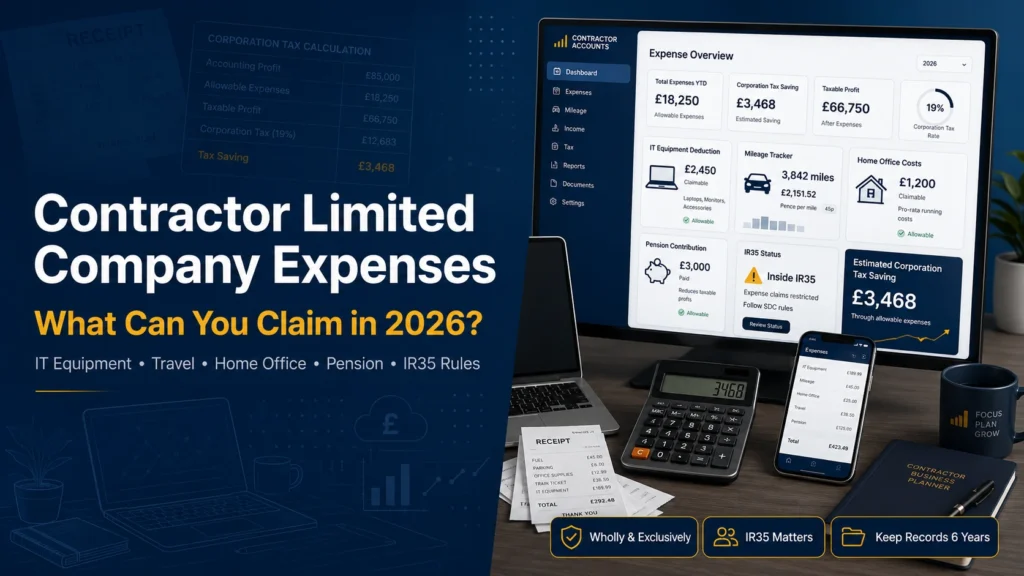
Running a limited company as a contractor gives you access to a broad range of allowable business expenses that reduce your corporation tax bill and, when structured correctly, your overall tax liability. The principle is consistent across all of them: an expense must be wholly and exclusively for business purposes to be claimable through the company.
What trips up many contractors is not the principle but the detail. Some expenses are allowable in full. Others are allowable only in proportion to business use. A handful of costs that look like genuine business costs are disallowed entirely by HMRC. This guide covers every major category and explains the IR35 interaction where it matters. If you are still deciding which structure to use, see our umbrella vs limited company comparison for 2026 first.
The HMRC Test Every Contractor Must Understand
Before looking at individual categories, it helps to understand the single rule that governs all of them. HMRC allows an expense if it is incurred wholly and exclusively for the purposes of the trade. If an expense serves a dual purpose, partly business and partly personal, it is generally disallowed unless HMRC accepts that the two elements can be separated and the business portion clearly quantified.
This test applies at the company level. Expenses paid by the company should relate to the company’s business activities. When you reimburse yourself for expenses you have personally incurred on the company’s behalf, those reimbursements are treated the same way: they reduce the company’s taxable profit only if they meet the same wholly and exclusively test.
Your IR35 status also matters. Outside IR35, your PSC is treated as a trading company and the normal company expense rules apply. Inside IR35, HMRC applies deemed employment legislation, which restricts the deductions available to those a deemed employee could claim. For a full breakdown of the IR35 rules, see our IR35 guide for contractors 2026. The categories below apply to outside IR35 engagements unless stated otherwise.
IT and Technology Equipment
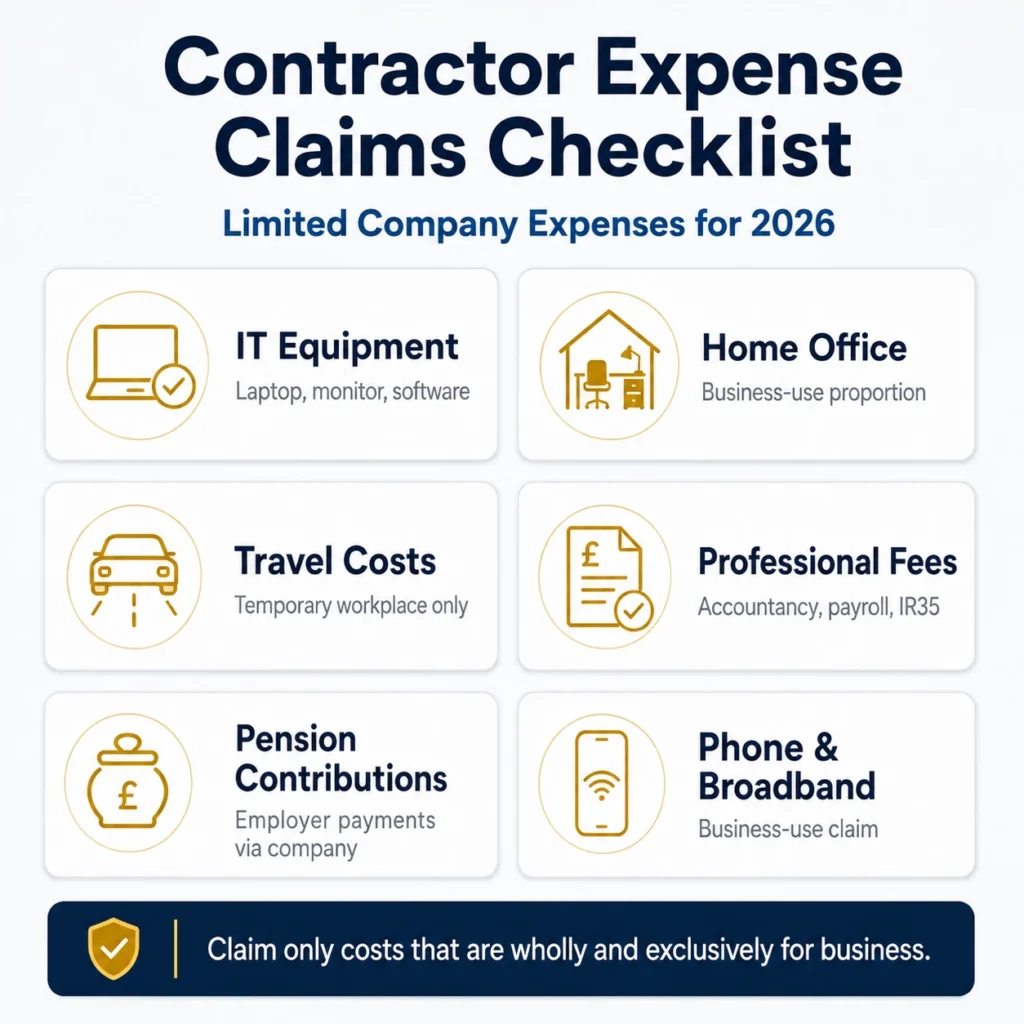
Laptops, monitors, keyboards, docking stations, mobile phones and tablets purchased by the company for business use are fully deductible against corporation tax through the Annual Investment Allowance. The full cost can be deducted in the year of purchase rather than depreciated over time.
The key rules are: purchase through the company rather than personally, and keep the VAT receipt. Where a device has mixed personal and business use, only the business proportion is deductible. Software licences and subscriptions needed for your work, including Xero, Microsoft 365, or project management tools, are also fully deductible in the same way.
Home Office Costs
If you work from home, you can claim a proportion of your household running costs through the company, but only the business element. There are two approaches.
The simplest is HMRC’s flat-rate allowance for use of home as office, which is a modest fixed amount per month based on hours worked. For most IT contractors, this significantly under-represents actual costs.
The more accurate method calculates the business proportion of actual costs, including heating, electricity, broadband, and mortgage interest or rent. You divide the total by the number of rooms in the property and multiply by the percentage of time the dedicated workspace is used for business. Keep a contemporaneous log of hours worked from home to support the claim.
- Broadband is typically fully deductible if you have a dedicated business connection, or apportioned if shared for personal use too.
- Do not claim your full mortgage payment or rent: only the business-use proportion is allowable.
- Claiming too high a proportion of home costs can trigger a Capital Gains Tax charge on private residence relief when you eventually sell the property.
Travel and Accommodation
Travel costs incurred to attend client sites, supplier meetings, or business events are deductible. The critical distinction is that ordinary commuting from your home to a regular, fixed place of work is not allowable. Temporary workplaces qualify; permanent ones do not.
- Mileage in your own vehicle: claim at the HMRC approved rate of 45p per mile for the first 10,000 business miles and 25p per mile above that, backed by a mileage log.
- Company car: actual fuel and running costs are deductible, subject to the benefit-in-kind rules if the car is also used privately.
- Train, taxi and flights: fully deductible for genuine business travel.
- Overnight accommodation: deductible for trips that require staying away from home, provided the destination is not your regular workplace.
- Subsistence: meals on genuine business trips away from your normal base are deductible; everyday lunches near your regular workplace are not.
The 24-month rule for temporary workplaces is important. If you work at a client site and you expect to be there for more than 24 months, or you are there for more than 40% of your working time, HMRC may reclassify it as a permanent workplace, removing the travel deduction entirely.
Mileage Rates 2026/27
| Vehicle type | First 10,000 miles | Above 10,000 miles |
| Car or van (own vehicle) | 45p per mile | 25p per mile |
| Motorcycle (own vehicle) | 24p per mile | 24p per mile |
| Bicycle | 20p per mile | 20p per mile |
These rates apply when you use your own personal vehicle for business travel and claim mileage reimbursement from the company. HMRC expects a contemporaneous mileage log showing dates, destinations and business purpose, not a year-end estimate reconstructed from memory.
Professional Subscriptions and Training
Subscriptions to professional bodies that relate to your contracting work are fully deductible. Training costs that maintain or improve skills relevant to your current trade also qualify. Annual membership fees to industry bodies such as BCS, IEEE or PMI are deductible. Online courses, conference tickets, and technical certifications directly related to your contracting specialism are deductible.
The important distinction is that training to acquire entirely new skills for a different trade, one your company does not currently carry out, is generally not allowable. Upskilling within your current specialism is fine; pivoting to a new business is not claimable through the existing company.
Accountancy and Professional Services
The cost of your accountant, payroll provider, and any legal advice taken in connection with business activities is fully deductible. This includes fees for corporation tax preparation, VAT returns, contract review, IR35 advice, and Companies House filings.
Legal costs incurred in connection with a specific business dispute or contract negotiation are allowable. General legal fees to acquire capital assets, or costs associated with a dispute that has a personal element, are more complex and should be discussed with your accountant before being claimed.
Pension Contributions
Employer pension contributions made by the company directly into a registered pension scheme on behalf of a director-shareholder are one of the most tax-efficient ways to extract money from a limited company. They are deductible as a company expense, reducing corporation tax, and do not attract National Insurance on either side. We model the optimal pension and dividend combination as part of our director salary and dividend planning service.
The annual allowance for pension contributions is £60,000 in 2026/27, subject to your earnings. Contributions above this threshold are subject to an annual allowance charge. For most contractors, the combination of a modest salary, dividend income and employer pension contributions is a highly efficient overall structure.
Telephone and Communication Costs
A mobile phone or SIM card contract held in the company’s name and used primarily for business is fully deductible. Where a personal contract is used for both business and personal calls, only the business proportion is claimable and you need records to support the split. The simplest approach is a second, dedicated business SIM or contract.
Business landline calls and the business element of a broadband connection used for work are similarly deductible. If the same broadband line serves both home personal use and business use, apportion on the basis of actual usage or time.
What Contractors Cannot Claim
The following costs are commonly confused with allowable expenses but are not deductible through a limited company.
- Ordinary commuting from home to a permanent, regular place of work.
- Personal clothing, including suits or smart wear worn exclusively for client meetings. HMRC allows only protective or specialist clothing that could not reasonably be used as ordinary clothing.
- Client entertainment. This is specifically disallowed as a corporation tax deduction, even where it has a clear business purpose.
- Personal meals at or near your regular workplace.
- Fines and penalties, including speeding fines incurred during business travel.
- Capital expenditure on home improvements that do not create a dedicated workspace.
IR35 caution: inside IR35, the normal company expense rules are significantly restricted. Travel from home to the end client is treated as commuting and is disallowed. If you are unsure of your status, request a written contract review from our IR35 team before your next engagement.
Record-Keeping Requirements
HMRC expects you to retain records supporting every expense claim for a minimum of six years from the end of the accounting period to which they relate. For a company with a 5 April year-end, expenses claimed for 2025/26 must be retained until at least 5 April 2032.
In practice, this means keeping receipts, bank statements, mileage logs, and supplier invoices in a form you could produce on request. Cloud accounting software such as Xero makes this straightforward: photograph receipts on your phone, attach them to transactions, and the digital record is retained automatically.
Frequently Asked Questions
Can I claim a new laptop through my limited company?
Yes, provided it is purchased by the company and used for business purposes. The cost is deductible through the Annual Investment Allowance in the year of purchase. Where the laptop has both business and personal use, only the business proportion is deductible and there may be a benefit-in-kind charge on the personal use element.
Are my accountancy fees tax-deductible?
Yes. Accountancy fees, including corporation tax preparation, VAT return management, payroll administration, IR35 contract reviews, and Companies House compliance, are fully deductible business expenses for your limited company.
Can I claim expenses when inside IR35?
Inside IR35, the expenses available are significantly restricted. Travel from home to the end client is treated as ordinary commuting and cannot be claimed. Broadly, only expenses that a deemed employee could claim in the equivalent employment are allowable. Accountancy fees and pension contributions remain claimable. See our IR35 advice service for a written contract review.
How do I pay myself back for expenses I have personally incurred?
You claim a reimbursement from the company. Keep the original receipt, record the expense in your accounting software, and process the payment as a reimbursement rather than a salary or dividend. Reimbursements for legitimate business expenses do not attract income tax or National Insurance, provided the underlying expense meets the wholly and exclusively test.
Where can I get contractor accounting advice in London?
Protax Consultants are FCCA Chartered Certified accountants based in Wimbledon, London. Our contractor accounting service covers PSC accounts, corporation tax, VAT, director salary and dividend planning, and IR35 contract reviews. Fixed fee, no surprises. Call 020 8545 7451.

Muhammad Bilal is a Fellow Chartered Certified Accountant (FCCA) and Director of Protax Consultants, a London-based accounting firm specialising in tax advisory, compliance, and business accounting services.
Bilal qualified with the Association of Chartered Certified Accountants (ACCA) in 2009 and later achieved FCCA status after gaining extensive professional experience. With more than 13 years of experience in accounting, taxation, and auditing, he advises SMEs, landlords, contractors, and charities on tax planning, compliance, and financial management.
As a registered HMRC agent, Bilal assists clients with Self Assessment tax returns, corporation tax planning, VAT compliance, payroll services, and HMRC enquiries.
Bilal holds a BSc (Hons) in Applied Accounting and leads the audit and compliance function at Protax Consultants.
Company Verification:
Protax Consultants Ltd – Company Number 14701253
View Companies House Record