

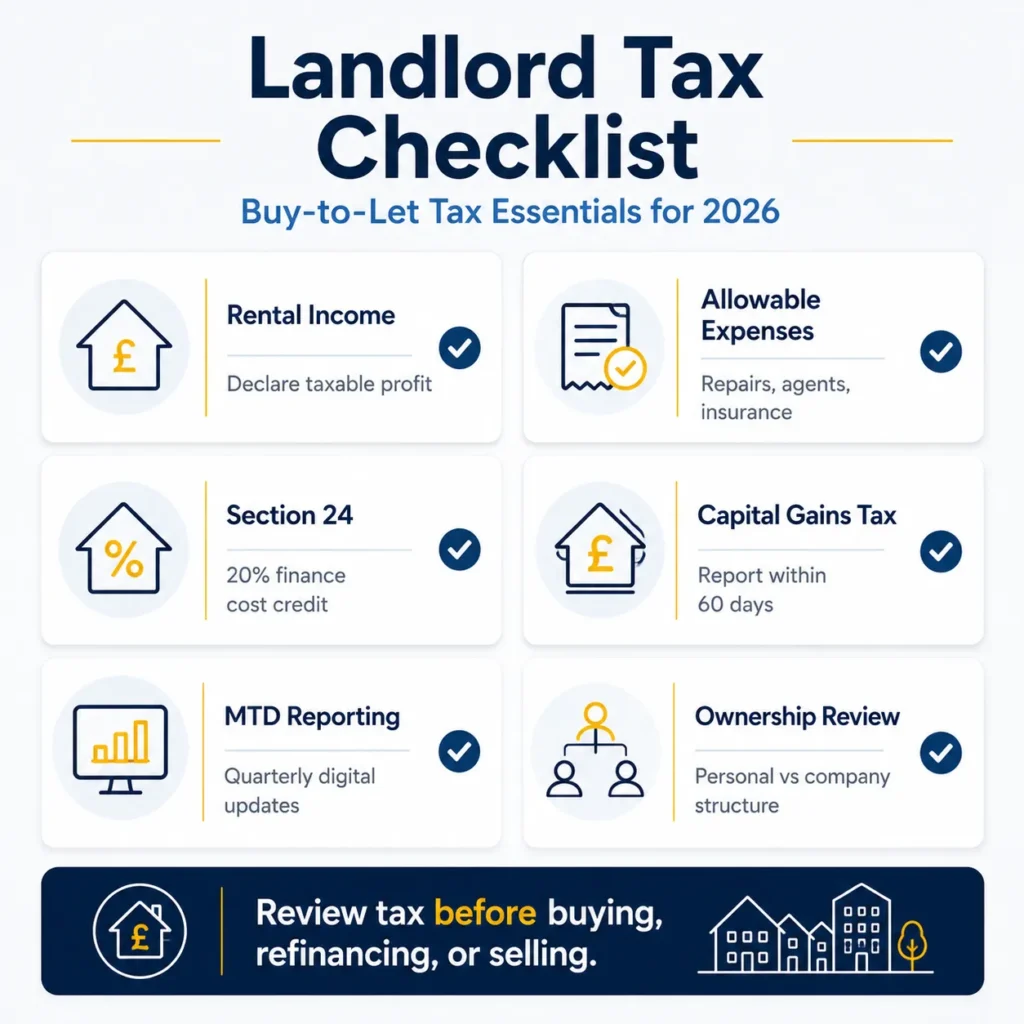
Buy-to-let property remains one of the most heavily taxed investment classes in the UK in 2026. A landlord today faces income tax on rental profits, a restricted mortgage interest deduction under Section 24, Capital Gains Tax on eventual disposal, and new digital reporting obligations that began in April 2026. This guide from our landlord property tax specialists at Protax Consultants covers every major tax obligation a UK residential landlord needs to understand in 2026.
| Quick Reference: Key Landlord Tax Rates 2026/27 |
| Income Tax on rental profit: 20% (basic) | 40% (higher) | 45% (additional) Section 24 mortgage interest credit: 20% flat rate — regardless of your actual tax rate CGT on residential property disposal: 18% (basic rate taxpayer) | 24% (higher/additional rate) CGT annual exempt amount: £3,000 MTD threshold from April 2026: Gross income over £50,000 CGT 60-day reporting deadline: From completion date |
How Rental Income Is Taxed
Rental income is added to all of your other income for the tax year — including employment salary, pension income, dividends, and savings interest — and taxed at your marginal rate. You pay income tax on your rental profit, not on your gross rental income.
| Income Component | Treatment | Rate 2026/27 | Notes |
| All other income + rental profit | Taxed together | 20% / 40% / 45% | Stacked on top of other income |
| Mortgage interest (Section 24) | Tax credit only | 20% flat credit | Not deducted from profit — see below |
| Allowable expenses | Deducted from rental income | Full deduction | Reduces taxable rental profit |
| Property Income Allowance | Exempt if gross rental under £1,000 | No tax | Cannot combine with expenses claim |
If your gross rental income exceeds £10,000, or your rental profit after expenses exceeds £2,500, you must register for Self Assessment and file a tax return each year. The registration deadline is 5 October following the first tax year in which you received rental income.
What Expenses Can a Landlord Deduct?
Expenses must be incurred wholly and exclusively for the purposes of the letting business. Our landlord property tax service includes a full annual review of every allowable deduction across your portfolio.
| Expense Category | Allowable? | Notes |
| Letting agent and management fees | Yes — fully | Incurred managing the letting |
| Buildings and contents insurance | Yes — fully | Policy must relate to the rental property |
| Repairs and maintenance | Yes — if repair, not improvement | See repairs vs improvements note below |
| Mortgage interest | No — credit only | Section 24 applies — 20% tax credit, not deduction |
| Ground rent and service charges | Yes — fully | Leasehold properties |
| Accountancy and legal fees (letting) | Yes — fully | Must relate to the letting business |
| Travel to inspect properties | Yes — 55p/mile (first 10,000) | Business purpose must be documented |
| Advertising / tenant-finding costs | Yes — fully | Online listings, agency introductory fees |
| Capital improvements | No — against income | May reduce CGT on disposal |
| Replacement of domestic items | Yes — like-for-like only | Replacement of Domestic Items Relief |
| Repairs vs Improvements — The Most Commonly Missed Distinction |
| A repair restores something to its original working condition and is deductible against rental income in the year incurred. An improvement adds something new or upgrades to a better standard — this is capital expenditure, not deductible against income, but it increases the base cost and reduces Capital Gains Tax on eventual disposal. Keep all invoices and clearly document what work was done. Mixed jobs (part repair, part improvement) should be split where possible. |
Section 24: Mortgage Interest Restriction
Since April 2020, individual landlords can no longer deduct mortgage interest from rental income. Instead, they receive a 20% basic rate tax credit on finance costs. Our dedicated Section 24 guide covers the full mechanics and all planning strategies. The core impact is shown below.
| Scenario | Before Section 24 | Under Section 24 (2026) | Difference |
| Rental income | £20,000 | £20,000 | — |
| Allowable expenses | −£3,000 | −£3,000 | — |
| Mortgage interest deduction | −£12,000 | Not deducted | +£12,000 to taxable profit |
| Taxable rental profit | £5,000 | £15,000 | +£10,000 |
| Tax (40% higher rate) | £2,000 | £6,000 | +£4,000 |
| Section 24 credit (20% of £12,000) | — | −£2,400 | — |
| Actual tax bill | £2,000 | £3,600 | **+£1,600 more |
The table above shows a landlord with £45,000 in employment income (higher rate taxpayer). Section 24 adds £1,600 per year in additional tax on this single property. A landlord with a larger portfolio or a higher mortgage will see a proportionally larger impact.
Capital Gains Tax on Disposal
When you sell a buy-to-let property at a gain, Capital Gains Tax applies. Our full Capital Gains Tax service covers all reliefs and planning options. The key 2026/27 figures are:
| CGT Element | 2026/27 Rate / Amount | Notes |
| Basic rate taxpayer | 18% | On portion of gain falling within basic rate band |
| Higher / additional rate taxpayer | 24% | On portion above basic rate threshold (£50,270) |
| Annual CGT exempt amount | £3,000 | Fixed — not index-linked. Was £12,300 until April 2023 |
| 60-day reporting deadline | From completion date | UK residential property only — HMRC online service |
| Late reporting penalty | £100 automatic | £300 at 6 months; daily penalties accumulate |
| Joint ownership benefit | Each owner has own £3,000 AEA | Splitting ownership between spouses can save up to £1,440 |
| The 60-Day CGT Reporting Rule — Do Not Miss This |
| UK residents who sell a residential property and have a CGT liability must report and pay within 60 days of the completion date — not exchange, not the following January. Missing the 60-day deadline results in an automatic £100 penalty, with further penalties at 6 months and daily charges thereafter. This is separate from your annual Self Assessment return. See our Capital Gains Tax on property guide for the full reporting process. |
The gain is calculated as sale price minus original purchase price, minus Stamp Duty paid at purchase, minus legal fees on both transactions, and minus the cost of capital improvements during ownership. This is where keeping records of improvement costs throughout the ownership period pays off. See our CGT on property 60-day rule guide for the full calculation walkthrough.
Making Tax Digital for Landlords — April 2026
From 6 April 2026, Making Tax Digital for Income Tax is mandatory for landlords in the first threshold band. Our full MTD guide for landlords covers everything you need to prepare.
| Phase | Mandatory From | Qualifying Income Threshold | What Changes |
| Phase 1 | April 2026 | Over £50,000 | Digital records + quarterly submissions to HMRC |
| Phase 2 | April 2027 | Over £30,000 | Same requirements — wider landlord population |
| Phase 3 | April 2028 | Over £20,000 | Most landlords with rental income now in scope |
| Important: The Threshold Is Gross Income, Not Profit — and It Combines Sources |
| The £50,000 MTD threshold applies to gross rental income (before expenses), not to profit. It also combines property income with any self-employment income. A landlord earning £35,000 in rent and £20,000 from freelance work has qualifying income of £55,000 and is in scope from April 2026, even though neither source alone exceeds £50,000. Limited company landlords are not affected by MTD for Income Tax. |
Quarterly submission deadlines under MTD are 7 August, 7 November, 7 February, and 7 May. These replace the single annual Self Assessment return for in-scope landlords.
The Furnished Holiday Let Abolition (April 2025)
The Furnished Holiday Let regime was abolished from 6 April 2025. Read our furnished holiday let abolition guide for the full transitional detail. The key changes are shown below.
| Tax Treatment | Under Old FHL Regime | Post-April 2025 | Impact |
| Mortgage interest | Fully deductible as expense | Section 24 applies — 20% credit only | Higher tax for leveraged FHL owners |
| Capital allowances | Available on furniture/equipment | Replacement of Domestic Items Relief only | Smaller allowable deductions |
| CGT on disposal | Business Asset Disposal Relief at 10% | Standard 18% / 24% residential rate | Higher CGT on sale |
| Pension contributions | FHL profit counted as relevant earnings | No longer relevant earnings for pensions | Reduced pension contribution capacity |
Personal Ownership vs Limited Company
Landlords acquiring new buy-to-let properties in 2026 increasingly use a limited company structure, primarily because companies are not subject to Section 24 and can deduct mortgage interest in full. Our Corporation Tax service covers the ongoing tax obligations for company-owned portfolios.
| Factor | Personal Ownership | Limited Company | Winner |
| Mortgage interest relief | 20% tax credit only (Section 24) | Fully deductible before Corporation Tax | Company |
| Tax rate on profits | 20% / 40% / 45% income tax | 19% or 25% Corporation Tax | Company (profits below £250k) |
| CGT on disposal | 18% / 24% CGT | Corporation Tax (19%/25%) on gain | Personal (lower rate) |
| SDLT on transfer in | N/A — already owned | Triggers SDLT + 5% surcharge on transfer | Personal |
| Mortgage availability | Wider choice, lower rates | Fewer lenders, higher rates | Personal |
| Profit extraction | Draws on rental income directly | Via salary/dividends — additional tax | Personal |
| Compliance cost | Self Assessment + property SA105 | Company accounts + CT600 + SA | Personal |
Transfer of existing personally-owned properties into a company triggers Stamp Duty Land Tax on the full transfer value including the 5% additional property surcharge, and Capital Gains Tax on any gain since original purchase. These upfront costs mean incorporation is rarely worthwhile for existing portfolios without professional modelling. Our landlord tax specialists can run a full comparison for your portfolio.
Tax Planning Strategies for Landlords in 2026
| Strategy | How It Works | Best For |
| Pension contributions | Reduces adjusted net income — can keep total income below 40% threshold or £100k taper. See our director pension contributions guide. | Higher-rate landlords approaching income thresholds |
| Form 17 ownership split | Vary income split between spouses to shift rental profit to a basic rate taxpayer. Requires formal HMRC declaration. | Jointly-owned properties with mixed rate taxpayer couple |
| Disposal timing | Sell in a year with lower total income — shifts gain from 24% to 18% CGT band. | Landlords planning portfolio exit or retirement |
| Mortgage reduction | Overpaying mortgage reduces interest paid, directly reducing Section 24 cost each year. | High LTV landlords with significant Section 24 exposure |
| New acquisitions via company | Companies not subject to Section 24. Plan structure before first purchase. | Higher-rate taxpayers buying additional properties in 2026 |
Frequently Asked Questions
How is rental income taxed in the UK in 2026?
Rental income is added to your other income and taxed at 20%, 40%, or 45% depending on your total taxable income. You are taxed on rental profit, which is rental income minus allowable expenses. Mortgage interest is not deducted as an expense — instead, you receive a 20% basic rate tax credit under Section 24.
Can landlords claim mortgage interest as an expense in 2026?
No. Individual landlords cannot deduct mortgage interest from rental income. Since April 2020, Section 24 replaced the full interest deduction with a 20% basic rate tax credit applied against your final tax bill. The credit is capped at the lower of 20% of finance costs, 20% of property profit, or 20% of adjusted income above the personal allowance. Limited companies are not subject to Section 24.
What CGT rate do landlords pay on property sales in 2026?
For 2026/27, CGT on residential property is 18% for basic rate taxpayers and 24% for higher rate and additional rate taxpayers. The annual exempt amount is £3,000. Landlords must report and pay CGT within 60 days of the completion date. See our CGT on property guide for the reporting process.
Does Making Tax Digital apply to landlords?
From 6 April 2026, MTD for Income Tax is mandatory for landlords with gross property and self-employment income combined above £50,000 in the 2024/25 tax year. Quarterly digital submissions are required with deadlines of 7 August, 7 November, 7 February, and 7 May. Read our MTD guide for landlords for the full requirements.
Where can I get landlord tax advice in London?
Protax Consultants are ACCA-qualified accountants based in Wimbledon. Our landlord property tax service covers Section 24 planning, CGT advice, MTD compliance, and portfolio structuring. Visit our landlords sector page or call 020 8545 7451 for a free initial consultation.

Muhammad Bilal is a Fellow Chartered Certified Accountant (FCCA) and Director of Protax Consultants, a London-based accounting firm specialising in tax advisory, compliance, and business accounting services.
Bilal qualified with the Association of Chartered Certified Accountants (ACCA) in 2009 and later achieved FCCA status after gaining extensive professional experience. With more than 13 years of experience in accounting, taxation, and auditing, he advises SMEs, landlords, contractors, and charities on tax planning, compliance, and financial management.
As a registered HMRC agent, Bilal assists clients with Self Assessment tax returns, corporation tax planning, VAT compliance, payroll services, and HMRC enquiries.
Bilal holds a BSc (Hons) in Applied Accounting and leads the audit and compliance function at Protax Consultants.
Company Verification:
Protax Consultants Ltd – Company Number 14701253
View Companies House Record