
A complete step-by-step guide to setting up a limited company in the UK in 2026 — covering the Companies House registration process, director identity verification, choosing a SIC code, share structure basics, the tax registrations you need within specific deadlines, and what happens in the first 90 days after incorporation.
Setting up a limited company in the UK is one of the fastest and lowest-cost company formations anywhere in the developed world. The standard online registration costs £100 and is typically approved within 24 hours. There are no minimum capital requirements, no notary, and no residency rules for directors. But incorporation is only the first step — a series of tax registrations, compliance decisions, and first-year filings follow in quick succession, and getting those right from the start matters far more than the registration itself. This guide covers the complete process for 2026.
Why Incorporate a Limited Company?
Before working through the mechanics, it is worth being clear about why incorporation makes sense — because the decision affects tax, liability, administration, and credibility simultaneously.
- Limited liability: A limited company is a separate legal entity from its owners. Your personal assets — home, savings, car — are protected from company debts. As a sole trader, personal and business liability are the same. This is often the most important reason to incorporate, irrespective of tax
- Tax efficiency: Limited companies pay Corporation Tax on profits — 19% for profits up to £50,000 and 25% above £250,000 in 2026/27. Directors can extract income as a combination of salary and dividends. Dividends are taxed at lower rates than salary (8.75% basic rate after the £500 annual allowance), and profits retained in the company are only taxed at the Corporate rate until withdrawn. At consistent annual profits above approximately £30,000–35,000, the tax saving over sole trader structure is typically meaningful
- Credibility: Many corporate clients, government contracts, and financial institutions require working with limited companies rather than sole traders. A Companies House registration with published accounts signals permanence and structure
- Investment readiness: If you plan to raise equity funding through SEIS or EIS, you must be a limited company. Venture capital and angel investment is not available to sole traders
Step 1: Choose Your Company Name
Your company name must be unique on the Companies House register and must end in “Limited” or “Ltd” (for private limited companies). Names are checked for uniqueness at the point of application — Companies House does not offer name reservations, so the only way to secure a name is to incorporate with it.
Certain words require special approval or cannot be used without consent: “Royal”, “NHS”, “British”, “Institute”, and similar terms that imply government connection or professional body status. The name must not be the same as or too similar to an existing registered company. You can check name availability on the Companies House register before applying. Note that a registered company name and a trading name are different — your company can trade under a different name to its registered name as long as the registered name appears on all official documents.
Step 2: Director Identity Verification (New from November 2025)
From autumn 2025, all company directors and people with significant control (PSCs) must complete mandatory identity verification with Companies House under the Economic Crime and Corporate Transparency Act 2023. This applies to all new incorporations from that date.
Verification requires a passport or UK driving licence. It can be completed directly through Companies House or through an Authorised Corporate Service Provider (ACSP) such as an accountant or formation agent. If you are incorporating directly online, you will complete identity verification as part of the IN01 application process. If you use a formation agent, they will handle this for you. There is no separate fee for identity verification itself, but you must complete it before the registration is approved.
ℹ️ Companies House Fee Increased to £100 from February 2026
The Companies House online registration fee increased from £50 to £100 on 1 February 2026. Same-day digital registration (for urgent incorporations) costs £156. Postal registration costs £124 and takes 8 to 10 working days. The annual Confirmation Statement fee also increased to £50 (from £34) from the same date. These are fixed statutory fees payable to Companies House and are the same regardless of who files on your behalf.
Step 3: Appoint Directors and Shareholders
Every limited company must have at least one director. Directors are legally responsible for running the company in compliance with the Companies Act 2006 and for filing accounts and returns on time. A director can also be the sole shareholder — for a one-person limited company, the same individual typically acts as both director and 100% shareholder.
At least one director must be a natural person (an individual, not a company). You no longer need a company secretary, though you can appoint one. Directors must provide their full name, date of birth, nationality, country of residence, and a service address for the public register. If you do not want your home address published on the public record, use a service address — your accountant’s or registered office address is commonly used for this purpose.
Shareholders hold the company’s share capital. Think carefully about how shares are allocated from the start. Changing the share structure after incorporation — adding co-founders, issuing shares to investors, or creating different share classes — is possible but generates legal and tax complexity. If you anticipate bringing in co-founders, external investment, or employee share schemes in the future, discuss the share structure with an accountant before filing, not after.
Step 4: Prepare Memorandum and Articles of Association
Every company must have a Memorandum of Association and Articles of Association. The Memorandum is a brief statement confirming the subscribers’ intention to form the company. The Articles set out the rules for running the company — how decisions are made, how shares are transferred, directors’ powers, and similar governance matters.
For most new companies, the standard Companies House Model Articles are perfectly adequate. They are adopted by default in online incorporations and cover all the standard governance requirements for a straightforward one-director, one-shareholder private company. Custom Articles are only necessary if you have multiple share classes, complex governance requirements, or are structuring for investment (SEIS/EIS investors often expect specific provisions in the Articles). Using standard Model Articles saves time and cost at incorporation.
Step 5: Choose a Registered Office Address and SIC Code
Your registered office is the official address where Companies House and HMRC send correspondence. It must be a physical address in the UK in the same jurisdiction as your registration — England and Wales, Scotland, or Northern Ireland. It does not need to be your trading address, but official mail must actually be received and handled there.
Using your home address as your registered office means it appears on the public Companies House register, visible to anyone. Many founders prefer to use their accountant’s address or a registered office service for privacy. Your accountant can typically provide a registered address as part of their service package.
You must also choose a Standard Industrial Classification (SIC) code that best describes your company’s main business activity. SIC codes are used by HMRC and Companies House for statistical purposes and have no direct tax consequence, but choosing the most accurate code is good practice. You can change your SIC code later through your annual Confirmation Statement.
Step 6: Register Online with Companies House
With your company name, director details, shareholder information, registered address, SIC code, and Articles prepared, you are ready to file. There are three routes:
- Direct through Companies House online (gov.uk): The DIY route. You complete the IN01 application yourself, pay the £100 fee, and submit directly. Usually approved within 24 hours. No guidance is provided — you are responsible for every field being correct
- Through a formation agent: Agents submit on your behalf and typically charge a small fee on top of the £100 Companies House fee. Most agents check the application for errors and include basic documents such as a share certificate and statutory registers. This is the most common route for straightforward one-director companies
- Through an accountant: Higher cost but includes advice on share structure, Articles, SIC code selection, and initial tax planning. Worth considering if you have multiple directors, complex share arrangements, or are planning for investment
Once approved, Companies House issues a Certificate of Incorporation. This document confirms your company number, name, and the date of incorporation. Your company legally exists from the date on the certificate. Keep this document — you will need it to open a business bank account and register for taxes.
Step 7: Register for Corporation Tax Within 3 Months
You must register your company for Corporation Tax with HMRC within 3 months of starting to trade. This is separate from the Companies House registration — incorporation and tax registration are two distinct processes. HMRC will not automatically know your company has started trading.
Register through your HMRC business tax account online. You will need your Companies House company number and Certificate of Incorporation to complete the registration. HMRC will issue a Unique Taxpayer Reference (UTR) within a few weeks, which you will need for all Corporation Tax communications and when filing your CT600 each year.
Step 8: Other Tax Registrations to Consider
Depending on your business, you may need to register for additional taxes after incorporation:
- VAT: Compulsory once your taxable turnover exceeds £90,000 in any rolling 12-month period. You can also register voluntarily below this threshold, which allows you to reclaim input VAT on purchases. If you are working with VAT-registered business customers, voluntary registration can be beneficial from the start
- PAYE: Register as an employer with HMRC before you make your first payroll run. This is necessary even if you are the only employee — you will need to pay yourself a salary and manage employer National Insurance. PAYE registration enables payslip production, RTI (Real Time Information) submissions, and P60 and P11D filings
- Auto-enrolment: As an employer, you are required to automatically enrol eligible employees in a workplace pension and make employer contributions. As a sole director with no other employees, you can apply to the Pensions Regulator for postponement or exemption. With other employees, the auto-enrolment duties apply from the first payroll run
Step 9: Open a Business Bank Account
A limited company must have its own bank account — legally and practically. The company is a separate legal entity, and its finances must be kept completely separate from your personal finances. Mixing personal and company money creates accounting problems, makes annual accounts harder to prepare, and can have tax consequences.
Your Certificate of Incorporation and personal identification are the minimum requirements to open a business account. Most online banks — Starling, Monzo Business, Tide, Wise Business, Revolut Business — can be opened quickly without visiting a branch and integrate directly with accounting software such as Xero. Traditional high-street banks typically have more onboarding steps but may be necessary for companies that need credit facilities, foreign currency accounts, or specific banking relationships.
Your First-Year Compliance Obligations
Incorporation creates ongoing compliance obligations that run from your first year. Understanding the key dates prevents avoidable penalties:
- Annual Confirmation Statement: Filed with Companies House once per year confirming that the company’s details (directors, shareholders, registered address, SIC code) are correct. The Companies House digital fee is £50. Your accountant typically prepares and files this for a small additional fee. Filing late results in an automatic penalty
- Annual Accounts: Statutory accounts must be filed with Companies House within 9 months of your accounting year end for a private company. Your first accounts cover the period from incorporation to your chosen year end and can cover up to 21 months. These are published on the Companies House public register
- Corporation Tax return (CT600): Filed with HMRC within 12 months of your accounting period end. Corporation Tax must be paid within 9 months and 1 day of the period end — before the filing deadline
- Self Assessment: As a company director receiving salary or dividends, you must also file a personal Self Assessment tax return by 31 January each year. The company’s tax return and your personal tax return are entirely separate obligations
⚠️ The Biggest Mistake New Directors Make: Leaving Tax Registration Too Late
Incorporation via Companies House does not notify HMRC that your company exists or has started trading. Many new directors discover this only when the first Corporation Tax deadline arrives. Register for Corporation Tax within 3 months of starting to trade — this is a legal requirement and the penalty for late registration can be substantial. If you are unsure whether you have already registered, check your HMRC business tax account. Our Corporation Tax service includes first-year registration for all new clients.
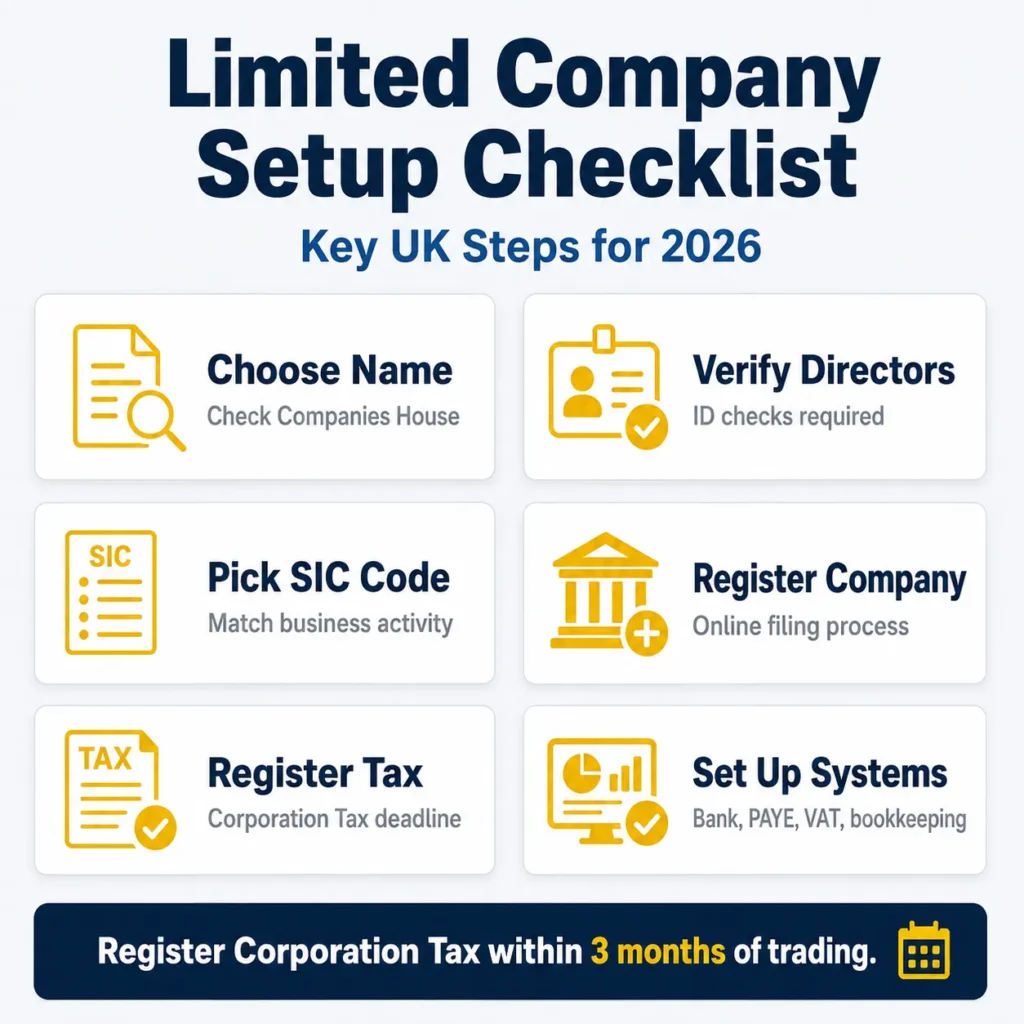
Limited Company Setup Checklist for 2026
- Check your preferred company name is available on the Companies House register
- Decide on share structure before incorporating — number of shares, classes, and who holds what percentage
- Arrange a registered office address that is not your home if privacy is a concern
- Prepare passport or driving licence for director identity verification (required from autumn 2025)
- Choose the most accurate SIC code for your main business activity
- File the IN01 application with Companies House — online costs £100, same-day costs £156
- Register for Corporation Tax with HMRC within 3 months of starting to trade
- Register for PAYE before your first payroll run
- Register for VAT if turnover will exceed £90,000 — or consider voluntary registration if you work with VAT-registered clients
- Open a dedicated business bank account using your Certificate of Incorporation
- Set up bookkeeping software — Xero or Sage — from day one and keep company and personal finances completely separate
- Note the annual Confirmation Statement deadline (Companies House, £50) and your accounting year end for accounts and CT600 filings
Setting Up a Limited Company? Get the Structure Right from Day One.
Our ACCA-qualified accountants handle your Companies House registration, Corporation Tax registration, PAYE setup, and first-year compliance — and advise on share structure, director salary, and VAT from the start. One fixed monthly fee, no surprises.
View Small Business Accounting ServiceFrequently Asked Questions
How much does it cost to set up a limited company in the UK in 2026?
The Companies House online registration fee is £100 for standard digital incorporation (increased from £50 on 1 February 2026). Same-day digital incorporation costs £156. Postal registration costs £124. Formation agents typically charge a small additional fee on top of the government fee in exchange for document preparation, error checking, and registered address services. If you use an accountant to handle the incorporation, their fee covers the filing plus advice on share structure, SIC code, and initial tax setup. Beyond the one-off registration fee, the ongoing annual costs include the £50 Confirmation Statement fee, accountancy fees for annual accounts and CT600, and software subscriptions.
How long does it take to set up a limited company in the UK?
Standard online registration with Companies House is typically approved within 24 hours of a complete, correct application. Same-day registration (£156) is processed within the same working day for applications submitted before the cut-off time. Postal applications take 8 to 10 working days from receipt at the Cardiff office. Once you have your Certificate of Incorporation, you can open a bank account and register for taxes — the full setup including Corporation Tax registration, PAYE registration, and bank account opening typically takes 5 to 10 working days in total.
Do I need a company secretary to set up a limited company?
No. Private limited companies are no longer required to appoint a company secretary. At least one director who is an individual (not a corporate director) is the only mandatory appointment. Many small companies — particularly one-person consultancies and freelancer vehicles — operate with a sole director and sole shareholder who is the same person, with no company secretary. If you later grow to a size where company secretarial services are useful, you can appoint one at any time.
What is the difference between a limited company and a sole trader?
A sole trader and their business are legally the same entity — there is no separation between personal and business finances, liability, or legal identity. A limited company is a separate legal entity: it can own assets, enter contracts, and hold debts independently of its directors and shareholders. Sole traders pay Income Tax and National Insurance on all profits. Limited company directors pay Corporation Tax on company profits, and personal income is drawn as salary (subject to PAYE) and dividends (subject to dividend tax at lower rates). The tax difference becomes meaningful at around £30,000–35,000 in consistent annual profits. Below that level, the additional administration of running a company often outweighs the tax saving.
When do I need to register for Corporation Tax after incorporating?
You must register your company for Corporation Tax with HMRC within three months of starting to trade. This is separate from the Companies House registration — incorporation does not automatically notify HMRC that your company exists. Register through your HMRC business tax account online using your company number and Certificate of Incorporation. HMRC will issue a Unique Taxpayer Reference within a few weeks. If your company is dormant after incorporation — not yet trading — you do not need to register until trading begins, but you must notify HMRC within three months of the first trading activity.
Can a non-UK resident set up a limited company in the UK?
Yes. There are no nationality or residency requirements for directors or shareholders of a UK limited company. Non-residents can incorporate and direct a UK company remotely. The requirements are: a UK registered office address (a physical address where official correspondence is received), completion of the identity verification process for all directors and persons with significant control, and compliance with the relevant UK tax obligations once the company is trading. Non-resident directors should seek specific advice on their personal UK tax position, as the company’s UK activities may create tax obligations in their country of residence as well.

Muhammad Bilal is a Fellow Chartered Certified Accountant (FCCA) and Director of Protax Consultants, a London-based accounting firm specialising in tax advisory, compliance, and business accounting services.
Bilal qualified with the Association of Chartered Certified Accountants (ACCA) in 2009 and later achieved FCCA status after gaining extensive professional experience. With more than 13 years of experience in accounting, taxation, and auditing, he advises SMEs, landlords, contractors, and charities on tax planning, compliance, and financial management.
As a registered HMRC agent, Bilal assists clients with Self Assessment tax returns, corporation tax planning, VAT compliance, payroll services, and HMRC enquiries.
Bilal holds a BSc (Hons) in Applied Accounting and leads the audit and compliance function at Protax Consultants.
Company Verification:
Protax Consultants Ltd – Company Number 14701253
View Companies House Record