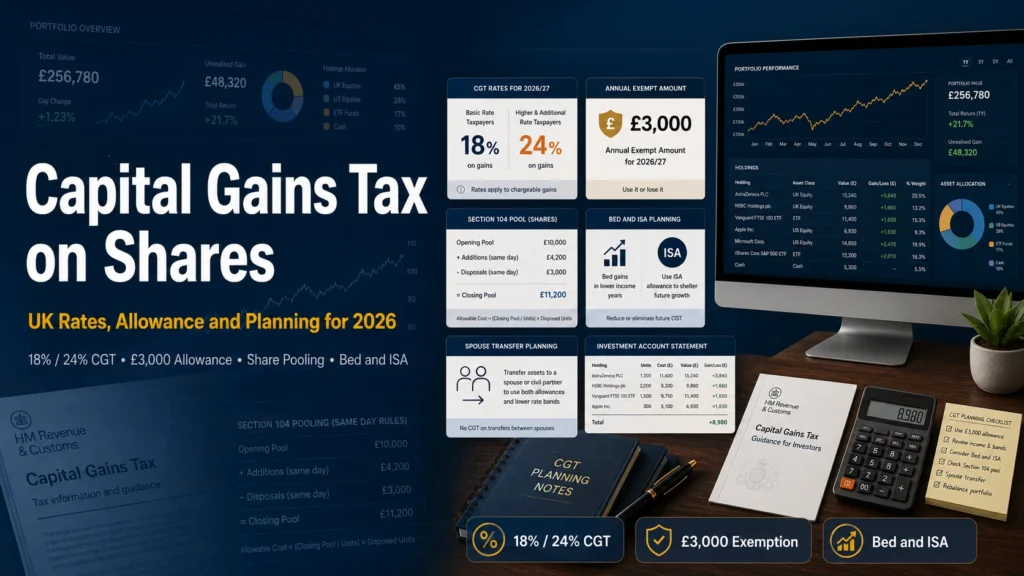
What is CGT on shares? Capital Gains Tax on shares is the tax charged on the profit you make when you sell shares or other investments for more than you paid for them. For 2026/27, the rate is 18% for gains within your basic rate band and 24% for gains above it. The first £3,000 of gains each tax year is exempt.
If you hold shares outside an ISA or pension, whether directly, through employee share schemes, or via a general investment account, selling them can trigger Capital Gains Tax. The rules for shares are different in several important ways from the rules for property, which trips up many people who research CGT and find guidance written for landlords rather than investors. This guide from Muhammad Bilal FCCA at Protax Consultants covers the current rates, how share pooling works, and the legitimate strategies available to reduce your bill in 2026/27.
CGT Rates on Shares in 2026/27
Shares are taxed at the same CGT rates as most other assets, excluding residential property, which has its own higher rate structure.
| Taxpayer position | Rate on share gains | Notes |
| Basic rate taxpayer | 18% | Applies to gains within the remaining basic rate band, up to total income and gains of £50,270 |
| Higher rate taxpayer | 24% | Applies to gains above the basic rate band threshold |
| Additional rate taxpayer | 24% | Same rate as higher rate for shares and most non-property assets |
| Gain straddling both bands | Split 18% / 24% | Part of the gain uses remaining basic rate space, the rest is charged at 24% |
The annual exempt amount for 2026/27 is £3,000 per individual. This has fallen substantially in recent years, from £12,300 in 2022/23. Investors who previously did not need to think about CGT because their gains sat comfortably within a larger allowance now find themselves liable at much lower gain levels.
How Share Gains Are Calculated: The Section 104 Pool
You cannot simply calculate the gain on shares by comparing the sale price to the price of the most recent purchase. HMRC requires share matching rules, applied in a strict order, to prevent investors selectively choosing which purchase price to match against a sale to minimise tax.
- Same-day rule: Shares of the same class in the same company bought and sold on the same day are matched first.
- 30-day rule (bed and breakfasting rule): If you buy shares of the same class in the same company within 30 days after selling, those shares are matched against the sale. This specifically prevents selling shares to crystallise a loss or gain, then immediately buying them back.
- Section 104 pool: All other shares of the same class in the same company are held in a single pool with a running average cost. When you sell, you use the weighted average cost of the whole pool, not the price of any specific purchase.
Worked Example: Section 104 Pool
| Date | Transaction | Value | Pool position |
| Jan 2023 | Buy 1,000 shares | Cost £8,000 | Pool: 1,000 shares, £8,000 |
| Jun 2024 | Buy 500 shares | Cost £5,500 | Pool: 1,500 shares, £13,500 |
| Oct 2026 | Sell 900 shares | Proceeds £12,600 | Cost: 900/1,500 × £13,500 = £8,100 |
| Gain calculation | £12,600 − £8,100 = £4,500 | Less £3,000 exempt = £1,500 taxable | |
| Tax at 18% | CGT payable: £270 | Remaining pool: 600 shares, £5,400 |
Legitimate Ways to Reduce CGT on Shares
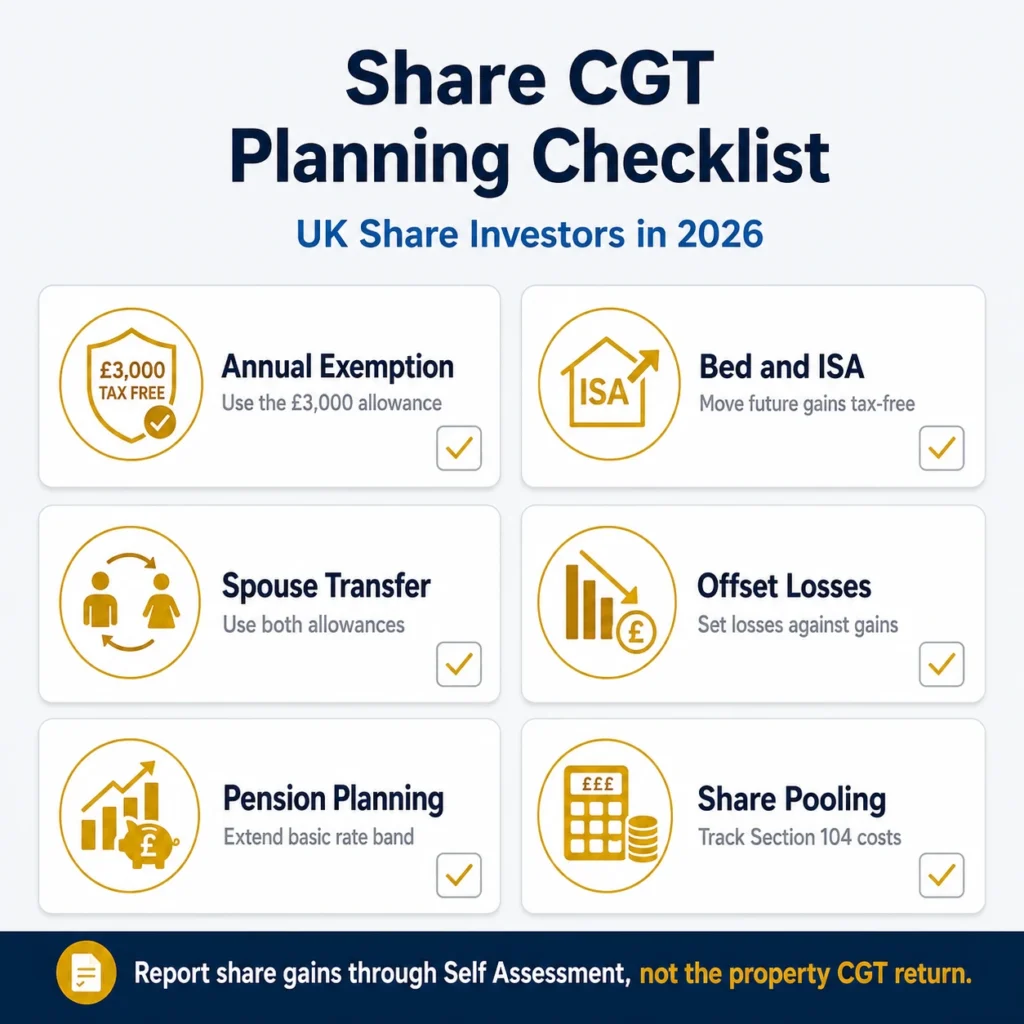
Use Your Annual Exempt Amount Every Year
The £3,000 exemption cannot be carried forward. Realising gains up to the threshold each year, where sensible for your investment strategy, uses an allowance that otherwise disappears.
Bed and ISA
The 30-day rule prevents you from selling and immediately rebuying the same shares in a general investment account to use your exemption. But if you sell shares in a general account and rebuy the same shares inside a Stocks and Shares ISA, the 30-day rule does not apply, because the repurchase is not for CGT purposes matched against the same account. This process, known as Bed and ISA, crystallises a gain (using your exempt amount) and moves the holding into a tax-free wrapper for future growth.
Spouse and Civil Partner Transfers
Transfers between spouses and civil partners are treated as no gain, no loss for CGT. If one spouse has unused annual exemption or sits in a lower tax band, transferring shares before sale can materially reduce the household’s overall CGT bill. Each partner gets their own £3,000 exemption.
Offsetting Losses
Capital losses on other shares or assets can be offset against gains in the same tax year, and unused losses carry forward indefinitely to offset future gains. Losses must be reported to HMRC, usually via Self Assessment, within four years of the end of the tax year in which they arose, even if you are not otherwise liable to file a return.
Pension Contributions
A pension contribution extends your basic rate band for the tax year. Where a large share disposal would otherwise push gains into the 24% band, a pension contribution timed in the same tax year can shift some of that gain back into the 18% band.
Employee Share Schemes: Additional Considerations
Shares acquired through an employer scheme, such as SAYE (Save As You Earn), SIP (Share Incentive Plan), or EMI (Enterprise Management Incentive) options, have their own acquisition cost rules that affect the CGT calculation on eventual sale.
| Scheme | CGT treatment on sale |
| SAYE (Sharesave) | Cost basis is the option price paid, not market value at exercise. Gains from option price to sale price are subject to CGT |
| SIP (Share Incentive Plan) | Shares held in the plan for 5 years and sold directly from the plan can be free of CGT entirely |
| EMI options | Cost basis is the exercise price. BADR may be available on the sale if conditions are met, reducing the rate to 18% (see our BADR guide) |
Reporting and Deadlines
CGT on shares is reported through Self Assessment, not the 60-day property CGT return that applies to residential property disposals. You must report gains above the £3,000 exemption, or if your total proceeds from all disposals exceed four times the annual exempt amount, even where the net gain is below the threshold.
For the 2025/26 tax year (6 April 2025 to 5 April 2026), the online Self Assessment deadline is 31 January 2027. Tax is due on the same date.
Protax Consultants: CGT Planning for London Investors
Muhammad Bilal FCCA and the Protax team advise London-based investors on CGT planning for shares, employee share schemes, and mixed portfolios, alongside broader Self Assessment and tax planning services. HMRC-authorised, ACCA-registered (5743262), based in Wimbledon, serving clients across London and remotely throughout the UK. Visit our Capital Gains Tax service or call 020 8545 7451.
Frequently Asked Questions
What is the CGT rate on shares in 2026/27?
18% for gains within your basic rate band, 24% for gains above it. The rate depends on your total taxable income plus gains, not the gain alone. The annual exempt amount is £3,000.
Do I pay CGT on shares held in an ISA?
No. Shares held in a Stocks and Shares ISA are completely free of Capital Gains Tax, regardless of the size of the gain or your income tax band.
Can I sell shares at a loss and buy them back straight away?
Not within a general investment account. The 30-day rule matches any repurchase within 30 days against the sale, which usually cancels out the loss for tax purposes. Buying the same shares back inside an ISA is not caught by this rule, which is the basis of the Bed and ISA strategy.
How do I report CGT on shares to HMRC?
Through your Self Assessment tax return, not the 60-day property return used for residential property. You must report if your gain exceeds £3,000, or if your total disposal proceeds exceed four times the annual exempt amount even where the gain itself is smaller.
Where can I get CGT advice for shares in London?
Protax Consultants in Wimbledon, London. Muhammad Bilal FCCA handles CGT calculations for share portfolios, employee share schemes, and Self Assessment reporting. Fixed fee. Visit protax.org.uk/services/capital-gains-tax or call 020 8545 7451.

Muhammad Bilal is a Fellow Chartered Certified Accountant (FCCA) and Director of Protax Consultants, a London-based accounting firm specialising in tax advisory, compliance, and business accounting services.
Bilal qualified with the Association of Chartered Certified Accountants (ACCA) in 2009 and later achieved FCCA status after gaining extensive professional experience. With more than 13 years of experience in accounting, taxation, and auditing, he advises SMEs, landlords, contractors, and charities on tax planning, compliance, and financial management.
As a registered HMRC agent, Bilal assists clients with Self Assessment tax returns, corporation tax planning, VAT compliance, payroll services, and HMRC enquiries.
Bilal holds a BSc (Hons) in Applied Accounting and leads the audit and compliance function at Protax Consultants.
Company Verification:
Protax Consultants Ltd – Company Number 14701253
View Companies House Record