
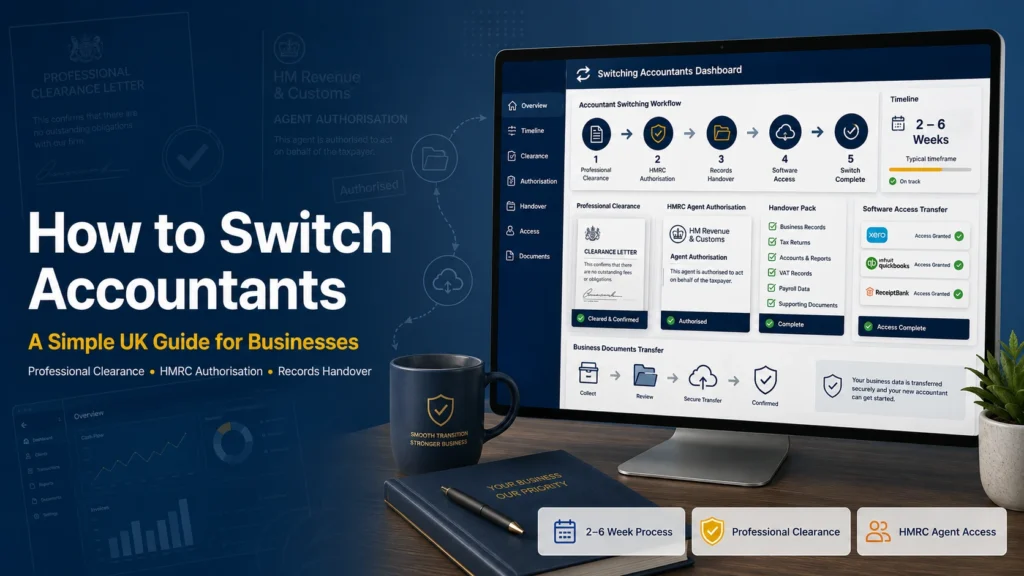
Quick answer: switching accountants in the UK typically takes 2–6 weeks. Your new accountant handles the professional clearance letter, records request, and HMRC agent authorisation. Your role is a couple of emails, an identity check, and approving the HMRC authorisation online.
The most common reason businesses delay switching accountants is the belief that it will be disruptive or complicated. In practice, the process is standard, professionally managed on both sides, and happens routinely. Millions of clients change practices every year. The professional clearance process, the HMRC handover, and the records transfer are all governed by ethical rules that protect you throughout. This guide from Muhammad Bilal FCCA at Protax Consultants walks through every step.
If you are considering switching to Protax, we manage the entire process for new clients. Visit our London accountants page or call 020 8545 7451 for a free, no-obligation conversation.
When Should You Switch? Signs It Is Time
| Warning sign | What it costs you |
|---|---|
| Calls and emails unreturned or slow | Lost time, unanswered questions, delayed decisions |
| Reactive, not proactive — only files, never advises | Missed tax savings; no planning, only compliance |
| Missed or near-missed HMRC deadlines | Penalties, HMRC surcharges, reputational risk |
| Fees rise without improved service | Cost overrun on a fixed overhead |
| Not set up for MTD — no software guidance, no quarterly update plan | MTD deadline missed; penalties from April 2026 cohort onwards |
| Generic advice — no understanding of your industry | Over-paying tax; missing sector-specific reliefs |
| No mention of dividend rates, salary planning, or CGT in last 12 months | Director remuneration not optimised; potentially thousands overpaid annually |
Making Tax Digital launched in April 2026 for sole traders with income over £50,000. If your current accountant has not spoken to you about MTD-compatible software, your quarterly update process, or your first submission deadline (7 August 2026), that is a significant warning sign. See our MTD guide for what an MTD-ready client relationship should look like.
Can You Switch Accountants at Any Time?
Yes. There is no legal or regulatory requirement to wait for year-end. You can switch mid-year without penalty or complication. That said, some timings are cleaner:
- After annual accounts are filed: The outgoing firm has completed the work you paid for; the handover is a clean starting point.
- At the start of a VAT quarter: Your new accountant can take on VAT returns from a natural beginning.
- Before an upcoming deadline: If your current firm is not managing compliance proactively, switching before a deadline is always better than after it.
The Seven-Step Switching Process
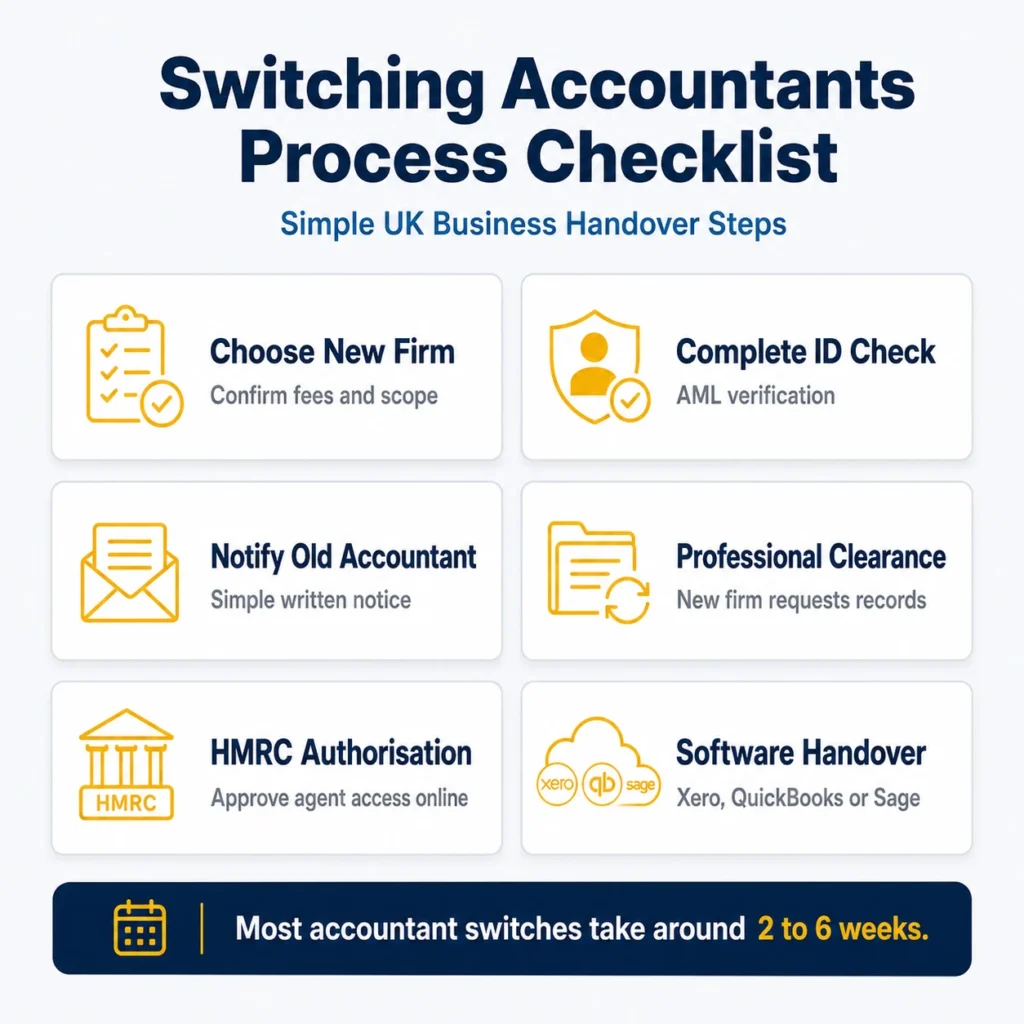
Step 1: Choose and Engage Your New Accountant
Before giving notice, have your new firm chosen and engaged. The handover cannot begin until you have signed with the new practice. When choosing:
- Credentials: Look for FCCA, ACA, ACCA, or CIMA qualification. Regulated firms have professional accountability and a complaints route.
- Fixed-fee pricing: Hourly billing creates unpredictability. Fixed fees agreed before work starts mean no surprises.
- Relevant expertise: A construction contractor, a landlord, and an e-commerce business have different needs. Sector knowledge matters.
- Software: Confirm the new firm is certified on your platform (Xero, QuickBooks, Sage) and supports MTD-compatible reporting.
- Communication: A direct number, named contact, and clear SLAs for response times.
Step 2: Anti-Money Laundering Identity Check
UK Anti-Money Laundering regulations require every regulated accounting firm to verify the identity of new clients before acting for them. You will typically provide photo ID (passport or driving licence) and proof of address (utility bill or bank statement within three months). Most firms do this digitally in minutes.
Step 3: Notify Your Existing Accountant
Send a brief written notice — email is entirely sufficient — confirming you are moving. You do not need to explain why or justify the decision. A simple professional message is appropriate:
“I am writing to give notice that I am transferring my accounting affairs to a new firm. [New firm name] will contact you shortly to request professional clearance. Please cease work on outstanding matters from [date] and let me know of any outstanding invoices so I can settle them promptly.”
Check your engagement letter for any notice period — typically 30 days. Clear any outstanding invoices. Unpaid fees are the most common cause of delayed handovers.
Step 4: Professional Clearance Letter
Your new accountant sends a formal professional clearance letter to your outgoing firm. This is an ethical requirement under ICAEW, ACCA, and IFA professional conduct rules. It asks: (a) whether there are any professional or ethical reasons the new firm should not act for you; and (b) for a handover pack of your financial records.
Your existing accountant is required to respond promptly. They cannot refuse on the grounds of outstanding fees — though they may withhold discretionary working papers (their own internal notes and calculations) until fees are settled. Statutory documents — your tax returns, filed accounts — must be provided.
In the rare case where a former accountant refuses to cooperate or is very slow, your new accountant can escalate through the relevant professional body (ICAEW Complaints or ACCA Professional Conduct). Firms are required to cooperate with professional clearance — this obligation is enforceable.
Step 5: Handover Pack
The handover pack typically includes:
- Latest filed statutory accounts
- Prior two to three years’ tax returns (Self Assessment, corporation tax, or partnership returns as relevant)
- Trial balance or management accounts to current period
- VAT registration number and recent return history
- PAYE employer reference and payroll records
- Companies House authentication code (limited companies)
- UTR for all relevant entities
- Details of any open HMRC enquiries or correspondence
Your new accountant coordinates collection. You do not need to chase documents yourself.
Step 6: HMRC Agent Authorisation
To deal with HMRC on your behalf, your new accountant must be formally authorised as your agent. The digital agent authorisation process has largely replaced the old paper 64-8 form. Your new accountant submits an authorisation request to HMRC; you receive a notification and approve it online through your Personal Tax Account or Business Tax Account. Once approved, your new accountant can access and manage Self Assessment, Corporation Tax, VAT, PAYE, and CIS as relevant to your business.
Time this carefully if a filing deadline is approaching. Agent authorisation should ideally be in place before any filing is due. If time is tight, your new accountant can file as soon as authorisation is confirmed — flag this at outset so they can prioritise.
Step 7: Cloud Software Handover
If you use Xero, QuickBooks, or Sage, the technical handover is simple. Invite your new accountant as an Advisor or Accountant role, then revoke the outgoing firm’s access once handover is complete. Your data stays in your account permanently — it never belonged to the accountant.
If you are also switching software platforms, your new accountant can manage data migration and setup as part of onboarding.
What to Have Ready to Speed the Transition
| Item | Where to find it | Why it helps |
|---|---|---|
| UTR (Unique Taxpayer Reference) | Any HMRC letter or SA302 | Core ID for HMRC authorisation |
| VAT registration number | VAT certificate or any HMRC VAT letter | Needed to authorise VAT agent access |
| PAYE employer reference | Any HMRC payroll letter or P60 | Needed if you run payroll |
| Companies House auth code | Companies House letter — request online if lost | Needed for annual confirmation statement filing |
| Last two tax returns | Request from old accountant or HMRC portal | Gives new accountant your compliance history |
| Accounting software login | Your own account | New accountant invited once engaged |
Common Concerns, Addressed
Will HMRC deadlines be missed?
Only in poorly managed transitions. Your new accountant reviews upcoming deadlines as one of their first actions. If the outgoing firm is mid-filing on a specific return, you can agree they complete it with a clean handover following.
Will I lose my financial history?
No. Historical accounts, tax returns, and records belong to you. Statutory documents must be handed over. If you use cloud accounting software, all your historical data remains in your account.
Can I switch if there is an ongoing HMRC enquiry?
Yes. Switching accountants during an HMRC enquiry is entirely possible — your new accountant simply takes over representation. Full disclosure of the open enquiry in the handover pack is important so nothing is missed.
Do I need to tell HMRC myself?
No. Your new accountant handles HMRC notification through the agent authorisation process. You do not contact HMRC directly.
Why 2026 Is a Common Trigger Year for Switching
Three 2026 developments are prompting many businesses to review their accountants: (1) Making Tax Digital for Income Tax launched in April 2026 — firms not prepared for MTD are exposing clients to penalties; (2) the working from home relief was abolished — clients not informed have filed incorrectly or missed backdating opportunities; (3) CARF from January 2026 affects crypto-holding clients who should have been advised about declaration obligations.
If any of these situations applies to you and your current accountant has not raised it proactively, that conversation is worth having — or a switch worth considering.
Switching to Protax Consultants
Protax Consultants are FCCA Chartered Certified Accountants based in Wimbledon, London. Muhammad Bilal FCCA and the team manage the entire switching process for new clients — professional clearance, HMRC agent authorisation, records request, software access. We serve sole traders, limited companies, landlords, contractors, and SMEs across all London boroughs and throughout the UK, all on fixed fees agreed before we start. Visit our London accountants page or call 020 8545 7451 for a free, no-obligation conversation.
Frequently Asked Questions
Can I switch accountants at any time of year?
Yes. There is no requirement to wait for year-end. Mid-year switches are common and routine. Some timings are cleaner than others (after annual accounts are filed, at the start of a VAT quarter), but any time is manageable when handled professionally.
What is professional clearance?
Professional clearance is a formal letter your new accountant sends to your existing accountant. It confirms there are no ethical reasons the new firm should not act for you, and requests a handover pack of your financial records. It is required under ICAEW and ACCA professional conduct rules. Your existing accountant must respond and cooperate.
Does my old accountant own my financial records?
No. Tax returns, filed accounts, and other statutory documents belong to you. Your accountant holds them on your behalf and must hand them over. They may withhold their own internal working papers until outstanding fees are settled, but your statutory records must be provided.
How do I authorise my new accountant with HMRC?
Your new accountant submits an online agent authorisation request through HMRC’s digital services. You approve it through your Personal Tax Account or Business Tax Account — a simple online process. The old 64-8 paper form is no longer required for most cases.
How long does switching accountants take?
Two to six weeks in most cases. The main variables are: how quickly the outgoing accountant responds to the clearance letter, and whether there are outstanding invoices to settle. Most firms cooperate promptly. Your new accountant provides updates throughout.
How do I switch to Protax Consultants?
Call 020 8545 7451 or visit protax.org.uk/contact. We will discuss your business, send a fixed-fee proposal, and manage the entire switching process once you proceed. No charge for the switch itself. FCCA qualified, HMRC-authorised, ACCA reg 5743262.

Muhammad Bilal is a Fellow Chartered Certified Accountant (FCCA) and Director of Protax Consultants, a London-based accounting firm specialising in tax advisory, compliance, and business accounting services.
Bilal qualified with the Association of Chartered Certified Accountants (ACCA) in 2009 and later achieved FCCA status after gaining extensive professional experience. With more than 13 years of experience in accounting, taxation, and auditing, he advises SMEs, landlords, contractors, and charities on tax planning, compliance, and financial management.
As a registered HMRC agent, Bilal assists clients with Self Assessment tax returns, corporation tax planning, VAT compliance, payroll services, and HMRC enquiries.
Bilal holds a BSc (Hons) in Applied Accounting and leads the audit and compliance function at Protax Consultants.
Company Verification:
Protax Consultants Ltd – Company Number 14701253
View Companies House Record