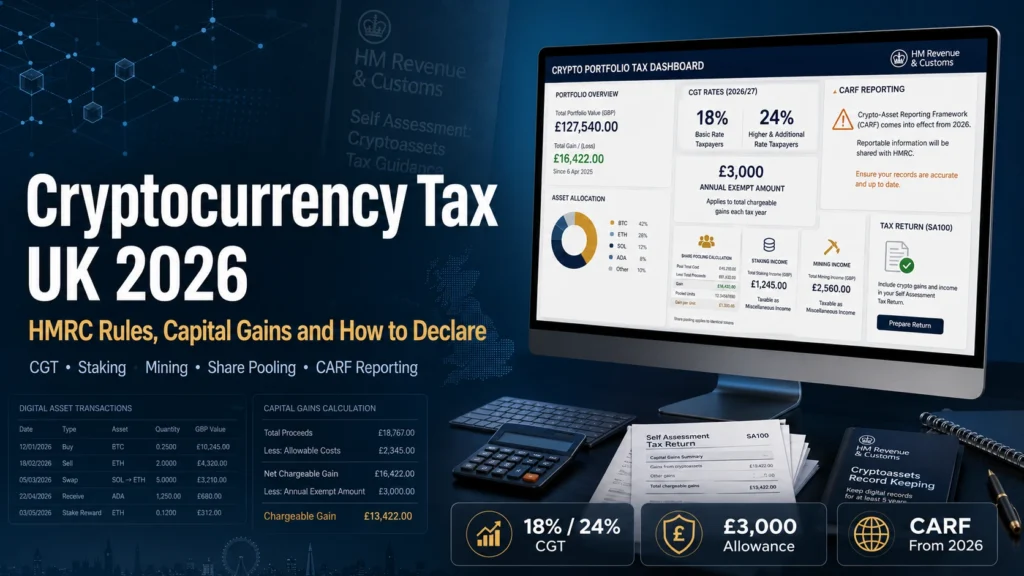
HMRC treats cryptocurrency as a chargeable asset, not currency, and has done since 2019. Almost every action a holder takes can generate a taxable event — selling, swapping, spending, gifting, mining, staking. With the Crypto-Asset Reporting Framework (CARF) now requiring UK exchanges to collect and share customer data from January 2026, the era of low-visibility crypto holdings is ending. This guide from Muhammad Bilal FCCA at Protax Consultants covers what triggers a tax event, the CGT rates and income tax treatment for 2026/27, how gains are calculated using HMRC’s share pooling rules, and how to declare correctly.
For help filing a Self Assessment return that includes crypto gains, visit our Self Assessment service.
How HMRC Classifies Cryptocurrency
HMRC classifies most cryptoassets — Bitcoin, Ethereum, altcoins, stablecoins, and most tokens — as chargeable assets for Capital Gains Tax. They are not currency, not trading stock (unless you are in the business of trading), and not exempt assets. When you dispose of a crypto asset for more than it cost you, the gain is subject to CGT. When you receive crypto as earnings, it is subject to income tax.
This treatment is set out in HMRC’s Cryptoassets Manual. The type of asset — coin, utility token, NFT — does not change the core treatment. What matters is the nature of the transaction: disposal for CGT, receipt for income tax.
CGT Rates on Crypto in 2026/27
Crypto gains are taxed at the same rates as shares and other non-residential assets.
| Taxpayer position | CGT rate | When it applies |
|---|---|---|
| Basic rate taxpayer — income within basic rate band | 18% | Remaining basic rate band (up to £50,270 of total income + gains) taxed here |
| Higher rate taxpayer — income above £50,270 | 24% | Gains that fall above the basic rate band |
| Additional rate taxpayer — income above £125,140 | 24% | Same rate as higher rate for non-property assets |
| Straddling the band | Split 18%/24% | Part of the gain fills remaining basic rate space at 18%; excess at 24% |
Annual exempt amount 2026/27: £3,000. This is the same as 2025/26 and is confirmed by HMRC for subsequent years (GOV.UK). Gains above £3,000 are taxable. You may still need to report gains below £3,000 if your total disposal proceeds exceed £50,000.
What Is — and Is Not — a Taxable Crypto Event?
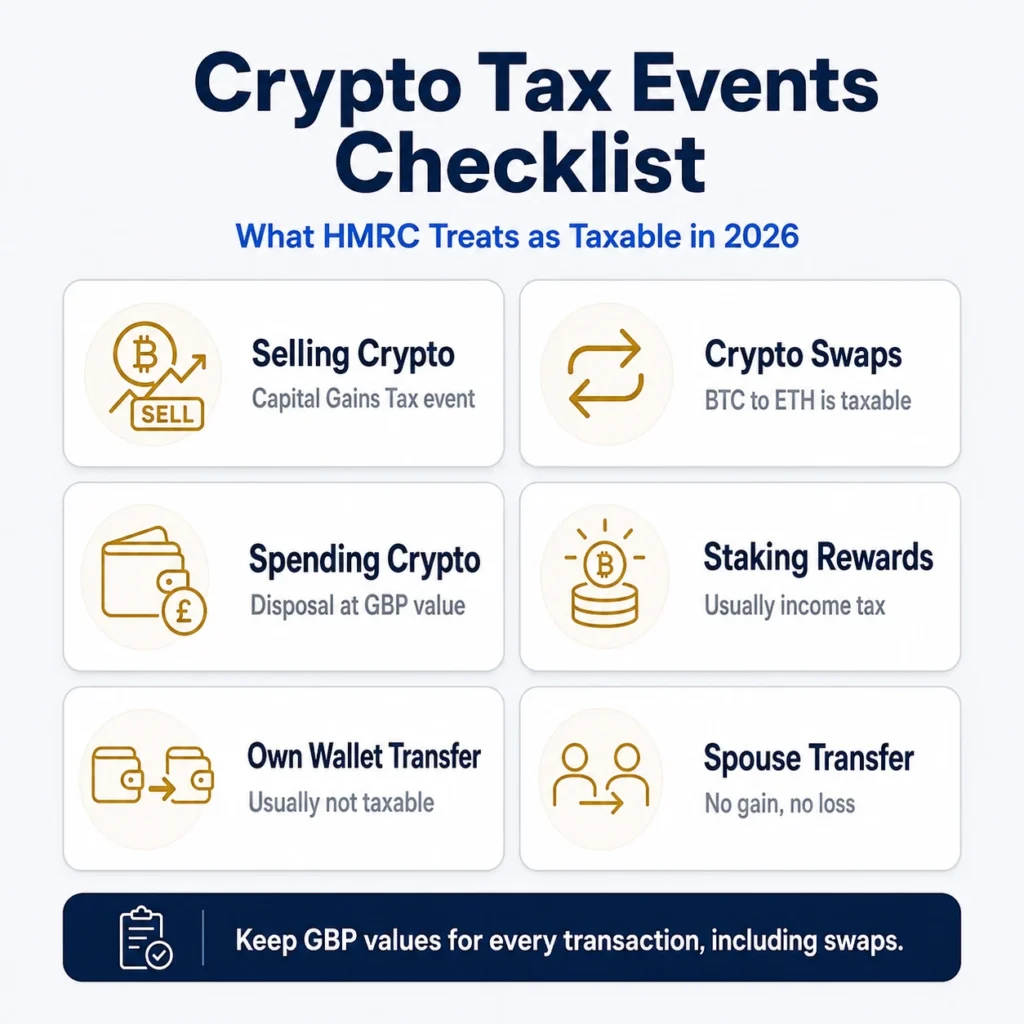
| Transaction | Tax trigger | Notes |
|---|---|---|
| Sell for GBP | CGT | Classic disposal — gain = proceeds minus cost |
| Swap BTC for ETH (or any crypto-to-crypto) | CGT | GBP value of asset given up at the moment of swap = proceeds |
| Spend crypto on goods/services | CGT | GBP value at time of spending minus cost basis |
| Gift to someone other than spouse/civil partner | CGT | Market value at date of gift used as proceeds |
| Staking rewards received | Income tax | Value in GBP at receipt; becomes cost basis for future disposal |
| Mining income | Income tax | Trading or miscellaneous income depending on scale and frequency |
| Crypto received as payment | Income tax | GBP value at receipt is employment or self-employment income |
| DeFi: liquidity/lending | Complex | Beneficial ownership analysis needed — may trigger disposal on entry/exit |
| Airdrop (nothing done to receive it) | May be income or free acquisition | Depends on nature of airdrop — HMRC gives specific guidance in manual |
| Transfer between own wallets | No taxable event | No disposal — beneficial ownership unchanged |
| Gift to spouse or civil partner | No CGT | No-gain/no-loss; recipient inherits cost basis |
| Buy crypto with GBP | No taxable event | Creates a cost record; acquisition date matters for future disposal |
| Holding crypto | No taxable event | Holding is not a disposal |
Critical point: Swapping Bitcoin for Ethereum is a disposal for CGT purposes even though no GBP changes hands. HMRC confirmed this in its Cryptoassets Manual. Active altcoin traders can generate hundreds of CGT events per year without ever selling to GBP.
Share Pooling: How HMRC Calculates Your Gains
HMRC uses share matching rules for crypto, preventing bed-and-breakfasting (selling to crystallise a loss then immediately buying back). The rules apply in this order:
- Same-day rule: Purchases on the same day as a disposal are matched against it first.
- 30-day rule: Purchases within 30 days after a disposal are matched against it. This prevents selling at a loss and immediately repurchasing to artificially generate losses.
- Section 104 pool: All remaining holdings of the same type are held in a single pool with a weighted average cost. Most disposals are calculated against pool costs.
Worked Example: Pool Calculation
| Date | Event | GBP | Notes |
|---|---|---|---|
| Jan 2024 | Buy 0.5 BTC | Cost £12,500 | Pool: 0.5 BTC, total cost £12,500 |
| Apr 2024 | Buy 0.5 BTC | Cost £15,000 | Pool: 1 BTC, total cost £27,500 (avg £27,500/BTC) |
| Oct 2026 | Sell 0.75 BTC | Proceeds £30,000 | Cost basis: 75% × £27,500 = £20,625 |
| Gain calculation | £30,000 − £20,625 = £9,375 | Less £3,000 exempt = £6,375 taxable | |
| Tax at 18% (basic rate) | CGT payable: £1,147.50 | Remaining pool: 0.25 BTC at £6,875 |
All figures must be in GBP, including crypto-to-crypto swaps. If you exchange BTC for ETH, you need the GBP value of the BTC at the exact moment of the swap to calculate your disposal proceeds. Using approximate values is an HMRC compliance risk.
Income Tax on Crypto: Staking, Mining, and Payments
| Source | Tax treatment | Rate |
|---|---|---|
| Staking rewards | Miscellaneous income at GBP value on receipt | 20%/40%/45% — personal allowance applies |
| Mining (individual, non-business scale) | Miscellaneous income | 20%/40%/45% |
| Mining (business scale, regular/organised) | Trading income — self-employed | Income tax + Class 4 NIC; can deduct costs |
| Crypto salary/freelance payment | Employment/self-employment income | PAYE or Self Assessment at marginal rate |
| DeFi yield/interest | Income tax in most cases | Depends on the structure of the protocol — seek advice |
CARF: The 2026 Change That Makes Non-Declaration Much Riskier
From 1 January 2026, the UK implemented the Crypto-Asset Reporting Framework (CARF). UK crypto service providers — exchanges, brokers, wallet services — now collect customer identity and transaction data. First reports covering 2026 activity are due with HMRC in 2027, and HMRC will exchange that data internationally through the OECD framework.
CARF removes the practical obscurity that allowed some crypto holders to quietly hold undeclared positions. Once exchange data arrives at HMRC in 2027, any discrepancy between reported gains and exchange transaction history will be visible.
If you have undeclared crypto gains from prior years, acting now rather than waiting for HMRC to contact you carries substantially lower penalties. HMRC’s penalty regime for unprompted voluntary disclosure is significantly more favourable than for prompted disclosure. The window to act without penalty is closing.
Reporting Thresholds and Deadlines
You must report crypto to HMRC on a Self Assessment return if your total net gains exceed £3,000, or if your total gross disposal proceeds exceed £50,000 (even if gains are below the exempt amount). The online Self Assessment deadline for 2025/26 (6 April 2025 to 5 April 2026) is 31 January 2027.
Legal Strategies to Reduce Crypto CGT
- Annual exempt amount: Use the full £3,000 each year. Cannot be carried forward. A married couple each has £3,000 — £6,000 combined.
- Spouse transfers: No-gain/no-loss transfer to a spouse or civil partner. The receiving spouse uses their own allowance and may pay CGT at a lower rate.
- Tax loss harvesting: Sell assets at a loss to offset gains. Losses carry forward indefinitely. Note: the 30-day rule prevents immediate repurchase of the same asset to crystallise a loss.
- Timing: Splitting large disposals across tax year boundaries uses two annual allowances. Pension contributions extend your basic rate band, potentially reducing the rate from 24% to 18%.
- Charity donation: Donating crypto to a UK-registered charity is exempt from CGT and attracts Gift Aid income tax relief.
NFTs: Same CGT Treatment
NFTs are chargeable assets with the same CGT treatment as other cryptoassets. Selling or swapping an NFT is a disposal. Receiving an NFT as payment is income. Because each NFT is typically unique, the Section 104 pool does not apply — each NFT has its own individual cost basis.
Protax Consultants: Crypto Tax for London Investors
Muhammad Bilal FCCA and the Protax team in Wimbledon advise London-based crypto investors, DeFi participants, and blockchain businesses on CGT calculations, income tax on staking and mining, Self Assessment filing, and voluntary disclosure of undeclared prior positions. HMRC-authorised, ACCA-registered (5743262). Fixed fee. Visit our Self Assessment service or our London accountants page. Call 020 8545 7451.
Frequently Asked Questions
Do I pay tax on crypto in the UK?
Yes, in most cases. Selling, swapping, spending, or gifting crypto (other than to a spouse) triggers Capital Gains Tax. Receiving crypto from staking, mining, or as payment triggers income tax. Holding, transferring between your own wallets, and buying with GBP are not taxable events.
What is the CGT rate on crypto in 2026/27?
18% for gains within your basic rate band, 24% for gains in the higher or additional rate bands. Your income fills the basic rate band first; crypto gains then use whatever space remains. The annual exempt amount is £3,000.
Is swapping Bitcoin for Ethereum a taxable event?
Yes. Any crypto-to-crypto swap is a disposal of the first asset for CGT purposes. You calculate the GBP value of the asset you gave up at the moment of the swap and use that as your disposal proceeds.
How does HMRC know about my crypto?
From 1 January 2026, UK exchanges must collect and report customer data to HMRC under CARF. HMRC has also had information-sharing arrangements with major exchanges for several years. 2026 activity data will reach HMRC in 2027.
Do I need to report gains under £3,000?
Not if your total gross disposal proceeds are also under £50,000. But if proceeds exceed £50,000 — even with gains below the exempt amount — you must still report.
Where can I get crypto tax help in London?
Protax Consultants in Wimbledon, London. Muhammad Bilal FCCA handles crypto CGT, Self Assessment filing, and prior year disclosures. Fixed fee. Visit protax.org.uk/services/self-assessment-tax-return or call 020 8545 7451.

Muhammad Bilal is a Fellow Chartered Certified Accountant (FCCA) and Director of Protax Consultants, a London-based accounting firm specialising in tax advisory, compliance, and business accounting services.
Bilal qualified with the Association of Chartered Certified Accountants (ACCA) in 2009 and later achieved FCCA status after gaining extensive professional experience. With more than 13 years of experience in accounting, taxation, and auditing, he advises SMEs, landlords, contractors, and charities on tax planning, compliance, and financial management.
As a registered HMRC agent, Bilal assists clients with Self Assessment tax returns, corporation tax planning, VAT compliance, payroll services, and HMRC enquiries.
Bilal holds a BSc (Hons) in Applied Accounting and leads the audit and compliance function at Protax Consultants.
Company Verification:
Protax Consultants Ltd – Company Number 14701253
View Companies House Record