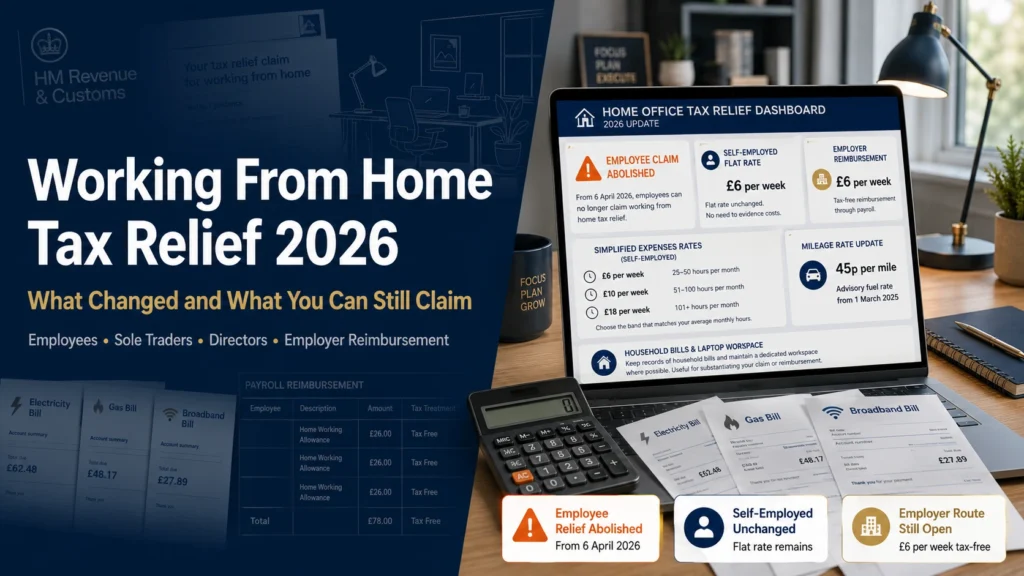
Until 5 April 2026, employees who were required to work from home could claim a flat rate of £6 per week directly from HMRC. That route has been completely closed from 6 April 2026. Self-employed workers, sole traders, and partnerships are entirely unaffected — their home working expenses remain fully claimable. This guide from Muhammad Bilal FCCA at Protax Consultants explains exactly who can claim what in 2026/27, what the alternatives are for employees, and the current rates for self-employed workers.
What Changed from 6 April 2026: The Abolition
The Autumn Budget 2025 announced the removal of the income tax deduction for non-reimbursed homeworking expenses. The Finance Act 2026 inserted section 360B into Chapter 11 of Part 4 ITEPA 2003 to explicitly disallow the deduction. HMRC’s stated reason: over half of the claims it reviewed were ineligible, indicating widespread non-compliance.
| Worker type | 2025/26 and earlier | 2026/27 onwards |
|---|---|---|
| Employee — voluntary WFH | Could claim during Covid years; restricted to contractually required from 2022 | Cannot claim anything from HMRC |
| Employee — contractually required WFH | Could claim £6/week flat rate or actual costs | Cannot claim — route abolished regardless of contract |
| Employee — employer reimburses costs | Reimbursement up to £6/week was tax-free | Still tax-free — employer exemption under s.316A unaffected |
| Sole trader / self-employed | Simplified expenses or actual costs — fully claimable | Unchanged — fully claimable |
| Company director (personal claim) | Could claim on Self Assessment | Cannot claim personally from 2026/27 |
| Company director (company pays) | Company could reimburse up to £6/week tax-free | Still available — company reimbursement route unaffected |
What Employees Can Still Do
1. Backdate Claims for Prior Tax Years — Act Now
The four-year backdating window still exists for years when you were eligible. For July 2026 onwards:
| Tax year | Claim deadline | Eligibility condition |
|---|---|---|
| 2022/23 | 5 April 2027 — deadline approaching | Contractually required to work from home |
| 2023/24 | 5 April 2028 | Contractually required to work from home |
| 2024/25 | 5 April 2029 | Contractually required to work from home |
| 2025/26 | 5 April 2030 | Contractually required to WFH — FINAL eligible year |
| 2026/27 onwards | No claim available | Relief abolished |
The 2022/23 deadline is 5 April 2027 — less than nine months from now. If you were required to work from home in 2022/23 and never claimed, this is time-sensitive. Claims are made via P87 form (under £2,500 total expenses) or Self Assessment. Protax can handle this as part of a Self Assessment service.
2. Ask Your Employer to Reimburse Your Costs
The section 316A ITEPA 2003 employer exemption is completely unaffected. An employer can pay up to £6 per week (£26 per month) towards an employee’s additional home working costs with no income tax and no National Insurance for either party. No receipts required for the flat rate. Higher amounts can be paid tax-free with evidence of actual additional costs.
The April 2026 change shifts responsibility from individual HMRC claims to employer-managed reimbursement. Many employers are not yet aware of this. If your employer does not have a homeworking reimbursement policy, raise it now.
Script for your HR team: Ask whether the company has a homeworking expense policy. If not, point them to HMRC’s guidance on the section 316A exemption (GOV.UK — Expenses and benefits: working from home). A single payroll policy update can restore the full £312/year tax-free benefit across the workforce.
Self-Employed Sole Traders: Fully Unaffected — What You Can Claim
Simplified Expenses: HMRC Flat Rate by Hours
The simplified expenses flat rate for working from home is available to sole traders and partnerships (without corporate partners). You must work 25 or more hours per month from home to use it. The rate covers heating, lighting, electricity, and utilities — not phone or internet (claim the business proportion of those separately).
| Monthly hours worked from home | Flat rate | Annual equivalent |
|---|---|---|
| 25–50 hours | £10/month | £120/year |
| 51–100 hours | £18/month | £216/year |
| 101 hours or more | £26/month | £312/year |
These rates are HMRC-confirmed and unchanged for 2026/27. No receipts required. Keep a simple monthly log of home working hours. Under MTD for Income Tax (mandatory from April 2026 for income above £50,000), simplified expenses work seamlessly with quarterly digital updates.
Actual Costs Method
If your actual additional household costs exceed the flat rate, you can claim a proportionate share of genuine household expenses: heating, electricity, council tax, mortgage interest or rent, insurance, and water rates. The calculation apportions by rooms (how many rooms, how many used for business) and time (hours used for work versus personal use). For most sole traders, the flat rate is simpler and gives a comparable or better result.
What Is Not Covered
The simplified expenses flat rate does not cover phone or internet — claim the business proportion of actual bills separately. It also does not apply if a room is used exclusively for business and never for personal use; exclusive-use rooms may have Capital Gains Tax implications on property sale. Using rooms for mixed purposes (business during work hours, personal otherwise) avoids this.
Company Directors: What Changed
Directors are employees for employment tax purposes. From 6 April 2026, directors cannot make a personal claim on their Self Assessment return for non-reimbursed home working costs. Two routes remain open:
- Company reimbursement: The company can pay up to £6/week tax-free to the director under section 316A if there is a qualifying homeworking arrangement. This is a company expense and reduces corporation tax.
- Licence/rental agreement: A formal agreement where the company pays the director for use of a room as a home office remains technically available but is administratively complex and requires a genuine commercial arrangement. Specialist advice is needed.
Directors of one-person service companies face a high bar for the employer reimbursement route. HMRC requires an objective business necessity to work from home — for example, no client premises and no other available location. A director who simply prefers to work from home may not satisfy the test. Take specialist advice before paying a home working allowance through your company.
Mileage Rates 2026/27: Increased from April 2026
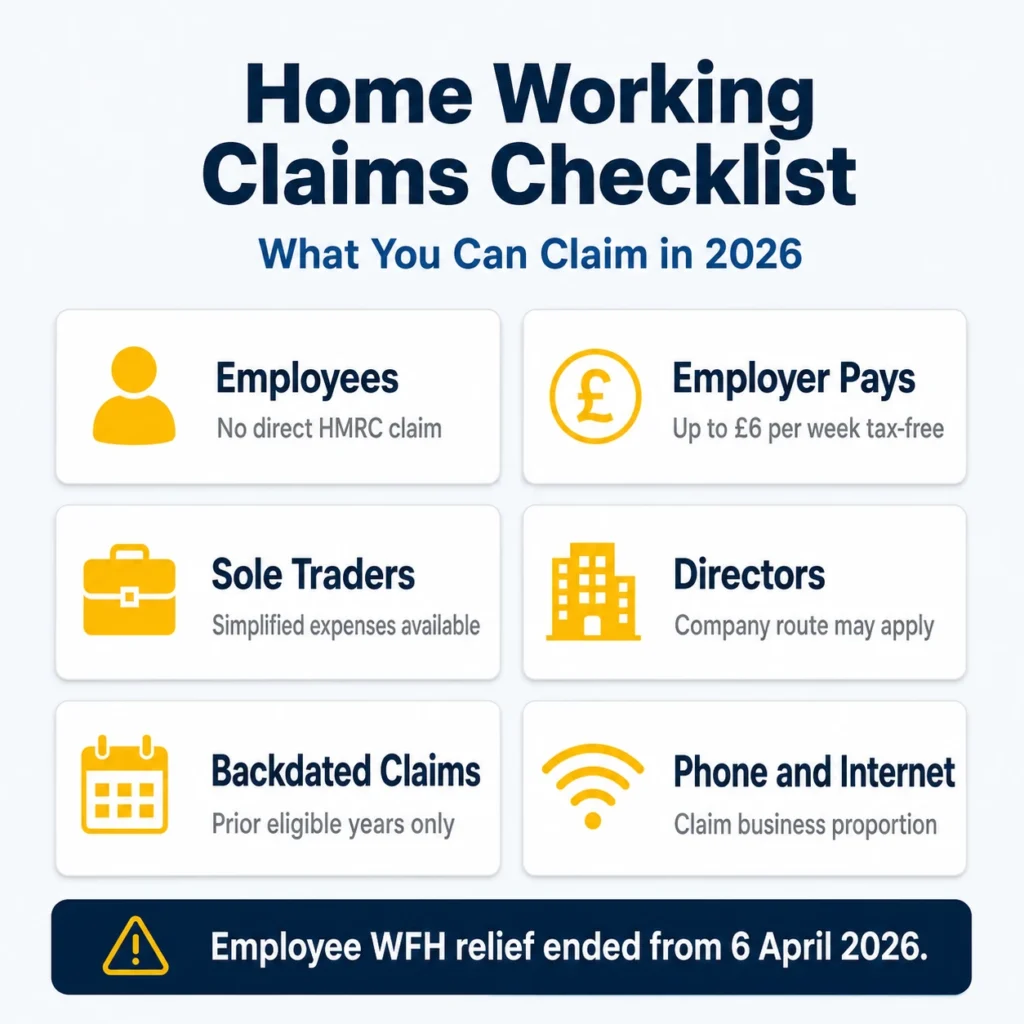
Separately from the WFH change, the approved mileage rate for cars and vans increased from 45p/mile to 55p/mile from 1 April 2026 — the first increase since 2012.
| Vehicle | First 10,000 business miles | Above 10,000 miles |
|---|---|---|
| Cars and vans | 55p/mile (from 1 April 2026) | 25p/mile |
| Motorcycles | 24p/mile | 24p/mile |
This applies to self-employed individuals claiming mileage on Self Assessment, employees receiving mileage from employers, and company directors claiming mileage from their company. The rate increase is confirmed by HMRC from 1 April 2026.
Quick Reference: Who Can Claim What in 2026/27
| Worker type | Home working claim 2026/27 |
|---|---|
| Employee (any WFH basis) | Nothing from HMRC directly — abolished |
| Employee — employer reimburses | Up to £6/week tax-free via employer exemption (s.316A) |
| Sole trader | Simplified expenses: £10/£18/£26 per month by hours, or actual costs |
| Partnership (no corporate partners) | Same as sole trader |
| Company director (personal claim) | Nothing from HMRC directly — abolished |
| Company director (company pays) | Up to £6/week from company if qualifying homeworking arrangement exists |
Protax Consultants: Self Assessment and Home Working Expenses
Working from home tax rules changed fundamentally in April 2026, and most online resources have not been updated. The Protax team in Wimbledon ensures London-based sole traders, company directors, and employees understand exactly what is claimable, handles Self Assessment returns with every legitimate deduction applied, and manages backdated claims for prior years. Visit our Self Assessment service or London accountants page. Fixed fee. Call 020 8545 7451.
Frequently Asked Questions
Can employees still claim working from home tax relief in 2026/27?
No. The employee working from home relief was abolished from 6 April 2026 by Finance Act 2026 (section 360B ITEPA 2003). Neither the £6/week flat rate nor actual cost claims are available directly from HMRC for 2026/27 onwards. You can backdate claims for prior eligible years (back to 2022/23), and your employer can reimburse up to £6/week tax-free under a separate employer exemption.
I work from home because my employer requires it — can I still claim?
Not from HMRC as an individual claim. From 6 April 2026 the abolition applies regardless of whether working from home is voluntary or contractually required. Your employer can still pay you up to £6/week tax-free under section 316A ITEPA 2003. Raise this with your HR or payroll team.
Does the 2026 change affect self-employed people?
No. Sole traders and partnerships are completely unaffected. Simplified expenses (£10/£18/£26 per month) and actual costs apportionment are both still available for 2026/27 and beyond.
What are the simplified expenses rates for working from home?
£10/month for 25–50 hours; £18/month for 51–100 hours; £26/month for 101 or more hours. These are HMRC-confirmed flat rates for sole traders. No receipts required. Phone and internet must be claimed separately based on actual business proportion.
Can I claim WFH tax relief for 2022/23?
Yes, if you were contractually required to work from home in 2022/23. The deadline for backdating the claim is 5 April 2027 — within nine months of this guide being written. Claims go on a P87 form or Self Assessment return. Act soon — this is the oldest claimable year and the deadline is approaching.

Muhammad Bilal is a Fellow Chartered Certified Accountant (FCCA) and Director of Protax Consultants, a London-based accounting firm specialising in tax advisory, compliance, and business accounting services.
Bilal qualified with the Association of Chartered Certified Accountants (ACCA) in 2009 and later achieved FCCA status after gaining extensive professional experience. With more than 13 years of experience in accounting, taxation, and auditing, he advises SMEs, landlords, contractors, and charities on tax planning, compliance, and financial management.
As a registered HMRC agent, Bilal assists clients with Self Assessment tax returns, corporation tax planning, VAT compliance, payroll services, and HMRC enquiries.
Bilal holds a BSc (Hons) in Applied Accounting and leads the audit and compliance function at Protax Consultants.
Company Verification:
Protax Consultants Ltd – Company Number 14701253
View Companies House Record