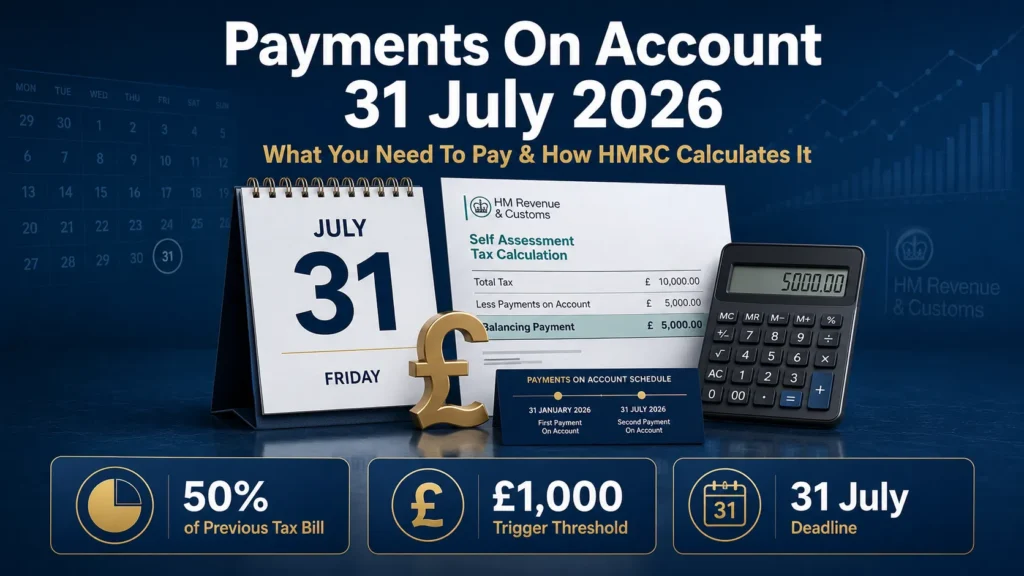
A practical UK guide to Self Assessment payments on account — what they are, how HMRC calculates them, the 31 July 2026 deadline, and exactly how to apply to reduce them if your income has dropped since last year.
If you file a Self Assessment tax return, there is a good chance you owe more to HMRC than just your annual tax bill. Payments on account are advance instalments toward next year’s bill that catch many self-employed people, landlords, and directors by surprise. The second instalment for the 2025/26 tax year is due on 31 July 2026. This guide explains exactly how the system works and what to do if the amount HMRC expects is too high.
What Are Payments on Account?
Payments on account are advance payments toward your next year’s Self Assessment tax bill. Rather than paying your entire tax liability in one lump sum in January, HMRC spreads the cost into two instalments paid throughout the year. Each instalment is 50% of your previous year’s Self Assessment tax bill, including both Income Tax and Class 4 National Insurance.
The system exists because HMRC cannot know in advance how much tax you will owe on income that has not yet been earned. Instead of waiting until you file your return to collect everything at once, HMRC collects advance instalments based on what you paid last year, then settles any difference with a balancing payment or refund once your return is filed.
Who Has to Make Payments on Account?
You must make payments on account if both of the following apply:
- Your Self Assessment tax bill for the previous year was more than £1,000
- Less than 80% of your tax was collected at source through PAYE, pension deductions, or similar
If either condition is not met, no payments on account are required, and your entire liability is paid by 31 January following the tax year. Payments on account typically apply to sole traders, freelancers, landlords, partners in partnerships, and limited company directors with significant dividend income.
When Are Payments on Account Due?
| Payment | Deadline | What It Covers |
|---|---|---|
| First payment on account for 2025/26 | 31 January 2026 | 50% of your 2024/25 Self Assessment bill — paid alongside the 2024/25 balancing payment |
| Second payment on account for 2025/26 | 31 July 2026 | The remaining 50% of your 2024/25 bill as an advance toward 2025/26 |
| Balancing payment for 2025/26 | 31 January 2027 | Any remaining tax owed after your two payments on account are deducted from your actual 2025/26 bill |
How Are Payments on Account Calculated? A Worked Example
Suppose your Self Assessment bill for 2024/25 was £6,000. HMRC assumes your 2025/26 income will be similar and calculates your payments on account as follows:
- First payment on account (31 January 2026): £3,000 (50% of £6,000)
- Second payment on account (31 July 2026): £3,000 (the other 50%)
- If your actual 2025/26 bill turns out to be £7,000: a balancing payment of £1,000 is due 31 January 2027
- If your actual 2025/26 bill turns out to be £5,000: HMRC owes you a refund of £1,000
⚠️ The January Bill Can Be Three Times What You Expect
The most common shock in Self Assessment is the January bill in the first year payments on account are triggered. You pay your entire balancing payment for the year just gone, plus the first 50% instalment for the year ahead, all in one go. On a £6,000 bill, that means paying £9,000 in January — the £6,000 balance plus £3,000 first instalment. Planning for this from the start of your self-employment is essential. Our Self Assessment service includes payment forecasting as standard.
How to Reduce Your Payments on Account
You can apply to reduce your payments on account if you genuinely expect your tax bill for the current year to be lower than last year. Common reasons for a reduction include a fall in business profits, loss of a client or contract, cessation of a rental property, or a significant drop in dividend income.
There are two ways to apply:
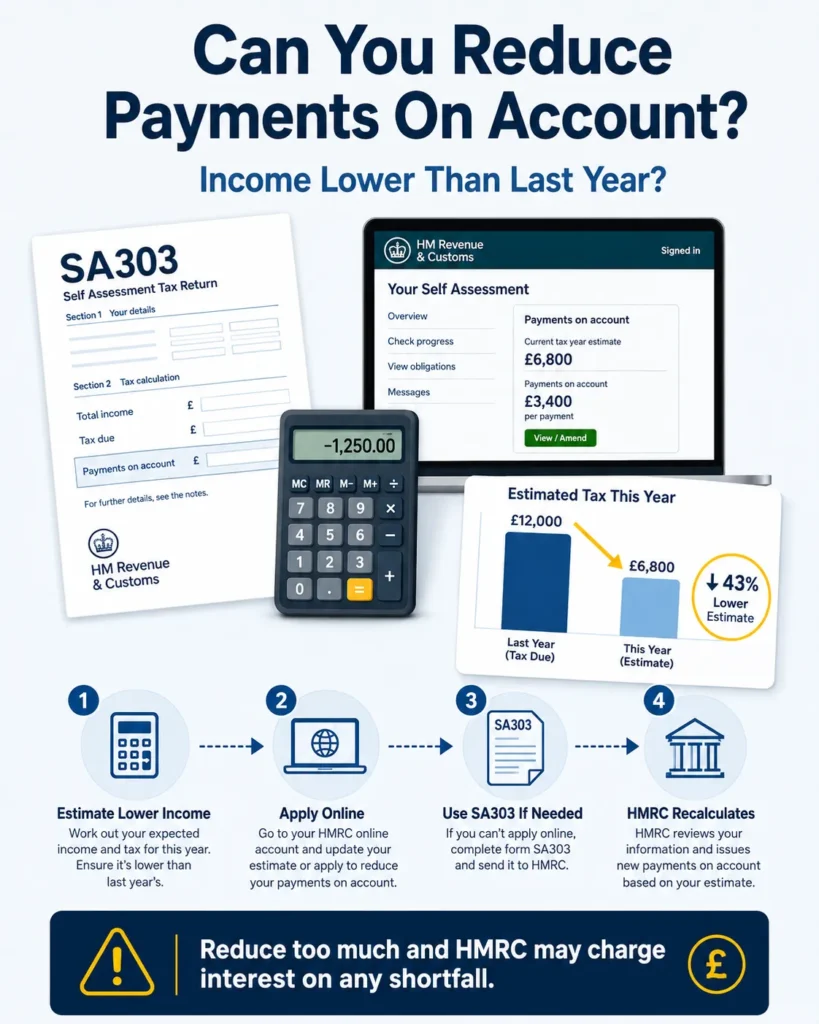
- Through your HMRC online account: Log into your Self Assessment account at GOV.UK and select the option to reduce your payments on account. You enter your estimate of your current year’s tax liability, and HMRC adjusts both instalments accordingly
- By post using form SA303: Complete and send form SA303 to HMRC with your revised estimate. This is slower and is now rarely necessary given the online option
The Risk of Reducing Too Much
Reducing your payments on account is legitimate, but it must be based on a genuine and reasonable estimate. If your final tax bill turns out to be higher than your revised estimate, HMRC will charge interest on the shortfall from the original payment due date. The interest rate HMRC charges on underpaid tax is currently 7.75% per year from 9 January 2026, although the rate can change, so under-estimating significantly is expensive.
There is no penalty for reducing in good faith if your estimate turns out to be wrong, but deliberately reducing to defer tax without reasonable grounds can attract HMRC scrutiny. Only reduce if you have a clear, documentable reason for believing your income will be lower.
What Happens If You Miss the 31 July Deadline?
HMRC charges interest from the day after the deadline on any unpaid amount. The late payment interest rate for unpaid Self Assessment tax is currently 7.75% per year from 9 January 2026, although HMRC interest rates can change. Late payment penalties also apply: 5% of the unpaid tax after 30 days, a further 5% after six months, and a further 5% after twelve months.
If you cannot afford to pay by 31 July, contact HMRC before the deadline and ask about a Time to Pay arrangement. HMRC will typically agree to spread the debt over a number of months if you engage proactively. Ignoring the deadline and waiting for HMRC to chase you results in a larger bill once interest and penalties are added.
Payments on Account vs Balancing Payment: What Is the Difference?
| Payment Type | What It Is | When It Is Due |
|---|---|---|
| First payment on account | 50% of previous year’s tax bill, paid as an advance toward the current year | 31 January (during the current tax year) |
| Second payment on account | The remaining 50% advance payment | 31 July (during the current tax year) |
| Balancing payment | The difference between your actual tax bill and the two advance payments made. Due if you owe more than you paid on account | 31 January (after the tax year ends) |
| Repayment | HMRC repays you the excess if your actual bill is less than your payments on account | After your return is filed and processed |
ℹ️ Filing Early Reduces the July Surprise
The earlier you file your 2025/26 Self Assessment return, the sooner you know your actual tax liability and whether a reduction in the July payment is justified. Filing in June or early July rather than waiting until January means you can adjust your payment on account with confidence based on real figures rather than an estimate. Our Self Assessment service includes year-round filing, not just January submissions.
31 July Deadline Approaching — Need Help With Your Return?
Our Self Assessment service includes payment on account forecasting, early filing, and advice on whether a reduction is justified based on your actual 2025/26 figures. Fixed fee, filed on time.
View Self Assessment ServiceFrequently Asked Questions
What are payments on account in Self Assessment?
Payments on account are advance tax payments toward your next year’s Self Assessment bill. Each payment is 50% of the previous year’s total tax and Class 4 NIC liability. They are due on 31 January and 31 July each year. If your actual bill turns out to be higher than your two advance payments, a balancing payment is due the following 31 January. If it is lower, HMRC refunds the difference after you file your return.
Do I have to make payments on account?
Yes, if your Self Assessment tax bill for the previous year exceeded £1,000 and less than 80% of your tax was deducted at source. If your bill was below £1,000, or if most of your tax is already collected through PAYE (for example, as an employee with a small rental income), payments on account may not be required. HMRC will tell you whether payments on account are due on your Self Assessment statement.
How do I reduce my payments on account?
Log into your HMRC Self Assessment online account and submit a revised estimate of your current year’s tax liability. HMRC will recalculate your payments on account based on your estimate. You can also use form SA303 by post. Only reduce if you have a genuine, documentable reason for expecting your income to be lower than last year. If your actual bill turns out higher than your estimate, HMRC charges interest on the shortfall from the original payment due date.
What happens if I miss the 31 July payment on account deadline?
HMRC charges interest from 1 August on any unpaid amount. The current HMRC late payment interest rate is 7.75% per year from 9 January 2026, although the rate can change. A 5% late payment penalty on the unpaid amount is added after 30 days. If you cannot pay in full, contact HMRC before the deadline to arrange a Time to Pay agreement. Do not ignore the deadline as interest and penalties accumulate quickly.
Do payments on account include National Insurance?
Yes. Payments on account cover both Income Tax and Class 4 National Insurance Contributions owed through Self Assessment. Class 2 NIC, where applicable, is also collected through Self Assessment but is treated separately. The 50% calculation is based on the total Self Assessment liability including both Income Tax and Class 4 NIC from the previous year.

Muhammad Bilal is a Fellow Chartered Certified Accountant (FCCA) and Director of Protax Consultants, a London-based accounting firm specialising in tax advisory, compliance, and business accounting services.
Bilal qualified with the Association of Chartered Certified Accountants (ACCA) in 2009 and later achieved FCCA status after gaining extensive professional experience. With more than 13 years of experience in accounting, taxation, and auditing, he advises SMEs, landlords, contractors, and charities on tax planning, compliance, and financial management.
As a registered HMRC agent, Bilal assists clients with Self Assessment tax returns, corporation tax planning, VAT compliance, payroll services, and HMRC enquiries.
Bilal holds a BSc (Hons) in Applied Accounting and leads the audit and compliance function at Protax Consultants.
Company Verification:
Protax Consultants Ltd – Company Number 14701253
View Companies House Record