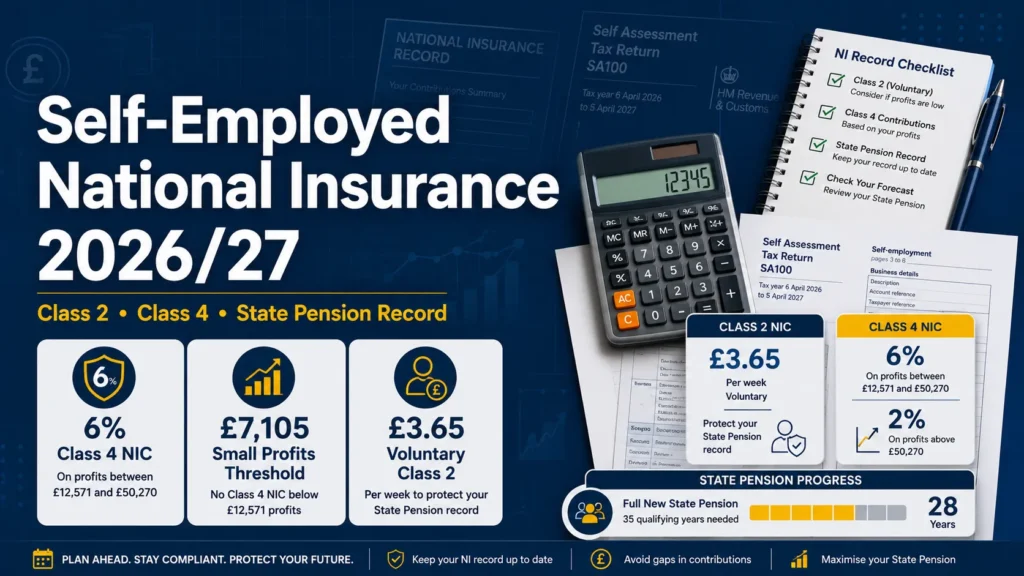
A complete 2026/27 guide for UK sole traders, freelancers, and self-employed people covering Class 2 and Class 4 National Insurance — what you owe, when you pay it, the Small Profits Threshold, and how your NI record affects your State Pension.
Self-employed National Insurance is one of the most misunderstood parts of the UK tax system. The rules changed significantly from April 2024 when mandatory Class 2 NIC was abolished, and many self-employed people filing their returns for the first time since then are unsure what they owe, what is now automatic, and what they need to do to protect their State Pension record. This guide explains the current position clearly.
How Self-Employed National Insurance Works in 2026/27
If you are self-employed in the UK, you pay two types of National Insurance on your business profits: Class 2 and Class 4. Both are reported and collected through your Self Assessment tax return, alongside your Income Tax. You do not pay them separately — they form part of your annual tax bill due on 31 January, with any payments on account due in January and July.
Class 4 NIC: The Main Self-Employed National Insurance Charge
Class 4 NIC is a percentage-based charge on your annual self-employed profits. It is the main National Insurance cost for most self-employed people and is calculated as part of your Self Assessment return.
| Profit Level | Class 4 NIC Rate 2026/27 |
|---|---|
| Below £12,570 (Lower Profits Limit) | 0% — no Class 4 NIC payable |
| £12,570 to £50,270 | 6% |
| Above £50,270 | 2% |
Class 4 NIC is calculated on your net profits after allowable business expenses. The thresholds are the same as the Income Tax personal allowance and higher rate threshold, so they align with your income tax calculation. Both are worked out on your Self Assessment return simultaneously.
Class 4 NIC Worked Example
A freelance consultant with net profits of £40,000 in 2026/27:
- Profits above Lower Profits Limit: £40,000 – £12,570 = £27,430
- Class 4 NIC at 6%: £27,430 × 6% = £1,645.80
- No Class 4 NIC above £50,270 applies (profits below that threshold)
Class 2 NIC: What Changed From April 2024
Class 2 NIC was historically a flat weekly charge paid by all self-employed people. From 6 April 2024, mandatory Class 2 NIC was abolished. The way it now works is:
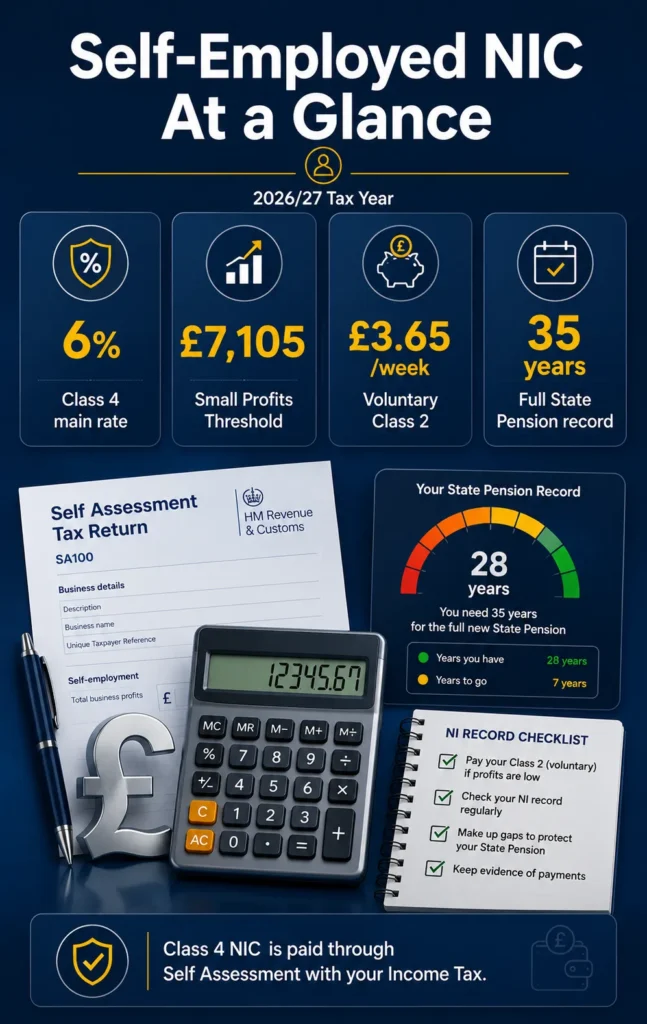
- If your profits are above the Small Profits Threshold (£7,105 in 2026/27), Class 2 NIC is treated as paid automatically. You do not pay anything and you still receive a qualifying year toward your State Pension and other contributory benefits
- If your profits are below £7,105, Class 2 NIC is not automatically credited. You can choose to pay voluntary Class 2 NIC at £3.65 per week (2026/27) to protect your State Pension entitlement and access to contributory benefits
ℹ️ No Class 2 on Your Return? That Is Normal
Many self-employed people filing their 2024/25 or 2025/26 return for the first time since the reform have noticed there is no Class 2 charge showing on their calculation. This is not an error. If your profits exceed the Small Profits Threshold, Class 2 is treated as paid and you receive your qualifying year automatically. Nothing further is required.
The Small Profits Threshold and State Pension
The Small Profits Threshold (SPT) for 2026/27 is £7,105. This was £6,845 in 2025/26. The threshold determines whether Class 2 NIC is automatically credited to your NI record:
| Profit Level | Class 2 Position | State Pension Qualifying Year? |
|---|---|---|
| Above £7,105 (SPT) | Treated as paid automatically — nothing to pay | Yes — qualifying year credited automatically |
| £0 to £7,104 (below SPT) | Not automatically credited. Can pay voluntarily at £3.65/week | Only if you pay voluntary Class 2 or Class 3 |
The State Pension requires 35 qualifying years for the full new State Pension where your National Insurance record started after April 2016. The full new State Pension is £241.30 per week in 2026/27. A minimum of 10 qualifying years is needed to receive any State Pension at all. Each year below the SPT where you do not pay voluntary Class 2 is a gap in your NI record. Voluntary Class 2 at £3.65 per week (around £189.80 per year) is one of the most cost-effective ways to buy a qualifying year, compared to the alternative of Class 3 NIC at £18.40 per week.
All Self-Employed NIC Rates at a Glance: 2026/27
| NIC Class | Who Pays | Rate / Amount 2026/27 | How Paid |
|---|---|---|---|
| Class 2 (mandatory) | Nobody — abolished from April 2024 | Not applicable | n/a |
| Class 2 (voluntary) | Self-employed with profits below £7,105 | £3.65 per week | Via Self Assessment |
| Class 4 (main rate) | Self-employed with profits above £12,570 | 6% on profits £12,570 to £50,270 | Via Self Assessment |
| Class 4 (upper rate) | Self-employed with profits above £50,270 | 2% on profits above £50,270 | Via Self Assessment |
| Class 3 (voluntary) | Anyone filling NI record gaps | £18.40 per week | Direct to HMRC |
Self-Employed NIC if You Are Also Employed
If you are both employed and self-employed, you pay Class 1 employee NIC on your employment earnings and Class 4 NIC on your self-employed profits. There is a maximum NIC limit to prevent you from overpaying. If the combined NIC liability across both income sources exceeds the maximum annual charge, HMRC will apply a deferment or repayment. The limit is complex to calculate and is usually handled automatically through your Self Assessment return.
How to Check Your NI Record
You can check your NI record, see how many qualifying years you have, and identify any gaps through your personal tax account on GOV.UK. It shows your qualifying years to date and an estimate of your State Pension at current contribution levels. If you have gaps in years before 2019/20, there is currently a limited window to pay voluntary contributions to fill those gaps — take advice before that window closes.
⚠️ Class 4 NIC Is Included in Your Payments on Account
Class 4 NIC is included in the total Self Assessment liability used to calculate your payments on account. This means your 31 January and 31 July advance payments cover both Income Tax and Class 4 NIC together. If your profits rise significantly in a year, your payments on account for the following year will also rise to reflect the higher combined liability. Planning ahead for both tax and NIC together is essential.
Unsure What NIC You Owe as a Sole Trader?
Our Self Assessment service calculates your Income Tax and Class 4 NIC together, checks your NI record, advises on voluntary Class 2 where relevant, and ensures your return is filed correctly and on time. Fixed fee.
View Self Assessment ServiceFrequently Asked Questions
Do self-employed people still pay Class 2 NIC?
Mandatory Class 2 NIC was abolished from 6 April 2024. If your profits exceed the Small Profits Threshold (£7,105 in 2026/27), Class 2 is treated as paid automatically and you receive a qualifying year toward your State Pension without paying anything. If your profits are below £7,105, Class 2 is not automatically credited — you can choose to pay voluntary Class 2 at £3.65 per week to protect your NI record.
What is the Class 4 NIC rate for 2026/27?
The Class 4 NIC rate for 2026/27 is 6% on self-employed profits between £12,570 and £50,270, and 2% on profits above £50,270. Class 4 NIC is calculated on your annual net profit through Self Assessment and is paid alongside your Income Tax. If your profits are below £12,570, no Class 4 NIC is payable.
What is the Small Profits Threshold for 2026/27?
The Small Profits Threshold for 2026/27 is £7,105. This is the profit level above which Class 2 NIC is treated as paid automatically. If your profits fall below £7,105, Class 2 is not credited and you would need to pay voluntary Class 2 NIC at £3.65 per week if you want that year to count toward your State Pension. The threshold was £6,845 in 2025/26.
How does self-employed NIC affect my State Pension?
The full new State Pension requires 35 qualifying years of NI contributions or credits. For self-employed people, a qualifying year is earned automatically if your profits exceed the Small Profits Threshold (£7,105 in 2026/27). If your profits fall below this level, no qualifying year is earned unless you pay voluntary Class 2 NIC at £3.65 per week. You can check your NI record and current State Pension estimate through your personal tax account on GOV.UK.
Is Class 4 NIC included in my payments on account?
Yes. Payments on account are based on your total Self Assessment liability, which includes both Income Tax and Class 4 NIC. This means your advance payments on 31 January and 31 July cover both taxes together. Voluntary Class 2 NIC, where applicable, is also collected through Self Assessment but is generally not included in the payments on account calculation.

Muhammad Bilal is a Fellow Chartered Certified Accountant (FCCA) and Director of Protax Consultants, a London-based accounting firm specialising in tax advisory, compliance, and business accounting services.
Bilal qualified with the Association of Chartered Certified Accountants (ACCA) in 2009 and later achieved FCCA status after gaining extensive professional experience. With more than 13 years of experience in accounting, taxation, and auditing, he advises SMEs, landlords, contractors, and charities on tax planning, compliance, and financial management.
As a registered HMRC agent, Bilal assists clients with Self Assessment tax returns, corporation tax planning, VAT compliance, payroll services, and HMRC enquiries.
Bilal holds a BSc (Hons) in Applied Accounting and leads the audit and compliance function at Protax Consultants.
Company Verification:
Protax Consultants Ltd – Company Number 14701253
View Companies House Record