
If you are a director of your own limited company, you can take up to £300 a year out of the company in small gifts without paying any tax or National Insurance on them, provided no single gift costs more than £50. The company gets the Corporation Tax deduction as well.
It is one of the few genuinely simple reliefs in the tax system. It is also one of the easiest to get wrong, because going a single pound over £50 makes the whole gift taxable rather than just the excess.
What is the trivial benefits exemption?
The trivial benefits exemption lets a company give an employee or director a small non-cash benefit without it being taxed as a benefit in kind. There is nothing to report on a P11D, no Class 1A National Insurance for the company, and no income tax for the recipient.
For ordinary employees, there is no annual limit on how many trivial benefits they can receive, only the £50 cap per benefit. For directors and other office holders of a close company, there is an additional £300 cap for the tax year. Most owner-managed UK companies are close companies, broadly those controlled by five or fewer participators or by their directors, so if you run your own company you should assume the £300 cap applies to you.
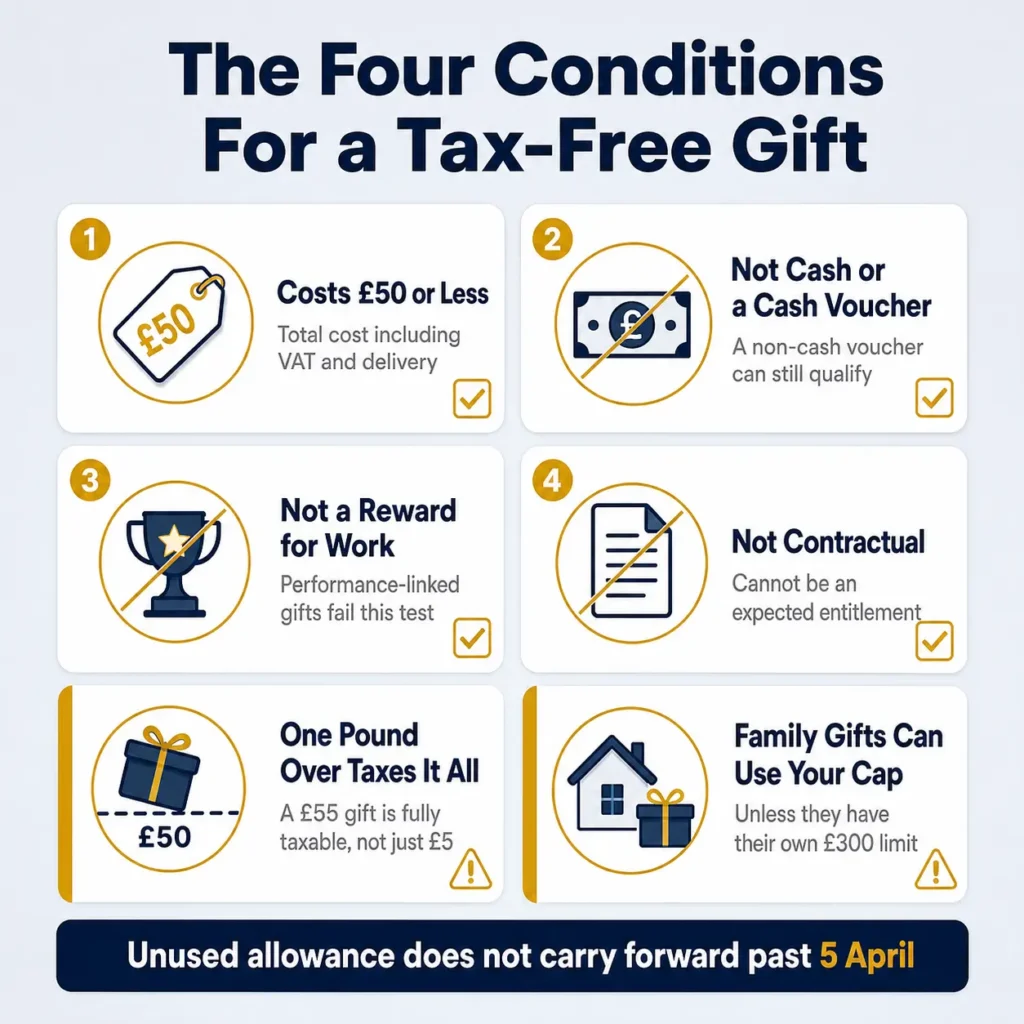
The four conditions
A benefit qualifies only if it meets all four:
- It costs £50 or less. This is the total cost to the company, including VAT and any delivery charge.
- It is not cash or a cash voucher. A non-cash voucher can qualify, but only if it cannot be exchanged for cash.
- It is not a reward for work or performance. A gift tied to hitting a target, winning work or doing a good job is earnings, not a trivial benefit.
- It is not part of the employment contract. Anything contractual, or that has become an expected entitlement, falls outside the exemption.
Fail any one of them and the benefit is taxable in the normal way. Our P11D and benefits in kind guide covers what happens to a benefit that does not qualify.
How the £300 cap works in practice
The £300 is an annual total for the tax year, which runs from 6 April to 5 April. It is not per gift, and it does not roll over.
| Gift | Cost | Running total | Qualifies |
| Birthday flowers | £35 | £35 | Yes |
| Christmas hamper | £45 | £80 | Yes |
| Store gift card, not exchangeable for cash | £40 | £120 | Yes |
| Bottle of wine for an anniversary | £25 | £145 | Yes |
| Restaurant meal | £50 | £195 | Yes, exactly at the limit |
| Theatre tickets | £50 | £245 | Yes |
| Hamper in March | £45 | £290 | Yes |
| A further £50 gift | £50 | £340 | No, it breaches the £300 cap |
Six £50 gifts take you to the cap exactly. Anything beyond £300 in the tax year is taxable.
Two directors, two caps
If your spouse or partner is also a director or employee of the company, they have their own £300 cap. The cap applies per individual, per employer, so a two-director company can support £600 of trivial benefits across the two of you. The gifts must genuinely be to each person, and each one still has to clear the £50 test on its own.
Three rules that catch people out
Going over £50 taxes the whole gift, not the excess
A £55 gift does not give you £50 tax-free and £5 taxable. The entire £55 becomes a taxable benefit. This is the most common and most expensive misunderstanding, and it means a gift should be chosen with a margin rather than aimed at exactly £50.
VAT and delivery count towards the £50
The test is the total cost to the company. A £42 gift with £9 delivery costs £51 and fails. So does a £45 item where the invoice shows £45 plus VAT. Check the invoice total, not the ticket price.
Gifts to your family can use up your allowance
If the company gives a benefit to a member of your family or household, it can count towards your £300 cap rather than being ignored. The exception is where that person is taxed on the benefit in their own right as an employee or office holder of the same company. In a family company, it is worth being deliberate about whose cap each gift belongs to.
What qualifies and what does not
| Benefit | Qualifies | Why |
| £35 birthday flowers | Yes | Under £50, non-cash, not a reward |
| £45 Christmas hamper | Yes | Under £50, non-cash, seasonal gesture |
| £40 non-cash gift card | Yes | Cannot be exchanged for cash |
| £25 bottle of wine | Yes | Under £50, personal occasion |
| £55 meal | No | Over £50, so the full £55 is taxable |
| £40 cash bonus | No | Cash is never a trivial benefit |
| £30 gift for hitting a sales target | No | A reward for performance |
| £42 gift plus £9 delivery | No | Total cost is £51 |
| £40 monthly lunch allowance | Usually no | Becomes expected, so it is treated as contractual |
How this differs from the Christmas party exemption
These are two separate exemptions, and you can use both in the same year.
The annual function exemption covers staff events such as a Christmas party and has its own, much larger limit. Spending under that exemption does not count towards your £300 trivial benefits cap. The rules and the limit are set out in our guide to tax-free staff Christmas parties.
So a director can hold a qualifying company event and separately take up to £300 of trivial benefits in the same tax year.
Using the allowance before 5 April 2027
The cap runs with the tax year, not your company’s accounting period. Whatever is unused at 5 April 2027 is gone, and nothing carries forward.
If you have not used any of it this year, you have until 5 April 2027 to take up to £300 in qualifying gifts. A few practical points:
- Keep the invoices. The company needs to show the cost of each benefit, including VAT and delivery, to evidence that each one was £50 or less.
- Spread the gifts. A run of identical monthly payments starts to look contractual or like earnings. Occasional gifts tied to real occasions sit far more comfortably within the exemption.
- Do not label it a bonus. Anything described as a reward for the year’s work fails the third condition.
- Record whose cap it belongs to if gifts go to family members who also work in the company.
Trivial benefits are a small part of a bigger question, which is how you take money out of your company in the first place. We model the salary, dividend and benefits mix as part of our director salary and dividend service, and the current rates are in our director salary and dividend guide.
Frequently asked questions
How much can a director take in trivial benefits?
Up to £300 in a tax year if you are a director or office holder of a close company, made up of individual benefits of £50 or less. Employees who are not directors of a close company have no annual cap, only the £50 limit per benefit.
Is the £50 limit per gift or per year?
Per gift. The £300 is the annual total for directors of close companies.
What happens if a gift costs more than £50?
The whole gift becomes a taxable benefit, not just the amount over £50. A £55 gift is taxable on the full £55.
Does VAT count towards the £50 limit?
Yes. The £50 test is the total cost to the company, including VAT and any delivery charge.
Can I give myself a cash bonus as a trivial benefit?
No. Cash and cash vouchers are excluded. A non-cash voucher can qualify if it cannot be exchanged for cash.
Can my spouse also claim £300?
If your spouse or partner is a director or employee of the same company, they have their own £300 cap. If they are not, benefits given to them can count towards your cap instead.
Do trivial benefits go on a P11D?
No. A qualifying trivial benefit does not need to be reported on a P11D and attracts no Class 1A National Insurance for the company.
Can the company claim Corporation Tax relief on trivial benefits?
The cost is generally an allowable business expense, so the company gets the deduction while the benefit stays tax-free for you. We can confirm the treatment for your own company.
Did the Autumn Budget 2026 change the trivial benefits rules?
No. The £50 limit and the £300 director cap are unchanged for 2026/27.
Does the £300 cap run with my company year end?
No. It runs with the tax year, from 6 April to 5 April, regardless of your company’s accounting date.
Make sure you are taking money out of your company efficiently
£300 of trivial benefits is worth having, but it is a rounding error next to getting your salary and dividend split right. If you are not confident the way you pay yourself is the most efficient available, that is the conversation worth having.
Protax Consultants is led by Muhammad Bilal FCCA and holds ACCA audit registration 5743262. We are based in Wimbledon and support company directors across London and the UK, with fees agreed before work begins.

Muhammad Bilal is a Fellow Chartered Certified Accountant (FCCA) and Director of Protax Consultants, a London-based accounting firm specialising in tax advisory, compliance, and business accounting services.
Bilal qualified with the Association of Chartered Certified Accountants (ACCA) in 2009 and later achieved FCCA status after gaining extensive professional experience. With more than 13 years of experience in accounting, taxation, and auditing, he advises SMEs, landlords, contractors, and charities on tax planning, compliance, and financial management.
As a registered HMRC agent, Bilal assists clients with Self Assessment tax returns, corporation tax planning, VAT compliance, payroll services, and HMRC enquiries.
Bilal holds a BSc (Hons) in Applied Accounting and leads the audit and compliance function at Protax Consultants.
Company Verification:
Protax Consultants Ltd – Company Number 14701253
View Companies House Record