The winter cash-flow squeeze is the most predictable crisis in a small business year, and it still catches people out. Between late November and the end of January a London SME typically pays December payroll early, loses two working weeks to the shutdown, waits longer than usual to be paid, and then meets a Self Assessment bill on 31 January.
None of that is a surprise. All of it is survivable with a forecast and a firmer line on collections. This guide covers what to model, how to use the 11.75% statutory interest rate you are probably not charging, and what to do if the January bill is the part that will not fit.
Why winter is the tightest quarter for small business cash flow
Four things land at once:
- Payroll moves earlier. Most businesses pay December wages before Christmas, pulling an outflow forward by a week or more while inflows stop.
- Your customers go quiet. Finance departments close. An invoice sent on 18 December may not be looked at until the second week of January, whatever the terms say.
- Trading splits. Retail and hospitality peak; professional services, construction and B2B suppliers often see December and January billing fall away.
- Tax clusters. The 31 January Self Assessment payment, a payment on account, and a quarterly VAT return can all fall within weeks of each other.
The combination, not any single item, is what causes the problem.
How to build a 13-week cash flow forecast
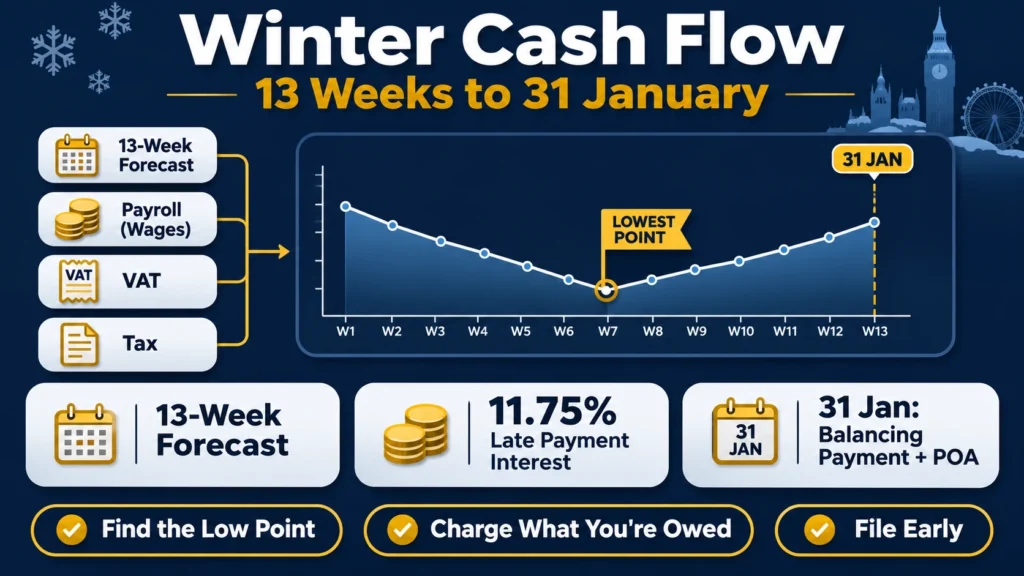
A monthly profit and loss will not show you a mid-January gap. A weekly cash forecast will. Thirteen weeks is the right horizon because it reaches past 31 January without becoming guesswork.
Model, week by week:
- Opening bank balance.
- Receipts, dated when you realistically expect them, not when terms say. If a customer habitually pays at 45 days, model 45 days.
- Payroll, including the early December run, plus PAYE and National Insurance on their own due dates.
- Rent, and whether a quarterly payment falls in the period.
- VAT, on its actual filing and payment date.
- The 31 January tax payment, including any payment on account.
- Supplier payments, split into what must be paid on time and what has flexibility.
Then look for the lowest point. That single number, and the week it falls in, is the only output that matters. If it is negative, you now have about eight weeks to fix it, which is enough time to act calmly.
If your records are not current enough to build this, that is the first job rather than the forecast. Our bookkeeping service keeps the underlying data in a state where a forecast takes minutes instead of a weekend.
Late payment interest: what you can charge in the UK
Most small businesses never charge late payment interest, and most assume they would need it written into a contract. They do not. Under the Late Payment of Commercial Debts (Interest) Act 1998 the right is automatic on business-to-business debts, whether or not your invoice mentions it.
How much late payment interest can you charge?
Statutory interest is the Bank of England base rate plus 8 percentage points. The base rate was 3.75% on both 31 December 2025 and 30 June 2026, which makes the rate 11.75% for any invoice that became overdue during 2026.
The rate is fixed by the base rate in force on the 30 June or 31 December before the invoice fell overdue, and it then stays at that level for the whole overdue period even if the base rate moves afterwards.
That matters this winter. The Bank of England raised the base rate to 4.00% in early November 2026, its first rise in more than three years. Invoices already overdue keep the 11.75% rate. For invoices falling overdue on or after 1 January 2027, the reference point is the base rate in force on 31 December 2026, so on a 4.00% base rate the statutory rate would be 12.00%. That is not settled until 31 December, so confirm it before you quote a figure in January.
How to calculate late payment interest
Statutory interest is simple interest, not compound, and it is calculated on the VAT-inclusive invoice value:
Interest = invoice value including VAT × 11.75% × (days overdue ÷ 365)
So an £8,000 invoice paid 60 days late earns £8,000 × 11.75% × 60 ÷ 365, which is £154.52 in interest. Add the £70 fixed compensation for an invoice in that band and you can recover £224.52 on top of the invoice itself.
Swap in 12.00% for invoices falling overdue on or after 1 January 2027, if the base rate holds at 4.00%.
Fixed compensation for late payment
Every overdue invoice also carries a fixed sum, automatically, without needing to be stated anywhere:
| Invoice value | Fixed compensation |
|---|---|
| Under £1,000 | £40 |
| £1,000 to £9,999.99 | £70 |
| £10,000 or more | £100 |
You can also recover reasonable, evidenced debt recovery costs beyond that, such as solicitor letters, court fees or collection agency charges.
When late payment interest starts running
The day after the agreed payment date. Where no payment date was agreed, 30 days after the later of delivery of the invoice or delivery of the goods or services.
How to use late payment interest to get paid faster
The point is rarely to collect the interest. It is to change the conversation. An £8,000 invoice 60 days overdue carries roughly £155 of interest plus £70 compensation. Naming that figure in a polite email, with the statutory basis, moves you up a payment run far more reliably than a fourth reminder. Reserve it for genuine problem payers rather than applying it across the board, because for good customers the relationship is worth more than the interest.
December invoicing: bill before the Christmas shutdown
Timing beats chasing in December. Three practical moves:
- Bring forward your December billing run. Invoice by the first week of December where the work allows, so it clears approval before finance teams close.
- Confirm who signs off, and when they leave. A named approver and their last working day is worth more than a payment term.
- Stage or deposit new winter work. For anything starting in December or January, take a deposit or bill in stages. It costs nothing to ask and it changes your January profile.
Your January tax bill: what it actually costs
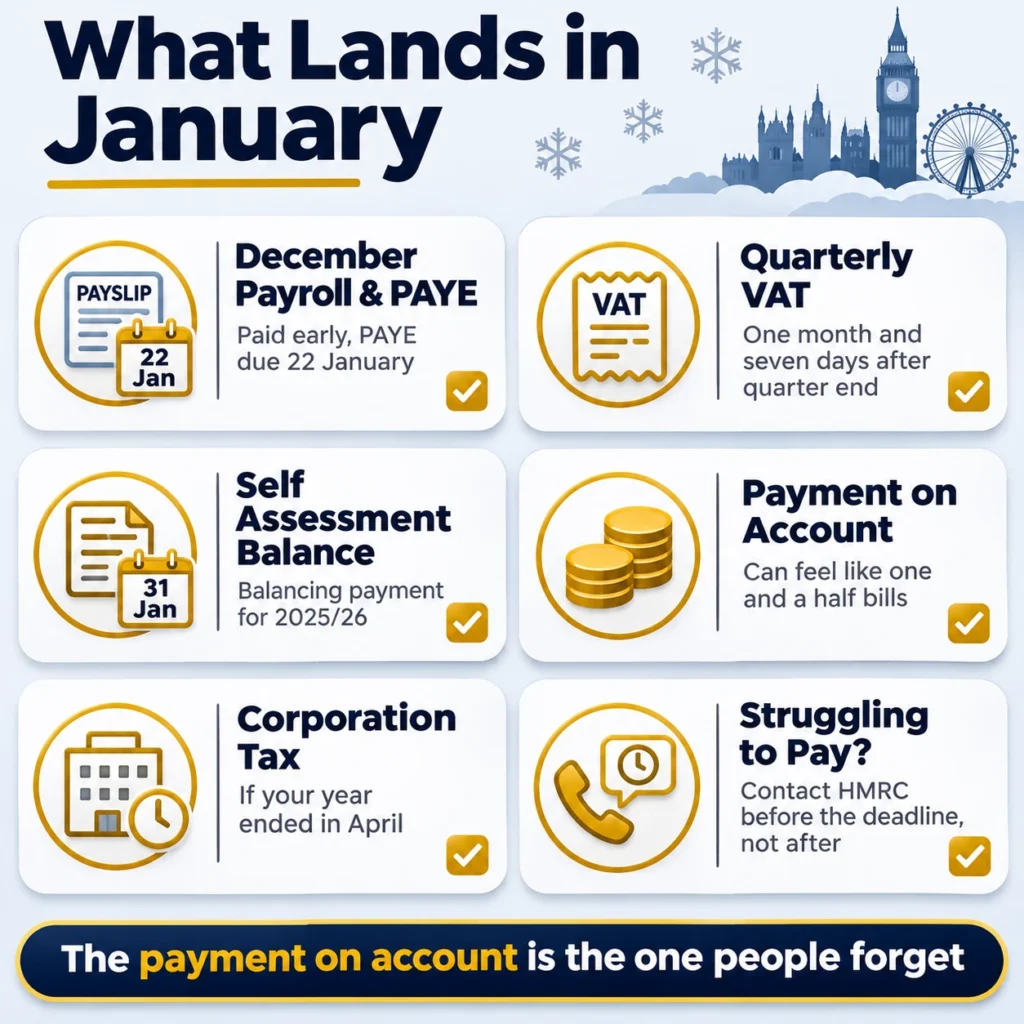
List the fixed obligations before you plan anything discretionary:
| Outgoing | Typical timing |
|---|---|
| December payroll, plus PAYE and National Insurance | Paid early, PAYE due 22 January |
| Quarterly VAT return and payment | One month and seven days after the quarter end |
| Self Assessment balancing payment for 2025/26 | 31 January 2027 |
| First payment on account for 2026/27 | 31 January 2027 |
| Corporation Tax, if your year ended in April | Nine months and one day after the year end |
The payment on account is the item people forget. It can effectively add half of last year’s liability again on the same day as the balancing payment. Our guide to payments on account explains how it is calculated, and if your income has fallen it can sometimes be reduced.
Filing your return early is also worth doing for cash-flow reasons alone. It does not bring the payment date forward, but it tells you the number in November rather than late January. Our Self Assessment service covers the 2025/26 return.
If you cannot pay the January tax bill in full
If the forecast shows you cannot meet the 31 January payment, contact HMRC before the deadline rather than after it. A Time to Pay arrangement spreads the liability over instalments, and approaching HMRC early is treated very differently from going quiet and being chased. Interest still runs, but late payment penalties can often be avoided. We will cover Time to Pay in detail in a separate article.
Business costs rising in 2027 to plan for now
Two items from the Autumn Budget on 28 October 2026 belong in a forecast that runs past this winter:
- National Minimum Wage and National Living Wage increases were confirmed, which raises payroll from April.
- Business rates relief in England improves from April 2027, with the small business rate relief threshold rising to £18,000 rateable value and a further 70,000 businesses taken out of business rates.
VAT on domestic electricity also stays at 0% until 30 June 2027, and fuel duty remains frozen.
Cash flow and late payment: frequently asked questions
What interest can I charge on a late invoice in the UK?
For business-to-business debts, statutory interest is the Bank of England base rate plus 8 percentage points. For invoices that became overdue during 2026, that is 11.75%, plus fixed compensation of £40, £70, or £100 depending on the invoice value. For invoices falling overdue from 1 January 2027, the rate is set by the base rate in force on 31 December 2026, which, on a 4.00% base rate, would make it 12.00%.
Do I need late payment terms in my contract to charge interest?
No. The right arises automatically under the Late Payment of Commercial Debts (Interest) Act 1998 for business-to-business debts, whether or not your invoice or contract mentions it.
When does late payment interest start running?
The day after the agreed payment date. If no date was agreed, 30 days after the later of the invoice being delivered or the goods or services being supplied.
How far ahead should a cash-flow forecast run?
Weekly for 13 weeks. That reaches past 31 January while the assumptions are still realistic.
Why is my January tax bill so much bigger than I expected?
Most likely a payment on account. The balancing payment for the previous tax year and the first payment on account for the current one both fall due on 31 January, which can feel like being charged one and a half times.
Can I spread my January tax bill?
Possibly, through an HMRC Time to Pay arrangement. Approach HMRC before the deadline rather than after it.
Can I claim my costs of chasing a debt?
Yes. On top of statutory interest and fixed compensation, you can recover reasonable, evidenced recovery costs, provided they are proportionate to the debt.
Get your cash flow forecast built by an accountant
A 13-week forecast is only as good as the records behind it. If yours are not current, or you would rather have someone build the forecast and tell you where the low point falls, that is a short piece of work with a clear answer at the end.
Protax Consultants is led by Muhammad Bilal FCCA and holds ACCA audit registration 5743262. We are based in Wimbledon and work with SMEs across London and the UK. Fees are agreed before work begins.
See our small business accounting services and our VAT returns service.
Sources:
- Alto Accounting, UK late payment interest rate 2026, for the 11.75% rate and the 30 June and 31 December reference dates
- MarketInvoice, Late Payment of Commercial Debts Act UK, for the compensation bands, the 30-day default and recoverable recovery costs
- Moneyfacts, Bank of England base rate November 2026, for the rise from 3.75% to 4.00% and that it was the first increase in more than three years

Muhammad Bilal is a Fellow Chartered Certified Accountant (FCCA) and Director of Protax Consultants, a London-based accounting firm specialising in tax advisory, compliance, and business accounting services.
Bilal qualified with the Association of Chartered Certified Accountants (ACCA) in 2009 and later achieved FCCA status after gaining extensive professional experience. With more than 13 years of experience in accounting, taxation, and auditing, he advises SMEs, landlords, contractors, and charities on tax planning, compliance, and financial management.
As a registered HMRC agent, Bilal assists clients with Self Assessment tax returns, corporation tax planning, VAT compliance, payroll services, and HMRC enquiries.
Bilal holds a BSc (Hons) in Applied Accounting and leads the audit and compliance function at Protax Consultants.
Company Verification:
Protax Consultants Ltd – Company Number 14701253
View Companies House Record