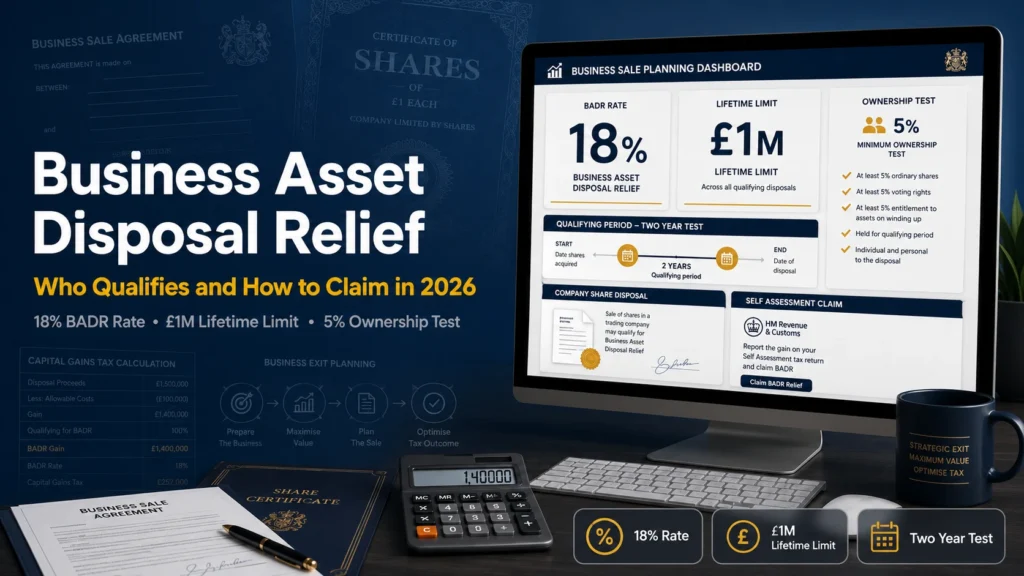
Business Asset Disposal Relief, formerly known as Entrepreneurs’ Relief, reduces the Capital Gains Tax rate on qualifying business disposals from the standard 24% down to a reduced rate. That reduced rate has changed twice in two years: 10% until April 2025, 14% for 2025/26, and 18% from 6 April 2026. If you are planning to sell your business, wind it up, or dispose of shares in your own company, understanding exactly how the current rate and qualifying conditions apply is essential before you sign anything.
This guide from Muhammad Bilal FCCA at Protax Consultants covers who qualifies, the current rate and lifetime limit, the anti-forestalling rules that catch contracts signed before the rate change but completing after, and how to make a valid claim.
What Is Business Asset Disposal Relief?
BADR allows individuals disposing of all or part of a business, or shares in a personal trading company, to pay a reduced rate of Capital Gains Tax on qualifying gains, up to a lifetime limit. Without the relief, the same gain would be taxed at the standard rate of 24% (for higher and additional rate taxpayers) or 18% (basic rate).
BADR Rate History and the Current Position
| Period | BADR rate | Standard CGT rate for comparison |
| Before 30 October 2024 | 10% | 20% (pre-Budget rate) |
| 30 October 2024 to 5 April 2025 | 10% | 18% / 24% (new rates from Budget) |
| 2025/26 (6 April 2025 to 5 April 2026) | 14% | 18% / 24% |
| 2026/27 (from 6 April 2026) | 18% | 18% / 24% |
At 18%, the BADR rate is now identical to the basic rate CGT rate, and the tax saving compared to the higher-rate CGT rate is £60,000 on the full £1 million lifetime limit (18% versus 24%). This is a substantially smaller saving than when the relief was introduced at a flat 10%.
Who Qualifies for BADR?
Qualifying conditions must be met for at least two continuous years before the disposal date.
Sole Traders and Partnerships
- You must dispose of the whole or part of a business you have owned for at least two years
- The disposal must include the business assets, not simply a sale of individual assets while the business continues
Company Shares
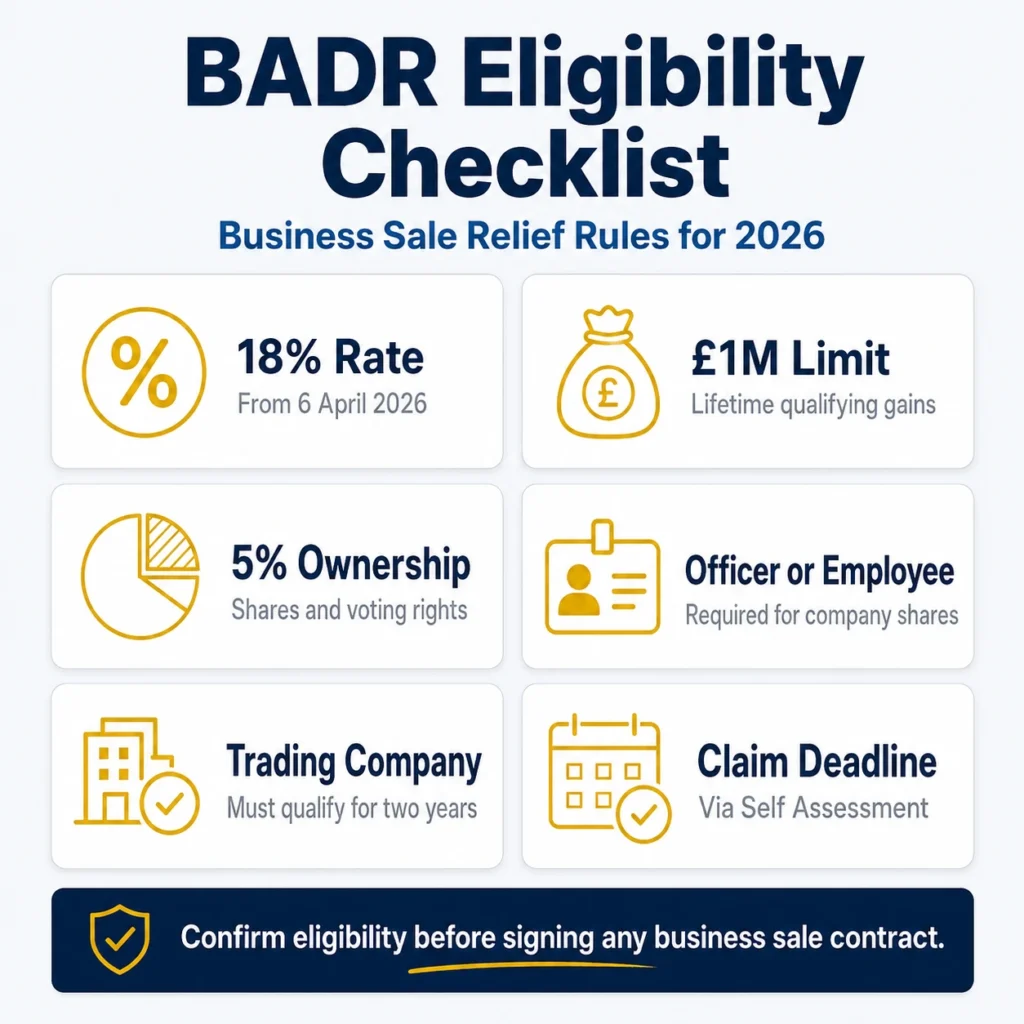
- You must be an officer or employee of the company (or a company in the same group)
- You must hold at least 5% of the ordinary share capital and voting rights
- You must be entitled to at least 5% of profits available for distribution and 5% of assets on a winding up
- The company must be a trading company, or the holding company of a trading group, throughout the two-year qualifying period
- All conditions must be met for the full two years ending with the date of disposal
The 5% ownership threshold is a common failure point. Founders who have been diluted below 5% through funding rounds, or company directors who never held a full 5% stake, do not qualify even if they were instrumental in building the business. Check your cap table position carefully before assuming BADR applies.
The £1 Million Lifetime Limit
BADR applies to the first £1 million of qualifying lifetime gains, cumulative across every BADR-qualifying disposal you have ever made, not per transaction and not annually. The limit has been reduced substantially over the scheme’s history, from £10 million originally down to the current £1 million (since March 2020).
Gains above the £1 million cumulative limit are taxed at the standard CGT rate applicable to the asset type, currently 24% for higher and additional rate taxpayers on most business assets.
The April 2026 Anti-Forestalling Rules
HMRC introduced specific anti-forestalling rules to prevent business owners from locking in the lower 14% rate by signing a contract before 6 April 2026 while completing the actual disposal afterwards. Where an unconditional contract was entered into before 6 April 2026 but completes on or after that date, HMRC will treat the disposal date as the completion date, applying the higher 18% rate, unless the contract qualifies as an excluded contract.
An excluded contract must satisfy two conditions: it must not have been entered into wholly or mainly to secure a tax advantage through timing, and where the parties are connected (for example, a sale to a family member or associated company), the contract must be for genuinely commercial reasons.
Where total gains across all excluded contracts are £100,000 or less, no separate claim to HMRC is required to rely on the excluded contract treatment. Above £100,000, a proactive claim must be made, and HMRC will expect supporting evidence that the contract was genuinely unconditional and commercially driven.
How and When to Claim
BADR is claimed through your Self Assessment tax return for the tax year of disposal, using the supplementary Capital Gains pages. If you are unable to file through Self Assessment for any reason, you can make a claim directly to HMRC in writing, or complete Section A of the HS275 helpsheet.
| Disposal tax year | Rate applicable | Payment deadline | Claim deadline |
| 2025/26 (14% rate) | 14% | 31 January 2027 | 31 January 2028 |
| 2026/27 (18% rate) | 18% | 31 January 2028 | 31 January 2029 |
The claim deadline is the first anniversary of the 31 January Self Assessment filing deadline following the tax year of disposal. Note that the payment deadline is earlier than the formal claim deadline, meaning you must pay the tax based on your expected BADR position on the normal Self Assessment schedule, with an additional year available to finalise the formal claim if needed.
BADR and Incorporation: A Related Consideration
Business owners incorporating a sole trade or partnership into a limited company sometimes consider deliberately disapplying Incorporation Relief in order to crystallise a gain and use BADR at 18%, rather than deferring the gain into the company’s share base cost. From 6 April 2026, this decision has become more consequential, because Incorporation Relief is no longer automatic and must be actively claimed on your Self Assessment return. If you want to use BADR instead of deferring under Incorporation Relief, you must simply not make the Incorporation Relief claim, rather than formally electing to disapply it, since the disapplication election under section 162A has been repealed.
Protax Consultants: BADR and Business Sale Planning in London
Selling or winding up a business is a significant, often once-in-a-lifetime financial event, and BADR eligibility needs to be confirmed well before any contract is signed, not after. Muhammad Bilal FCCA and the Protax team review qualifying conditions, calculate lifetime limit usage across prior disposals, and prepare BADR claims for company directors, sole traders, and partners across London and the UK.
Based in Wimbledon, HMRC-authorised, ACCA-registered (5743262). Visit our Capital Gains Tax service or Corporation Tax service, or call 020 8545 7451.
Frequently Asked Questions
What is the BADR rate for 2026/27?
18%, up from 14% in 2025/26 and 10% before April 2025. The rate applies to the first £1 million of qualifying lifetime gains.
Do I still qualify for BADR if I own less than 5% of the company?
No. You must hold at least 5% of ordinary share capital and voting rights, and be entitled to at least 5% of distributable profits and assets on a winding up, throughout the two years before disposal. Falling below 5% at any point in that period, including through dilution from funding rounds, breaks the qualifying condition.
I signed a contract before 6 April 2026, but completion is after. What rate applies?
HMRC will treat the disposal date as the completion date and apply 18%, unless your contract qualifies as an excluded contract — meaning it was genuinely unconditional, not entered into mainly for tax timing reasons, and (for connected parties) commercially driven. Contracts with total gains under £100,000 do not need a separate claim to rely on this; above that, a claim must be made.
Can I use BADR more than once?
Yes. There is no limit on the number of times you can claim BADR. The limit is on the total qualifying gains across your lifetime, currently £1 million. Once you have used the full £1 million, further qualifying disposals are taxed at the standard CGT rate.
Where can I get BADR advice before selling my business?
Protax Consultants in Wimbledon, London. Muhammad Bilal FCCA reviews BADR eligibility, calculates lifetime limit position, and prepares claims for business sales, share disposals, and incorporations. Fixed fee. Visit Capital Gains Tax or call 020 8545 7451.

Muhammad Bilal is a Fellow Chartered Certified Accountant (FCCA) and Director of Protax Consultants, a London-based accounting firm specialising in tax advisory, compliance, and business accounting services.
Bilal qualified with the Association of Chartered Certified Accountants (ACCA) in 2009 and later achieved FCCA status after gaining extensive professional experience. With more than 13 years of experience in accounting, taxation, and auditing, he advises SMEs, landlords, contractors, and charities on tax planning, compliance, and financial management.
As a registered HMRC agent, Bilal assists clients with Self Assessment tax returns, corporation tax planning, VAT compliance, payroll services, and HMRC enquiries.
Bilal holds a BSc (Hons) in Applied Accounting and leads the audit and compliance function at Protax Consultants.
Company Verification:
Protax Consultants Ltd – Company Number 14701253
View Companies House Record