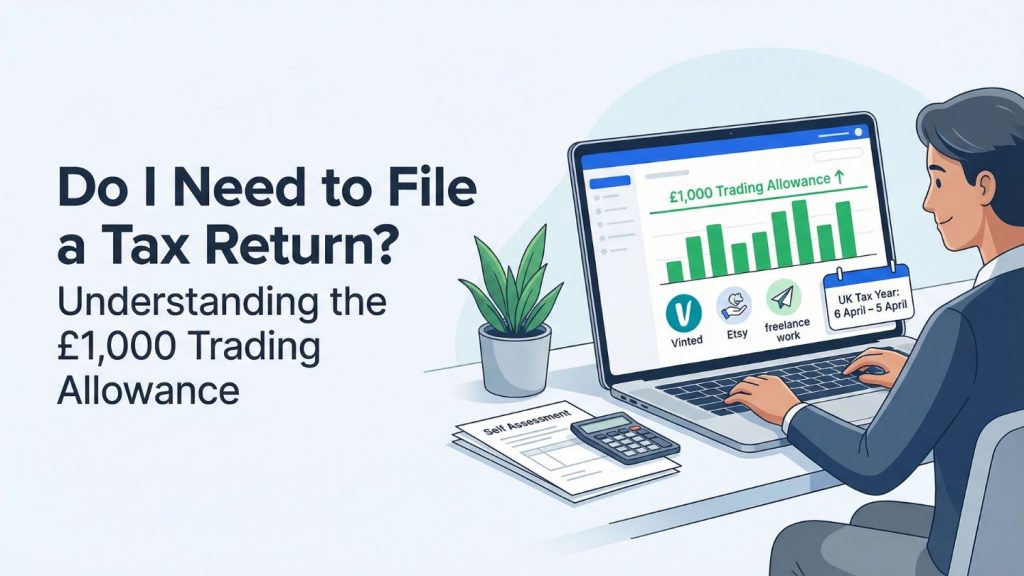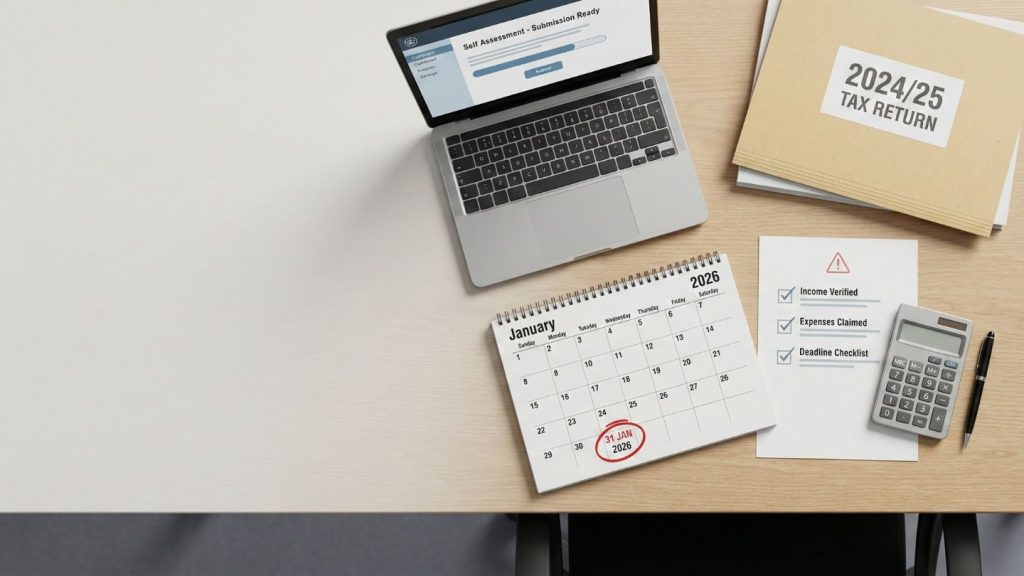
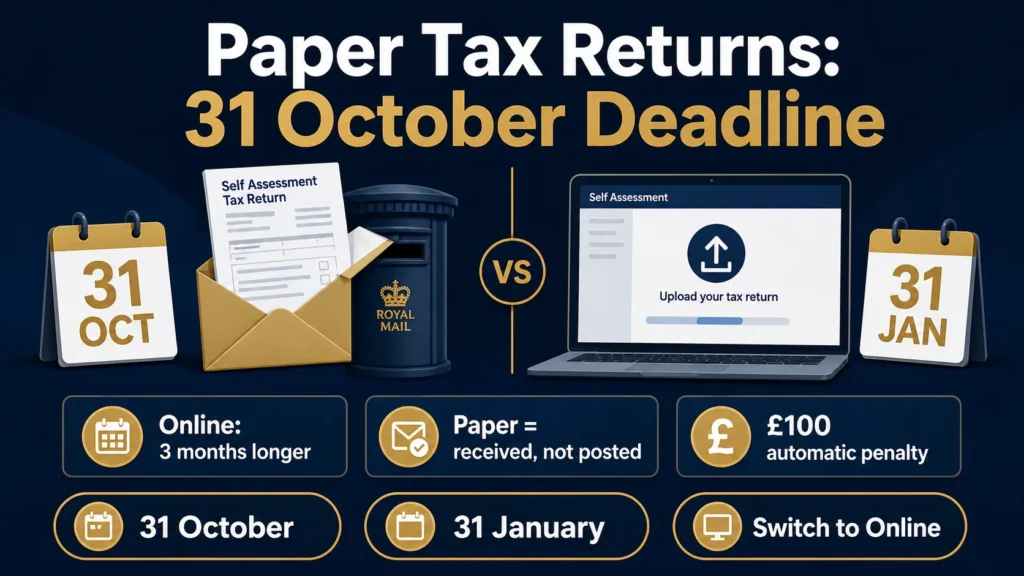
Quick answer: If you’re filing a 2025/26 Self Assessment tax return on paper, HMRC must receive it by 11:59 pm on 31 October 2026, three months earlier than the better-known 31 January online deadline. Most people now file online and never encounter this date at all. But if you were planning to file on paper and you’re going to miss 31 October, switching to online filing and submitting by 31 January instead will generally avoid a late-filing penalty. Submitting an actual paper return after 31 October will not.
Who actually needs to file a paper tax return?
HMRC no longer automatically posts paper returns to most taxpayers. You have to request one, or you fall into a category where paper is effectively the only option. In practice, that’s a fairly small group:
- People who genuinely cannot use HMRC’s online service (certain trustees, Lloyd’s underwriters, some non-resident taxpayers, or those claiming specific reliefs not supported by HMRC’s free online software)
- People who object to using electronic communications, including for religious reasons
- People who simply prefer paper and request a form in good time
- Anyone who receives a formal notice to file and chooses the paper route over online
If none of that applies to you, you can almost certainly file online, and your real deadline is 31 January 2027. If you’re not even sure you need to file at all, start with do you need to file a tax return.
What is the 31 October deadline, exactly?
For the 2025/26 tax year (6 April 2025 to 5 April 2026), HMRC must physically receive your completed paper return by 11:59 pm on 31 October 2026. Post it in good time: HMRC goes by the date they receive it, not the date you put it in the postbox. If HMRC issues you a notice to file after 31 July 2026, you instead get three months from the date on that notice, whichever route you choose.
What happens if you miss it?
This is the part most guidance gets slightly wrong, so it’s worth being precise.
The standard late-filing penalty, an automatic £100 rising steeply the longer a return stays outstanding, is triggered by the return you actually submit being late against its own deadline. That gives you two genuinely different outcomes:
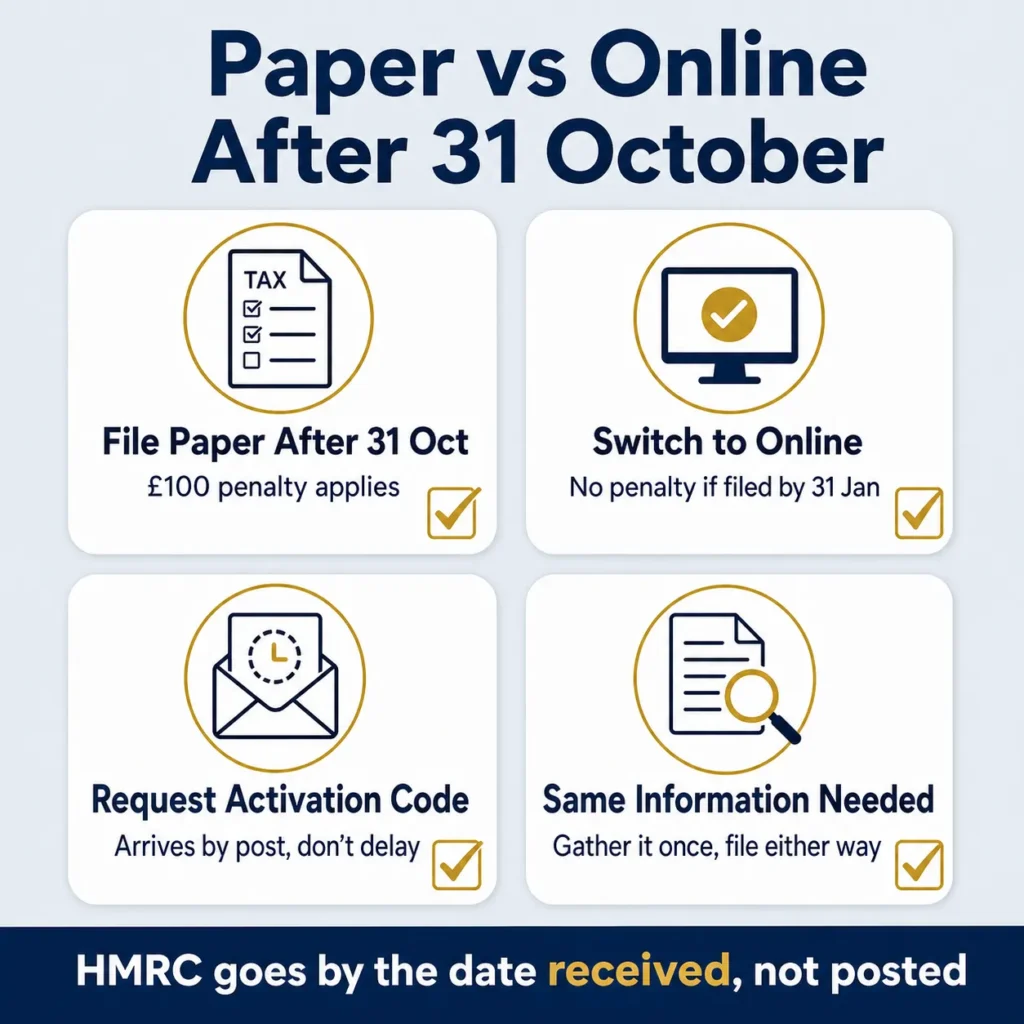
- You submit a paper return after 31 October. That return is late against the paper deadline. The £100 penalty applies, even if you’d technically still have been within the 31 January window had you been filing online.
- You intended to file on paper, missed 31 October, but switched to filing online instead and submitted by 31 January 2027. Your actual submission, the online one, met its own deadline. On the generally accepted position (confirmed in LITRG’s guidance, part of the Chartered Institute of Taxation), no late-filing penalty arises in this case.
In other words: the 31 October date isn’t a hard stop for everyone who was thinking about paper. It’s a hard stop for anyone who actually submits paper after it. For a fuller breakdown of how these penalties escalate, see our guide to late filing penalties specifically.
If you’re going to miss the paper deadline, switch to online now
- Register for HMRC’s online Self Assessment service if you haven’t already. This involves an activation code sent by post, so don’t leave it until January. If you’ve also missed the registration deadline entirely, see our guide on missing the 5 October registration deadline.
- Gather the same information you’d have put on the paper form: income, expenses, reliefs.
- File online by 31 January 2027.
- Pay what you owe by the same date, regardless of which method you used to file, including any payment on account instalment that’s also due.
Other deadlines worth knowing while you’re here
- 5 October 2026: the deadline to register for Self Assessment if this is your first time filing.
- 30 December 2026: if you file online and owe less than £3,000, this is the deadline to ask HMRC to collect it through your tax code instead.
- 31 January 2027: the deadline to file online and pay what you owe, for everyone not filing on paper.
For the fuller calendar, see our Self Assessment deadlines guide. As HMRC continues extending Making Tax Digital to more taxpayers over the next few years, paper filing is likely to become rarer still.
How Protax can take this off your hands
Whether you’re filing on paper for a genuine reason or simply want someone to handle the online return properly and on time, our Self Assessment service manages the whole process. Get a free, no-obligation quote and we’ll tell you straightforwardly what route makes sense for you.
Frequently Asked Questions
Do I have to file a paper tax return?
No, not unless you fall into a specific category: certain trustees, Lloyd’s underwriters, some non-residents, or people claiming reliefs HMRC’s online service doesn’t support, plus anyone who simply prefers paper. Most people can and should file online, where the deadline is 31 January rather than 31 October.
What happens if I miss the paper tax return deadline?
Submitting an actual paper return after 31 October results in the standard £100 late-filing penalty. Switching to file online instead and submitting by 31 January generally avoids a late-filing penalty.
Can I switch from paper to online filing after missing the 31 October deadline?
Yes, provided you do so by 31 January. You’ll need to be registered for HMRC’s online service, which has its own setup time if you haven’t used it before.
Is the payment deadline also 31 October for paper filers?
No. The payment deadline is 31 January 2027 regardless of whether you filed on paper or online.
Why does HMRC still have a paper deadline if most people file online?
Paper returns take HMRC longer to process by hand, so the earlier deadline gives them time to calculate what’s owed before the 31 January payment date.

Muhammad Bilal is a Fellow Chartered Certified Accountant (FCCA) and Director of Protax Consultants, a London-based accounting firm specialising in tax advisory, compliance, and business accounting services.
Bilal qualified with the Association of Chartered Certified Accountants (ACCA) in 2009 and later achieved FCCA status after gaining extensive professional experience. With more than 13 years of experience in accounting, taxation, and auditing, he advises SMEs, landlords, contractors, and charities on tax planning, compliance, and financial management.
As a registered HMRC agent, Bilal assists clients with Self Assessment tax returns, corporation tax planning, VAT compliance, payroll services, and HMRC enquiries.
Bilal holds a BSc (Hons) in Applied Accounting and leads the audit and compliance function at Protax Consultants.
Company Verification:
Protax Consultants Ltd – Company Number 14701253
View Companies House Record