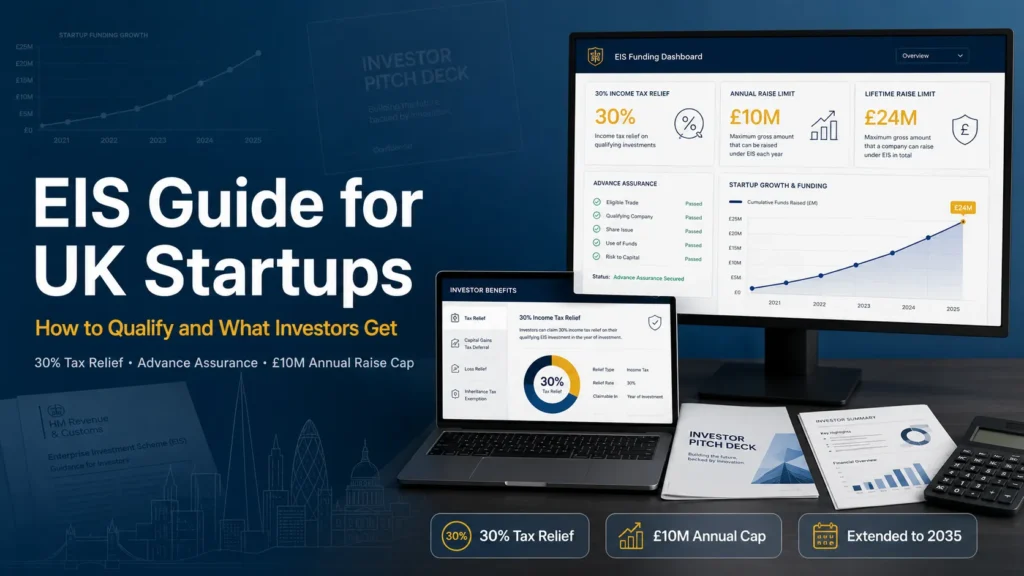
A complete 2026 guide to the Enterprise Investment Scheme (EIS) for UK startup founders and growth-stage companies — covering the significant rule changes from 6 April 2026, investor tax reliefs, company eligibility, Knowledge Intensive Companies, the Advance Assurance process, and how EIS fits into a post-SEIS funding strategy.
The Enterprise Investment Scheme is the UK’s flagship tax-advantaged funding route for growth-stage companies. From 6 April 2026, the scheme became significantly more powerful: annual fundraising caps doubled, lifetime limits doubled, and gross asset thresholds doubled — changes announced in the Autumn Budget 2025 and confirmed to take effect in April 2026. For founders approaching the end of a SEIS round or scaling beyond seed stage, EIS is now accessible to more companies, for more capital, for longer. This guide explains how the scheme works in 2026 and how to access it.
What Is EIS?
EIS is a UK government scheme that offers individual investors tax relief when they subscribe for newly issued shares in qualifying growth-stage companies. Like SEIS, it is an investor incentive rather than a company grant — your startup does not receive a subsidy. What you get is a structure that reduces your investors’ effective cost and caps their downside, making equity investment in your company materially more attractive than it would otherwise be.
EIS serves a different point on the startup funding curve than SEIS. Where SEIS targets very early-stage companies — under three years old, gross assets under £350,000 — EIS is designed for companies that have proven initial traction and are ready to scale. A company typically uses SEIS to raise its first £250,000, then moves to EIS for larger rounds as the company grows beyond SEIS eligibility. The two schemes are explicitly designed to work in sequence.
What Changed in April 2026: The Doubled Limits
The Autumn Budget 2025 announced a package of changes to EIS that took effect from 6 April 2026. These are the most significant changes to the scheme since 2023 and directly affect how much your company can raise and which companies are now eligible:
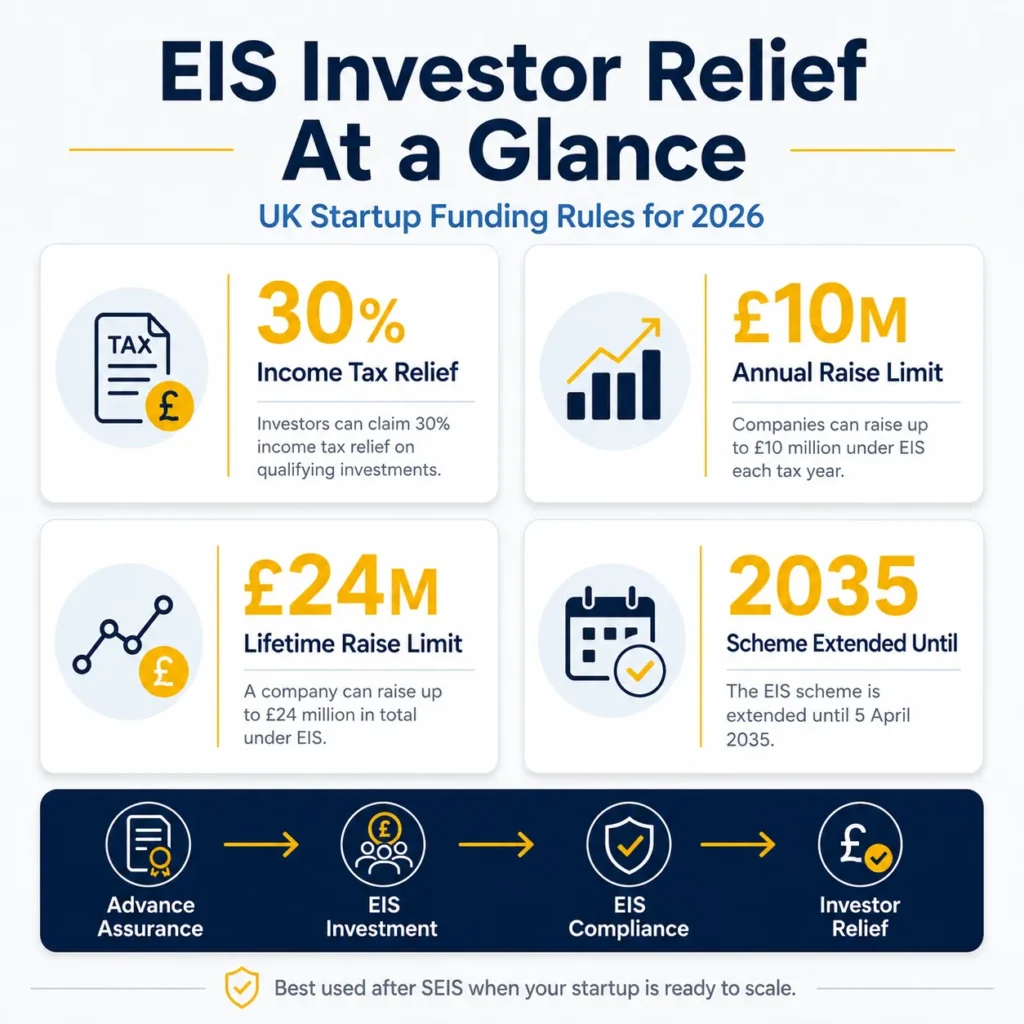
- Annual fundraising cap: Doubled from £5 million to £10 million per year for standard EIS companies
- Lifetime fundraising limit: Doubled from £12 million to £24 million for standard EIS companies
- Gross assets threshold (pre-investment): Doubled from £15 million to £30 million — meaning significantly larger companies now qualify for EIS for the first time
- Gross assets threshold (post-investment): Increased from £16 million to £35 million
- Knowledge Intensive Companies (KICs): Annual limit doubled from £10 million to £20 million; lifetime limit doubled from £20 million to £40 million
- Scheme extended: EIS is confirmed to continue until at least April 2035
The doubling of the gross assets threshold from £15 million to £30 million is particularly significant. Companies that previously exceeded the EIS eligibility threshold — often tech and SaaS businesses with substantial balance sheets — may now qualify for the first time. If your company was EIS-ineligible before April 2026 because of the gross assets test, it is worth reassessing your position under the new limits.
ℹ️ EIS vs VCT: Why the 2026 Changes Matter
From 6 April 2026, VCT income tax relief reduced from 30% to 20% — while EIS income tax relief remains at 30%. This 10-percentage-point gap significantly widens the advantage of direct EIS investment over VCT funds for investors seeking maximum income tax relief. The Autumn Budget 2025 changes effectively made EIS the stronger route for individual investors focused on income tax efficiency, while also expanding the universe of EIS-qualifying companies. For founders raising equity in 2026, EIS-eligible status is a more valuable differentiator than it was a year ago.
What Tax Relief Do EIS Investors Get?
An investor subscribing for EIS shares in a qualifying company receives four core reliefs:
- 30% Income Tax relief: The investor claims back 30% of their investment against their income tax liability. The maximum EIS investment per investor is £1 million per tax year (£2 million if at least £1 million is invested in Knowledge Intensive Companies), giving maximum income tax relief of £300,000 (or £600,000). Relief can be carried back to the previous tax year
- Capital Gains Tax exemption: If EIS shares are held for at least three years and income tax relief has not been withdrawn, any gain on disposal is entirely free of CGT — no limit on the qualifying gain
- CGT deferral: Investors can defer CGT on gains from any asset by reinvesting those gains into EIS shares. The CGT is deferred until the EIS shares are eventually sold. Unlike SEIS reinvestment relief, EIS deferral is not capped
- Loss relief: If EIS shares become worthless, investors can offset their net loss (after income tax relief) against other income or capital gains. The protection is less generous than SEIS but still meaningful — a higher-rate taxpayer’s worst-case loss on a £100,000 EIS investment is approximately £42,000 (£100,000 investment minus £30,000 income tax relief = £70,000 net cost × 40% loss relief = £28,000 recovered, leaving a £42,000 net loss)
Does Your Company Qualify for EIS in 2026?
For a company to issue EIS-qualifying shares, it must meet all of the following conditions (updated to reflect the April 2026 changes):
- UK establishment: The company must be UK-incorporated and have a permanent establishment in the UK. Non-UK incorporated companies can qualify if they have a UK permanent establishment
- Trading age: The company must generally be within seven years of its first commercial sale at the time of the EIS share issue. Knowledge Intensive Companies have an extended window of ten years
- Employees: Fewer than 250 full-time equivalent employees at the time of the share issue (500 for Knowledge Intensive Companies)
- Gross assets (from 6 April 2026): No more than £30 million immediately before the share issue, and no more than £35 million immediately after. Companies with gross assets between £15 million and £30 million that were previously excluded from EIS should reassess their eligibility under the new limits
- Unquoted: The company must not be listed on a recognised stock exchange at the time of the share issue
- Qualifying trade: The company must carry on a qualifying trade. The same excluded activities that apply to SEIS apply to EIS — property development, financial services, legal services, farming, hotels, and energy generation from subsidised sources
- Annual raise limit (from 6 April 2026): The company can raise up to £10 million per year under EIS (previously £5 million)
- Lifetime raise limit (from 6 April 2026): The company can raise up to £24 million in total under EIS across its lifetime (previously £12 million)
Knowledge Intensive Companies (KICs)
Knowledge Intensive Companies are a category within EIS that benefits from higher annual and lifetime funding limits, reflecting the greater capital requirements and longer development cycles of research and innovation-led businesses. From 6 April 2026, KIC limits are £20 million per year and £40 million lifetime.
A company qualifies as a KIC if it meets one of two conditions: at least 20% of its employees are engaged in research, development or innovation activities (or at least 15% over three years); or the company has incurred qualifying R&D expenditure equal to at least 15% of operating costs in one of the three preceding years. UK tech companies, life sciences businesses, AI product companies, and engineering-led startups frequently qualify as KICs. If your company has significant R&D expenditure, it is worth assessing KIC status specifically — the higher funding limits and extended seven-to-ten-year trading window can materially affect how long you can access EIS.
EIS Advance Assurance
EIS Advance Assurance works identically to SEIS Advance Assurance — a pre-investment confirmation from HMRC that your proposed share issue is likely to qualify. It is not a legal guarantee but is expected by most institutional and professional investors before they commit capital.
The application requires a business plan, financial projections, details of the proposed share structure, and information about the company’s trade and history. Allow 6 to 12 weeks for HMRC to respond to an EIS Advance Assurance application — EIS applications can take slightly longer than SEIS due to the additional eligibility conditions. If your company has a complex model or sits near an excluded activity, a qualified adviser should prepare the application.
Three Disqualifying Events to Avoid
EIS relief can be withdrawn — from investors, retrospectively — if certain disqualifying events occur within three years of the share issue. The three most important to avoid:
- Preferential shares: EIS shares must be ordinary, full-risk shares with no preferential rights to assets or income (beyond a limited dividend preference). Issuing shares with liquidation preferences, convertible notes, or structured returns can disqualify the round
- Capital returns: The company must not return capital to shareholders within three years of the share issue. Dividends, share buybacks, or any other return of capital in that window can trigger clawback of EIS relief
- Significant trade change: If the company materially changes its qualifying trade within three years — or is acquired — EIS relief can be withdrawn from all investors in that round. Acquisition negotiations during the three-year window require careful advice
⚠️ Track Fund Usage Carefully After Investment
EIS funds must be used to grow or develop the qualifying business. Spending outside the qualifying activity — such as using EIS funds to repay existing debt, fund passive investments, or acquire another business — can trigger HMRC enquiries and potential clawback of investor relief. Keep clear, documented records of how EIS funds are deployed from the date of investment. This is where most HMRC enquiries into EIS rounds focus: not on the structure of the share issue, but on what the money was actually spent on.
EIS Eligibility Checklist for Founders
- Confirm your company is within seven years of its first commercial sale (ten years for KICs)
- Confirm gross assets are under £30 million immediately before the share issue (from April 2026)
- Confirm employee headcount is fewer than 250 full-time equivalents (500 for KICs)
- Confirm the total amount to be raised does not exceed £10 million in this tax year or £24 million in total across the company’s lifetime (from April 2026)
- Confirm the company’s main trade does not fall within an excluded activity
- Check whether the company qualifies as a Knowledge Intensive Company — if so, higher limits of £20 million annual and £40 million lifetime apply
- Ensure SEIS shares were issued before EIS shares if both schemes are being used in sequence
- Apply for EIS Advance Assurance before approaching investors — allow 6 to 12 weeks
- Ensure all EIS shares are ordinary, full-risk shares — no preferential rights to assets, income, or liquidation
- Keep detailed records of fund deployment from the date of investment to support the EIS1 compliance submission
Scaling Beyond SEIS? Structure Your EIS Round Correctly.
Our ACCA-qualified accountants advise London startups on EIS eligibility, the April 2026 changes, KIC qualification, Advance Assurance applications, and post-investment compliance. Free initial consultation for qualifying companies.
View Startup Accounting ServicesFrequently Asked Questions
How much can a UK startup raise under EIS in 2026?
From 6 April 2026, a standard EIS company can raise up to £10 million per year and £24 million across its lifetime. These limits doubled from the previous annual cap of £5 million and lifetime cap of £12 million, as announced in the Autumn Budget 2025. Knowledge Intensive Companies have higher limits: £20 million per year and £40 million lifetime. If your company was approaching the old lifetime limit, the new cap may allow further EIS fundraising that was previously unavailable.
What is the difference between EIS and SEIS?
SEIS is for very early-stage companies — under three years old, fewer than 25 employees, gross assets under £350,000, company raise limit of £250,000 — with investors receiving 50% income tax relief. EIS is for more developed companies — up to seven years old, fewer than 250 employees, gross assets under £30 million (from April 2026), annual raise up to £10 million — with investors receiving 30% income tax relief. The two schemes are designed to work in sequence: raise under SEIS first, then transition to EIS. SEIS shares must be issued before EIS shares in the same accounting period.
What changed about EIS in April 2026?
Four significant changes took effect on 6 April 2026 as a result of the Autumn Budget 2025. The annual EIS fundraising cap doubled from £5 million to £10 million. The lifetime EIS limit doubled from £12 million to £24 million. The gross assets threshold doubled from £15 million pre-investment to £30 million, meaning larger companies now qualify for the first time. Knowledge Intensive Company limits also doubled to £20 million annually and £40 million lifetime. VCT income tax relief reduced from 30% to 20% on the same date, widening the gap between direct EIS investment and VCT funds.
Can company directors invest under EIS?
Directors who are employees of the company cannot invest and claim EIS relief — EIS specifically excludes employees from claiming. However, non-executive directors and directors who are not employed by the company can invest and claim EIS relief, subject to the other eligibility conditions. This is one of the key differences from SEIS, which expressly allows directors to invest and claim, provided they hold no more than 30% of the company. If your funding round includes director investors, the SEIS versus EIS distinction on this point needs to be considered carefully.
What is a Knowledge Intensive Company for EIS purposes?
A Knowledge Intensive Company is a company where at least 20% of employees are engaged in research, development or innovation activities (or at least 15% over three years), or where qualifying R&D expenditure equals at least 15% of operating costs in one of the three preceding years. KICs benefit from higher EIS funding limits — £20 million per year and £40 million lifetime from April 2026 — and an extended trading history window of ten years rather than seven. Many London tech companies, AI businesses, life sciences, and engineering-led startups qualify as KICs. The classification should be confirmed with a qualified adviser before applying for Advance Assurance.

Muhammad Bilal is a Fellow Chartered Certified Accountant (FCCA) and Director of Protax Consultants, a London-based accounting firm specialising in tax advisory, compliance, and business accounting services.
Bilal qualified with the Association of Chartered Certified Accountants (ACCA) in 2009 and later achieved FCCA status after gaining extensive professional experience. With more than 13 years of experience in accounting, taxation, and auditing, he advises SMEs, landlords, contractors, and charities on tax planning, compliance, and financial management.
As a registered HMRC agent, Bilal assists clients with Self Assessment tax returns, corporation tax planning, VAT compliance, payroll services, and HMRC enquiries.
Bilal holds a BSc (Hons) in Applied Accounting and leads the audit and compliance function at Protax Consultants.
Company Verification:
Protax Consultants Ltd – Company Number 14701253
View Companies House Record