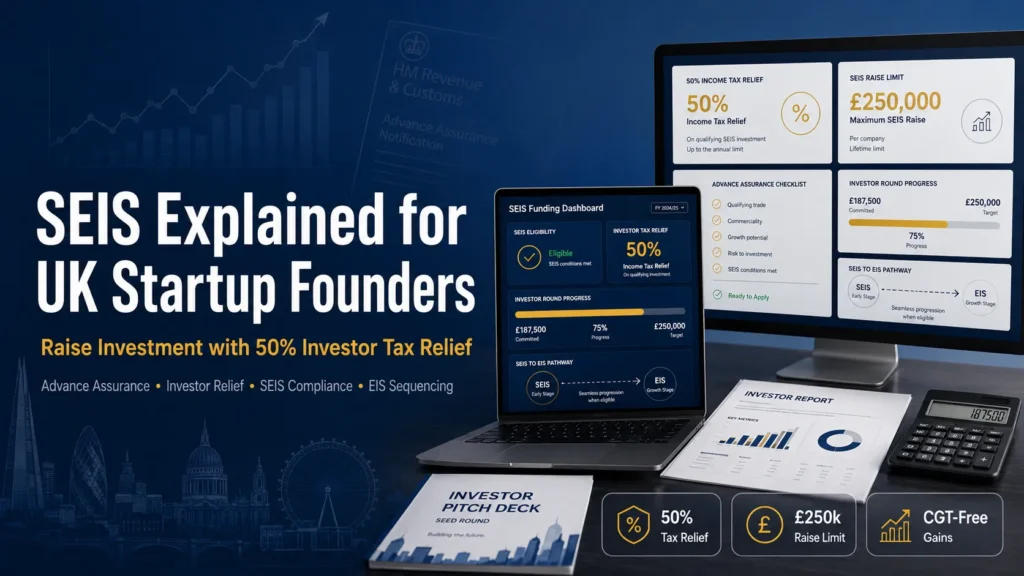
A complete 2026 guide to the Seed Enterprise Investment Scheme (SEIS) for UK startup founders — covering how the scheme works, the investor tax reliefs that make your shares genuinely attractive, the company eligibility rules, Advance Assurance, the compliance process, and how to sequence SEIS into a follow-on EIS round.
The Seed Enterprise Investment Scheme is one of the most generous tax incentives in the developed world for early-stage investment. A higher-rate taxpayer investing £100,000 into a SEIS-qualifying startup receives £50,000 back through their tax return immediately, reducing their net cost to £50,000 before they know whether the company succeeds. If it fails entirely, loss relief recovers a further £20,000, meaning their worst-case outcome on a £100,000 cheque is a net loss of £30,000. For founders raising their first round, that structure changes every conversation with a potential investor. This guide explains how to access it.
What Is SEIS?
SEIS is a UK government scheme that gives individual investors significant tax reliefs when they invest in newly issued shares in qualifying early-stage companies. The scheme was introduced in 2012 and exists specifically to encourage investment into the riskiest end of the startup funding market — pre-revenue and very early-stage companies that struggle to attract capital through conventional routes.
Crucially, SEIS is an investor incentive, not a company grant. Your startup does not receive a tax cut or a government subsidy. What you get is a structure that makes your shares materially more attractive to investors by significantly reducing their effective cost and capping their downside. That distinction matters in a pitch — you are not telling investors the government is funding you. You are telling them the government has reduced the risk of backing you.
What Tax Relief Do SEIS Investors Get?
An investor who subscribes for SEIS shares in a qualifying company receives four distinct tax reliefs:
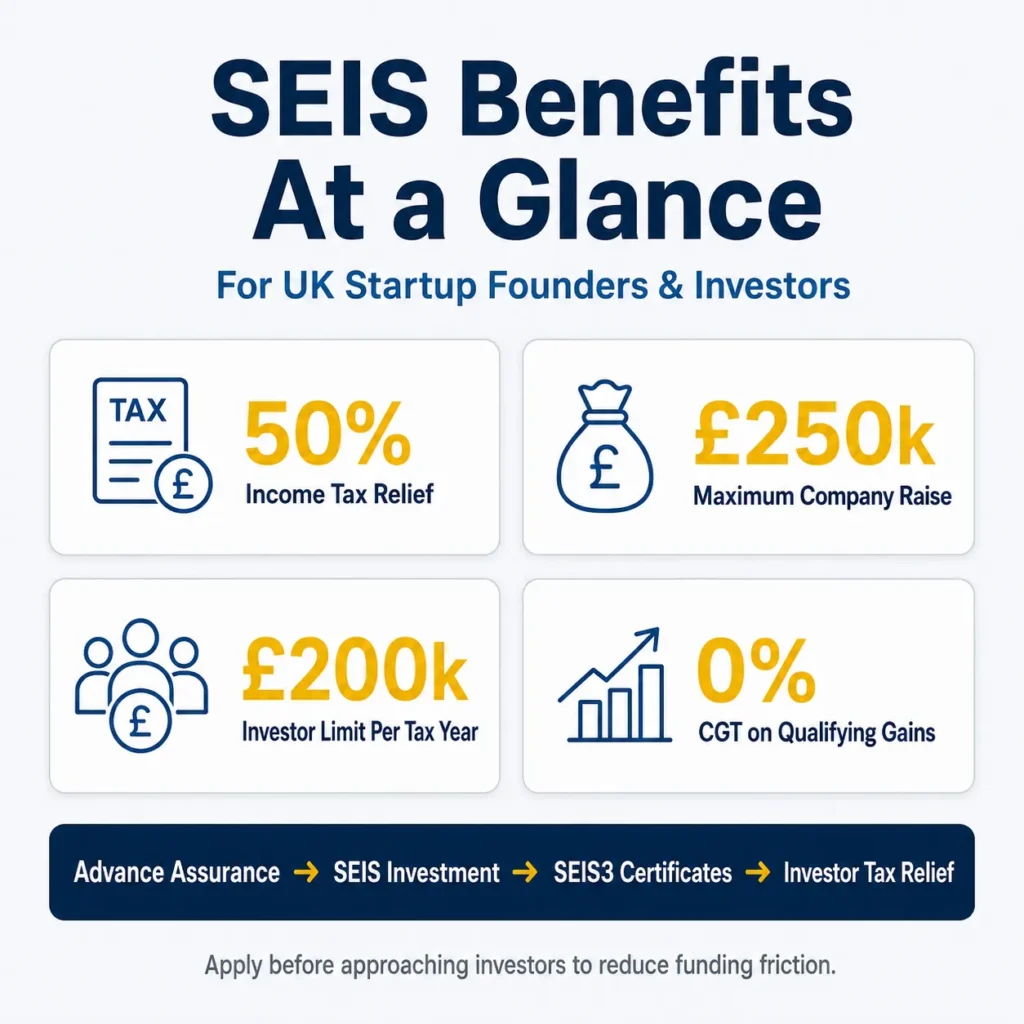
- 50% Income Tax relief: The investor can claim back 50% of their investment against their income tax liability in the year of investment. On a £20,000 investment, that is £10,000 back from HMRC. The maximum investment per investor per tax year is £200,000, giving a maximum income tax relief of £100,000 per year. The relief can also be carried back to the previous tax year if the investor has a higher tax liability in that year
- Capital Gains Tax exemption: If the investor holds SEIS shares for at least three years and income tax relief has not been withdrawn, any gain on disposal is entirely free of Capital Gains Tax. There is no upper limit on the qualifying gain — a £1,000 investment that returns £500,000 after five years creates no CGT liability whatsoever
- CGT reinvestment relief: Investors can apply a 50% CGT exemption on gains from other assets that are reinvested into SEIS shares, up to £100,000 of reinvested gains per tax year. An investor with a £50,000 capital gain who reinvests into SEIS pays CGT on only £25,000 of that gain
- Loss relief: If the company fails and the shares become worthless, the investor can claim loss relief on the amount of their investment after income tax relief has been accounted for. A higher-rate taxpayer who invested £100,000 and received £50,000 income tax relief can claim loss relief on the remaining £50,000 at 40%, recovering a further £20,000. Their total worst-case loss on a £100,000 SEIS investment is therefore £30,000
ℹ️ The Real Cost of a SEIS Investment for a Higher-Rate Taxpayer
An angel investor at the 40% income tax rate invests £100,000 in a SEIS-qualifying London startup:
- Investment: £100,000
- Income Tax relief at 50%: −£50,000
- Net cost after relief: £50,000
- If company fails entirely — loss relief at 40% on remaining £50,000: −£20,000
- Worst-case total loss: £30,000 on a £100,000 investment
- If company succeeds — gains are entirely free of CGT
This is why SEIS moves investment conversations forward — the downside is structured, and the upside is unlimited and tax-free.
Does Your Company Qualify for SEIS?
For a company to issue SEIS-qualifying shares, it must meet all of the following conditions at the time the shares are issued:
- Trading age: The company must have been trading for fewer than three years at the date of the share issue. Companies that have been trading for three years or more do not qualify for SEIS, though they may qualify for EIS
- Employees: Fewer than 25 full-time equivalent employees at the time of the share issue
- Gross assets: No more than £350,000 in gross assets immediately before the share issue
- UK establishment: The company must be UK-incorporated and have a permanent establishment in the UK
- Unquoted: The company must not be listed on a recognised stock exchange. AIM and AQSE-listed companies do not qualify
- Qualifying trade: The company must be carrying on (or preparing to carry on) a qualifying new trade on a commercial basis. Certain activities are excluded — see below
- No prior EIS or VCT investment: SEIS shares must be issued before any EIS or VCT investment in the same accounting period
- Raise limit: The company can raise a maximum of £250,000 under SEIS across its lifetime. This is a cumulative cap across all SEIS funding rounds, not per round
Which Trades Are Excluded from SEIS?
Not every business activity qualifies for SEIS. HMRC excludes certain trades because they are considered asset-backed, lower-risk, or otherwise unsuitable for the scheme. The main excluded activities include:
- Property development and dealing in land
- Financial activities — banking, insurance, money-lending, and dealing in financial instruments
- Legal and accountancy services
- Farming, market gardening, and forestry
- Hotels and nursing homes
- Energy generation from subsidised sources
Technology-led businesses — SaaS platforms, marketplaces, AI products, data tools, and B2B software — typically qualify readily provided their revenue comes from technology or services rather than asset ownership. If your business model sits near an excluded activity, seek advice before applying for Advance Assurance. A small structural choice made early in the company’s life can determine SEIS eligibility for the entire round.
Can Founders Invest in Their Own Company Under SEIS?
Yes — this is one of SEIS’s most significant advantages over EIS. Founders can invest their own money into their company and claim full SEIS income tax relief, subject to one condition: the founder (including connected parties such as a spouse) must hold no more than 30% of the company’s shares, voting rights, or rights to assets at the time of the investment and throughout the three-year holding period.
A sole founder who owns 100% of the company cannot claim SEIS relief on their own investment — they exceed the 30% limit. But the same founder can structure the round so that co-founders and early investors each hold up to 30%, creating a cap table where SEIS is available to those investors even if not to the founding shareholder. In practice, most early rounds are structured specifically to allow maximum SEIS eligibility for the investors writing the cheques.
What Is SEIS Advance Assurance?
SEIS Advance Assurance is a confirmation from HMRC that your proposed share issue is likely to qualify for SEIS relief. It is not a legal guarantee — final SEIS status is determined after shares are issued — but it gives investors confidence before they commit, and most professional angel investors and syndicates will not invest without it.
Applying for Advance Assurance requires submitting a business plan, financial projections, details of the proposed share issue, and information about the company’s trading activity. HMRC typically responds within 4 to 6 weeks from a complete application. Allow at least 8 weeks before your target investment date to avoid delays. The Advance Assurance confirmation can then be shared with potential investors as part of your pitch materials.
⚠️ Apply for Advance Assurance Before You Approach Investors
Approaching investors without Advance Assurance in place adds unnecessary friction to your round. Most angel investors and syndicates in London will stall or decline to proceed until they have confirmation that SEIS relief is available. For first-time founders in particular, having HMRC’s advance assurance letter in hand signals that the company structure has been reviewed and that relief is likely to be available — this is often what moves a conversation from “interested” to “term sheet.” Apply before you start approaching investors, not after.
The SEIS Compliance Process After Investment
Receiving SEIS investment is not the end of the process. After shares are issued, the company must complete a compliance process with HMRC to enable investors to actually claim their relief:
- SEIS1 — Compliance Statement: Once the company has spent at least 70% of the SEIS funds on qualifying business activity (or after four months of trading, whichever is later), the company submits a SEIS1 compliance statement to HMRC confirming that all conditions have been met
- SEIS2 — HMRC authorisation: HMRC reviews the SEIS1 and, if satisfied, authorises the issue of SEIS3 certificates
- SEIS3 — Investor certificates: The company issues SEIS3 certificates to each investor. Investors need their SEIS3 to claim relief on their tax return. This process typically takes around 14 weeks from submission of the SEIS1
Common mistakes that jeopardise SEIS compliance include: spending less than 70% of SEIS funds on qualifying activity before submitting the SEIS1; issuing preferential shares rather than ordinary full-risk shares; including connected persons or employees in the share issue who are not eligible; and making changes to the company’s trade within three years of the share issue that could invalidate the qualifying trade condition.
How SEIS and EIS Work Together
SEIS and EIS are designed to work in sequence. Most London startups raise their initial seed round under SEIS — up to £250,000 — and then move to EIS for subsequent rounds as the company grows beyond the SEIS eligibility criteria. EIS allows companies to raise up to £10 million per year (doubled from £5 million from 6 April 2026), with a lifetime limit of £24 million (doubled from £12 million), from investors who receive 30% income tax relief rather than 50%.
There is one critical sequencing rule: SEIS shares must be issued before any EIS shares. You cannot issue EIS shares in the same accounting period before SEIS shares have been issued. Once SEIS shares are in issue, EIS can follow in subsequent rounds. Getting this sequencing wrong does not merely reduce the relief available — it can disqualify investors from claiming either scheme for that accounting period entirely.
SEIS Eligibility Checklist for Founders
- Confirm your company has been trading for fewer than three years at the proposed share issue date
- Confirm gross assets are under £350,000 immediately before the share issue
- Confirm employee headcount is fewer than 25 full-time equivalents
- Confirm the company’s main trade does not fall within an excluded activity
- Confirm no EIS or VCT shares have been issued in the same accounting period prior to the SEIS shares
- Confirm the total amount raised under SEIS across all rounds does not exceed £250,000
- Confirm shares to be issued are ordinary, full-risk shares paid in full in cash at issuance — no preferential rights to assets or income
- Apply for SEIS Advance Assurance from HMRC before approaching investors — allow 8 weeks minimum
- Plan the SEIS1 submission timeline — the compliance statement can only be submitted once 70% of funds have been spent on qualifying activity
- If founders plan to invest their own money, confirm share ownership will not exceed 30% per founder including connected parties
Raising Your First Round? Get Your SEIS Structure Right from Day One.
Our ACCA-qualified accountants advise London startups on SEIS eligibility, company structure, Advance Assurance applications, and EIS sequencing. Getting the structure right before you approach investors saves months of delay and protects your investors’ relief. Free initial consultation.
View Startup Accounting ServicesFrequently Asked Questions
How much can a UK startup raise under SEIS?
A company can raise a maximum of £250,000 under SEIS across its lifetime. This is a cumulative cap across all SEIS funding rounds — it is not reset per round or per tax year. Once the company has raised £250,000 under SEIS, it cannot raise additional funds under the scheme. Any excess above the cap would not carry SEIS relief for investors. Companies that have reached their SEIS limit can typically transition to EIS for subsequent rounds, subject to meeting EIS eligibility conditions.
What income tax relief do SEIS investors receive?
SEIS investors receive 50% income tax relief on their investment, capped at £200,000 per investor per tax year. This means the maximum income tax relief per investor per year is £100,000. The relief reduces the investor’s income tax bill in the year of investment — it is not a cash payment from HMRC but a reduction in their tax liability. If the investor does not have sufficient income tax liability in the current year, they can carry the relief back to the previous tax year. The investment must be held for at least three years for the relief to be retained.
Can a founder claim SEIS relief on their own investment?
Yes, founders can invest in their own company and claim SEIS income tax relief, provided they hold no more than 30% of the company’s shares, voting rights, or rights to assets on a winding up at the time of investment. This is one of the key differences between SEIS and EIS — EIS does not allow investors who control the company to claim relief. A sole founder owning 100% of the company cannot claim SEIS on their own investment but can structure the cap table so that investors taking smaller stakes can claim the relief.
What is SEIS Advance Assurance and do I need it?
SEIS Advance Assurance is a letter from HMRC confirming that your proposed share issue is likely to qualify for SEIS. It is not a legal guarantee, but it gives investors confidence before they commit. While it is not a legal requirement, in practice most professional angel investors and early-stage funds in the UK will not invest without it. The application requires a business plan, financial projections, and details of the proposed share structure. HMRC typically responds within 4 to 6 weeks. Apply before you begin approaching investors — not after terms are agreed.
What is the difference between SEIS and EIS?
SEIS is designed for very early-stage companies — under three years old, fewer than 25 employees, gross assets under £350,000, maximum company raise of £250,000. Investors receive 50% income tax relief. EIS is for more developed companies — up to seven years old, fewer than 250 employees, gross assets under £30 million (from April 2026), annual raise up to £10 million. EIS investors receive 30% income tax relief. The two schemes are complementary and designed to be used in sequence: raise under SEIS first, then transition to EIS once the SEIS limit is reached and the company has grown beyond the SEIS eligibility thresholds.
What happens to SEIS relief if the company fails?
If a SEIS-backed company fails and the shares become worthless, investors can claim loss relief on the net cost of their investment after income tax relief. For a higher-rate taxpayer who invested £100,000 and received £50,000 in income tax relief, their net cost is £50,000. They can claim loss relief at 40% on that £50,000, recovering a further £20,000. Their total worst-case loss is £30,000 on a £100,000 investment. Loss relief is claimed on the investor’s Self Assessment tax return in the year the loss is established. The SEIS3 certificate is required to support the original income tax relief claim.

Muhammad Bilal is a Fellow Chartered Certified Accountant (FCCA) and Director of Protax Consultants, a London-based accounting firm specialising in tax advisory, compliance, and business accounting services.
Bilal qualified with the Association of Chartered Certified Accountants (ACCA) in 2009 and later achieved FCCA status after gaining extensive professional experience. With more than 13 years of experience in accounting, taxation, and auditing, he advises SMEs, landlords, contractors, and charities on tax planning, compliance, and financial management.
As a registered HMRC agent, Bilal assists clients with Self Assessment tax returns, corporation tax planning, VAT compliance, payroll services, and HMRC enquiries.
Bilal holds a BSc (Hons) in Applied Accounting and leads the audit and compliance function at Protax Consultants.
Company Verification:
Protax Consultants Ltd – Company Number 14701253
View Companies House Record