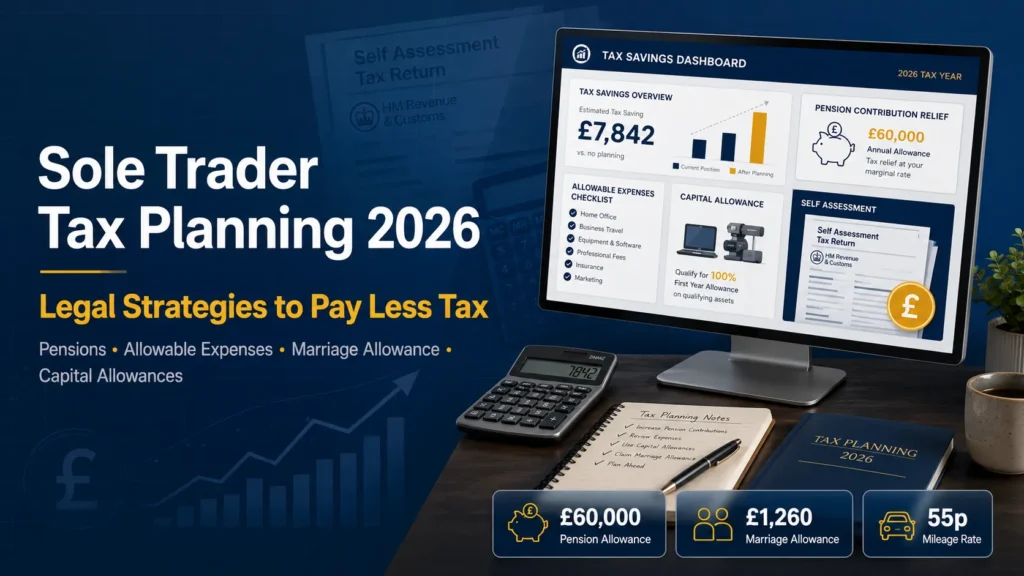
A practical 2026/27 tax planning guide for UK sole traders and freelancers — covering pension contributions, the marriage allowance, capital allowances, income timing, and the most effective legal strategies to reduce your Self Assessment bill.
Being a sole trader gives you less flexibility than a limited company when it comes to tax planning — you cannot split income through dividends or retain profits at a lower rate. But there are still several powerful and entirely legal strategies that can meaningfully reduce your annual Income Tax and National Insurance bill. This guide covers the most effective ones for 2026/27.
Strategy 1: Pension Contributions — The Most Powerful Relief Available
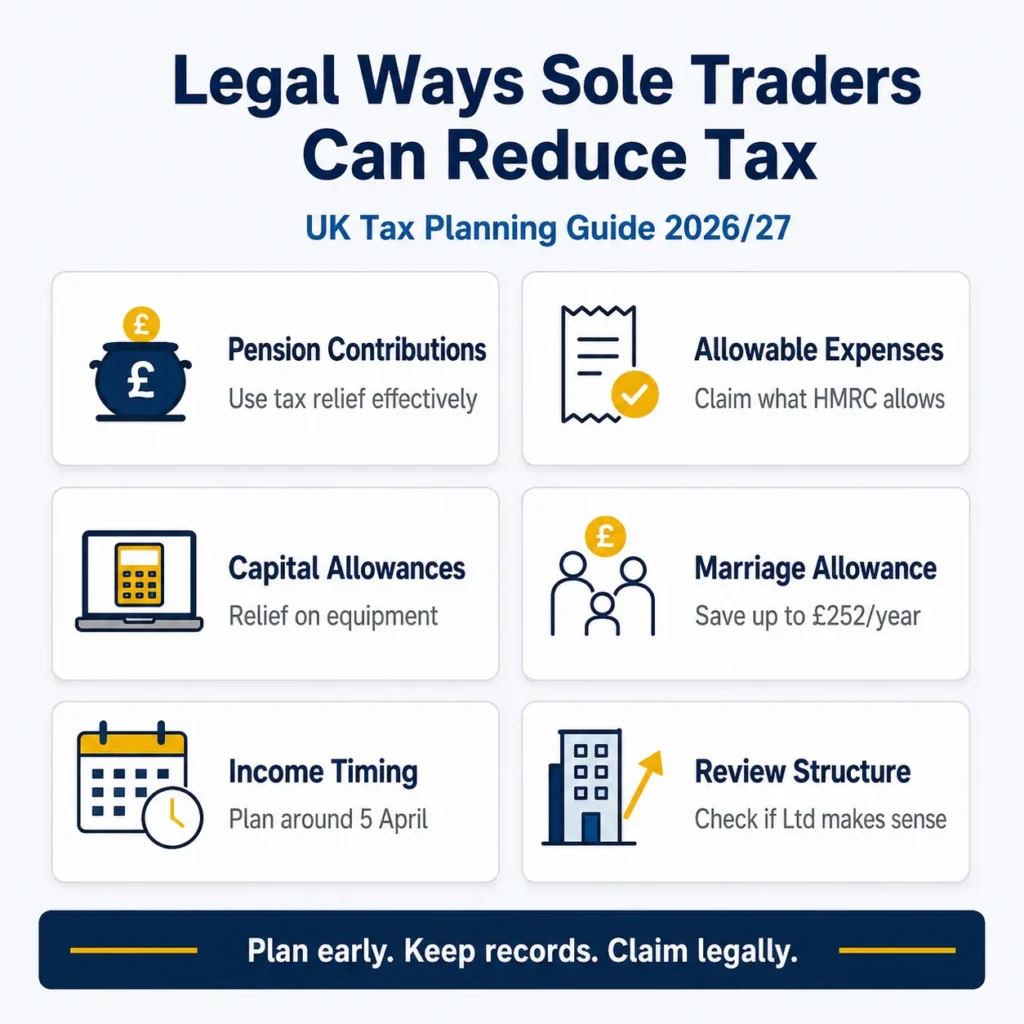
Personal pension contributions are one of the most effective tax planning tools available to sole traders. Contributions to a registered pension scheme — such as a SIPP (Self-Invested Personal Pension) — can reduce your adjusted net income and attract tax relief at your marginal rate. If you are a basic rate taxpayer, every £100 gross pension contribution usually costs you £80 after basic rate relief is added by the pension provider. If you are a higher rate taxpayer, you can normally claim further relief through Self Assessment, meaning a £100 gross contribution can effectively cost around £60.
The annual pension allowance for 2026/27 is £60,000. For personal pension contributions, tax relief is also limited by your relevant UK earnings, so a sole trader usually needs sufficient taxable trading profit to support the contribution. In a high-profit year, pension planning can reduce adjusted net income and help manage exposure to higher rate tax, the personal allowance taper, or payments on account.
ℹ️ Pension Carry Forward Is Available to Sole Traders Too
If you have not used your full annual pension allowance in the previous three tax years, you can carry forward the unused amounts and make a larger contribution this year. This is particularly useful in a high-profit year where profits have exceeded your expectations. You must have been a member of a registered pension scheme in each year from which you carry forward, even if you made no contributions that year.
Strategy 2: Maximise Every Allowable Business Expense
Every pound of allowable business expense reduces your taxable profit directly, saving you both Income Tax and Class 4 NIC. Many sole traders under-claim, particularly on:
- Business mileage: 55p per mile for the first 10,000 car or van business miles in the 2026/27 tax year, and 25p per mile thereafter. This simplified mileage method is often more generous than claiming actual motoring costs, particularly for lower-mileage users with efficient cars
- Home office costs: If you work from home, you can claim either HMRC’s self-employed simplified expenses rate (£10, £18, or £26 per month depending on monthly business hours) or a reasonable proportion of actual home running costs based on the space and time used for work
- Professional subscriptions and training: Subscriptions to professional bodies relevant to your trade, and training that updates existing skills (not skills that are entirely new), are both deductible
- Equipment and technology: Computers, phones, software, and other equipment used for your business are deductible — either as capital allowances or as revenue expenses if they are not capital in nature
- Accountancy and professional fees: The cost of your accountant, bookkeeper, and other professional advisers is deductible as a business expense
Strategy 3: Claim Capital Allowances on Equipment
Sole traders can claim the Annual Investment Allowance (AIA) on qualifying plant and machinery purchases up to £1 million per year — giving 100% tax relief in the year of purchase rather than writing the cost off over several years. For a sole trader spending £10,000 on equipment in a profitable year, claiming AIA in that same year reduces taxable profit by £10,000 immediately.
Timing your equipment purchases strategically — buying before your accounting year end rather than just after — ensures the relief falls in the tax year where it has the greatest impact. If you are likely to cross into the higher rate band this year, an equipment purchase before year end can bring profits back into the basic rate band and save 40% rather than 20% in Income Tax.
Strategy 4: Use the Marriage Allowance
If you are married or in a civil partnership and your spouse or civil partner has income below the personal allowance (£12,570), they can transfer £1,260 of their personal allowance to you. This reduces your Income Tax bill by up to £252 per year. The saving is modest but consistent, requires only a one-time application, and is backdatable for up to four previous tax years — potentially worth over £1,000 if you have not already claimed.
The marriage allowance is only available if the transferring partner pays no Income Tax (their income is below £12,570) and the receiving partner is a basic rate taxpayer. If either partner pays higher rate tax, the allowance is not available.
Strategy 5: Time Your Income and Expenditure
As a sole trader, your taxable profit is based on your accounting period — typically the tax year from 6 April to 5 April, unless you use a different accounting date. Timing can make a meaningful difference:
- Time receipts and invoicing carefully if you have already had a high-income year. From 2024/25, cash basis is the default for most sole traders, so income is generally recorded when payment is received unless you opt to use traditional accounting. Do not delay invoices artificially for completed work, but do plan genuine project timing and payment dates carefully around 5 April
- Bring forward deductible expenditure into a year when your profits are higher. Prepaying for annual software licences, professional subscriptions, or stationery before your year end increases your expenses and reduces your current year profit
- Consider making a pension contribution before 5 April to reduce this year’s taxable income rather than waiting until after the tax year ends
Strategy 6: Review Your Accounting Date
Most sole traders use 5 April as their accounting year end, aligning with the tax year. However, using a different accounting date — for example, 31 March or 31 December — was historically used to defer tax through overlap relief and overlap profits. The rules changed significantly with the introduction of Making Tax Digital for Income Tax, with a new “tax year basis” applying from 2024/25. Under the new rules, all sole traders are assessed on profits arising in the tax year regardless of their accounting date, reducing the deferral benefit. If you use a non-April year end, check with your accountant whether it still serves a purpose for your specific circumstances.
Strategy 7: Employ a Spouse or Civil Partner
If your spouse or civil partner genuinely works in your business, paying them a salary for that work is a legitimate and deductible business expense. The salary must reflect the actual work performed and be commercially reasonable — you cannot pay a spouse a salary of £12,570 for doing nothing. If the salary is genuine and documented, it reduces your taxable profit and makes use of the spouse’s personal allowance and lower tax bands.
This strategy requires careful administration: the salary must be paid through payroll with PAYE registration, RTI submissions, and payslips. Our small business accounting service includes guidance on family employment arrangements and the documentation required to withstand HMRC scrutiny.
Strategy 8: Consider Whether Incorporation Makes Financial Sense
Tax planning as a sole trader has real limits. Above a certain profit level — typically around £30,000 to £35,000 per year — a limited company structure can become more tax-efficient through the salary and dividend model, retained profits taxed at Corporation Tax rates, and employer pension contributions. If your profits are growing consistently, it is worth running the numbers annually.
Incorporation is not right for everyone, and the additional admin and accountancy costs need to be factored in. Our business accounting service includes a structural review for clients approaching the threshold where incorporating may start to make financial sense.
⚠️ MTD for Income Tax Is Coming — Plan Now
Making Tax Digital for Income Tax applies to sole traders and landlords with qualifying income above £50,000 from April 2026, above £30,000 from April 2027, and above £20,000 from April 2028. Under MTD, you must keep digital records and send quarterly updates using compatible software, but you will still need to complete year-end finalisation through the MTD process and pay your tax by the usual deadlines. If you are above or approaching these thresholds, now is the time to ensure your bookkeeping software is MTD-compatible and your records are maintained digitally throughout the year.
Sole Trader Tax Planning Checklist for 2026/27
- Review all business expenses and check nothing allowable is being missed, particularly mileage, home office, and equipment
- Calculate your expected profit and check whether you are approaching the higher rate threshold (£50,270). If so, model the impact of a pension contribution before 5 April
- Check whether the marriage allowance applies and claim it if not already done — backdating to 2022/23 if eligible
- Consider any equipment purchases needed in the business and whether buying before year end makes sense for AIA purposes
- Review the timing of any large invoices or contracts near your year end
- If your profits consistently exceed £30,000, run a comparison with a limited company structure this year
- Check your NI record on GOV.UK — confirm qualifying years are being credited and consider voluntary Class 2 if profits are below £7,105
Want to Reduce Your Sole Trader Tax Bill Legally?
Our ACCA-certified accountants review your profit position, identify every planning opportunity, and ensure your Self Assessment return claims everything you are entitled to. Fixed fee, proactive advice every year.
View Self Assessment ServiceFrequently Asked Questions
How can a sole trader legally reduce their tax bill?
The most effective legal strategies include making personal pension contributions (which reduce taxable income at your marginal rate), claiming all allowable business expenses, using the Annual Investment Allowance on equipment purchases, applying for the marriage allowance if eligible, and timing income and expenditure around your tax year end. None of these involve artificial arrangements — they are all straightforward reliefs designed for self-employed people that HMRC explicitly allows.
How much can a sole trader put into a pension to reduce tax?
The annual pension allowance is £60,000 in 2026/27. For personal pension contributions, tax relief is normally limited to 100% of your relevant UK earnings as well as the annual allowance. Contributions receive tax relief at your marginal rate — basic rate relief is normally added by the pension provider, while higher or additional rate relief is claimed through Self Assessment. If you have unused allowances from the previous three years, carry forward rules may allow you to contribute more than £60,000 in a single year, provided you have enough relevant earnings and meet the carry forward conditions.
What is the marriage allowance and can a sole trader claim it?
The marriage allowance allows a spouse or civil partner who earns below the personal allowance (£12,570) to transfer £1,260 of their unused personal allowance to their partner. The recipient must be a basic rate taxpayer — not a higher rate taxpayer. The saving is £252 per year and is applied as a reduction to your Income Tax bill. It is available to sole traders and employees alike. It can be backdated for up to four previous tax years, potentially worth over £1,000 in total if not previously claimed.
Can I claim capital allowances as a sole trader?
Yes. Sole traders can claim the Annual Investment Allowance (AIA) on qualifying plant and machinery up to £1 million per year, giving 100% tax relief in the year of purchase. Cars are excluded from AIA but attract a writing down allowance based on their CO2 emissions. The AIA is available to both sole traders and limited companies — it is not restricted to incorporated businesses.
At what profit level should a sole trader consider incorporating?
As a general guide, the tax saving from incorporating a sole trader business becomes meaningful once profits consistently exceed £30,000 to £35,000 per year. Below that level, the additional accountancy and administration costs of running a limited company may outweigh the tax saving. Above that level, the salary and dividend model, Corporation Tax rates on retained profits, and the ability to make employer pension contributions can produce a materially better outcome. The correct answer depends on your individual circumstances, including whether you can claim the Employment Allowance and how much profit you need to draw immediately each year.

Muhammad Bilal is a Fellow Chartered Certified Accountant (FCCA) and Director of Protax Consultants, a London-based accounting firm specialising in tax advisory, compliance, and business accounting services.
Bilal qualified with the Association of Chartered Certified Accountants (ACCA) in 2009 and later achieved FCCA status after gaining extensive professional experience. With more than 13 years of experience in accounting, taxation, and auditing, he advises SMEs, landlords, contractors, and charities on tax planning, compliance, and financial management.
As a registered HMRC agent, Bilal assists clients with Self Assessment tax returns, corporation tax planning, VAT compliance, payroll services, and HMRC enquiries.
Bilal holds a BSc (Hons) in Applied Accounting and leads the audit and compliance function at Protax Consultants.
Company Verification:
Protax Consultants Ltd – Company Number 14701253
View Companies House Record