

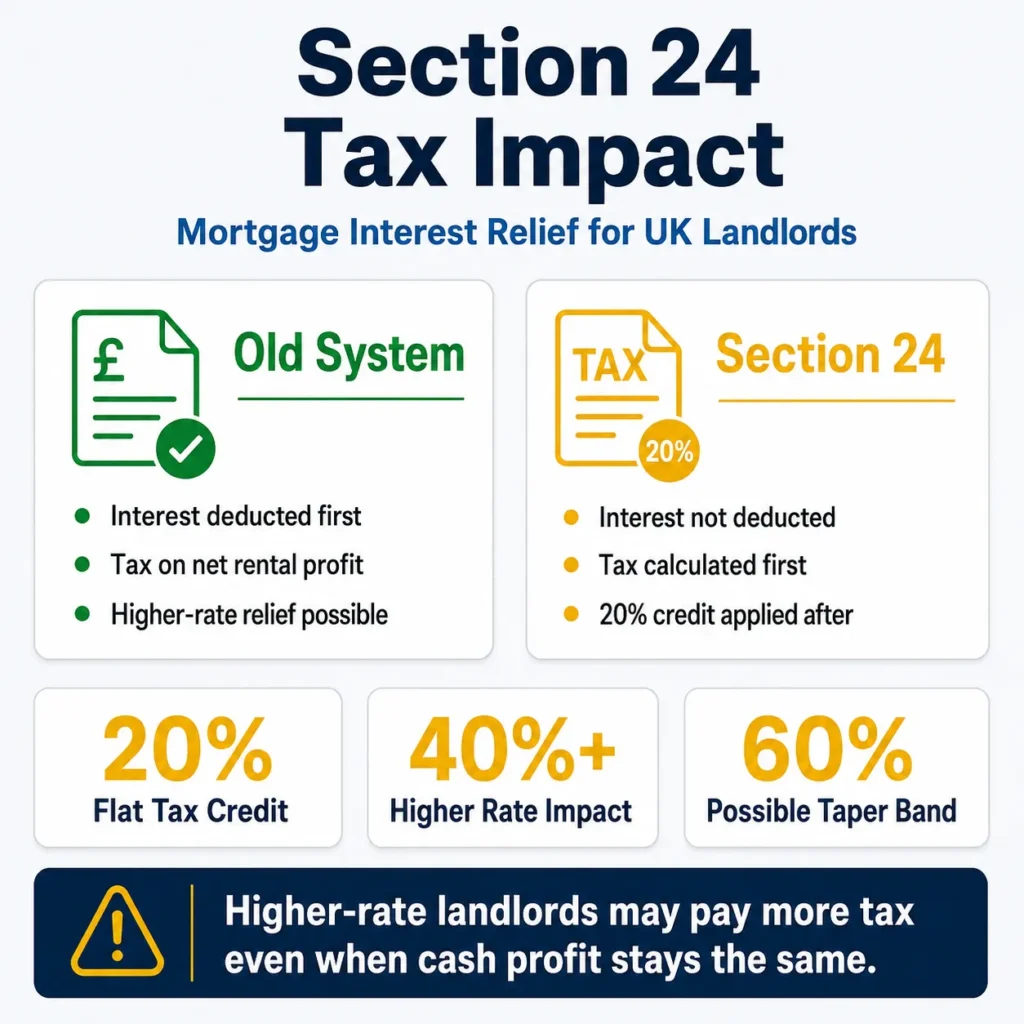
Section 24 of the Finance (No. 2) Act 2015 is the most significant tax change to affect buy-to-let landlords in the past decade. Fully in force since April 2020, it replaced the system of deducting mortgage interest as a business expense with a basic rate tax credit of 20% of finance costs. For basic rate taxpayers the effect is broadly neutral. For higher-rate taxpayers, the additional annual tax cost can run to thousands of pounds on a single property. This guide from the landlord tax team at Protax Consultants explains exactly how Section 24 works, who it affects, and what landlords are doing about it in 2026.
| Section 24 at a Glance |
| Old system (pre-2020): Mortgage interest deducted from rental income before calculating tax Current system (2020 onwards): Tax calculated on full rental profit, then 20% credit applied Who is affected: Individual landlords of residential property with a mortgage Who is NOT affected: Limited companies | Commercial property | (Former FHLs now are affected) The credit is: Always 20% — regardless of whether you are a 40% or 45% taxpayer Result for higher-rate taxpayers: Effective relief halved from 40% to 20% |
What Section 24 Changed and Why
Before Section 24 was phased in between 2017 and 2020, landlords could treat mortgage interest as an allowable business expense, deducting it from rental income before calculating taxable profit. A landlord with £20,000 in rental income and £12,000 in mortgage interest paid tax only on the £8,000 net profit.
From April 2020, that system was removed entirely for individual landlords of residential property. Mortgage interest is no longer deductible. Instead, after calculating tax on the full rental profit, landlords receive a tax credit worth 20% of their finance costs. This credit reduces the final tax bill, but only at the basic rate regardless of the landlord’s actual marginal tax rate.
For the full picture of all landlord tax obligations in 2026, see our complete buy-to-let tax guide.
Who Is, and Is Not, Affected by Section 24?
| Landlord Type | Section 24 Applies? | Mortgage Interest Treatment |
| Individual — residential buy-to-let (own name) | YES | 20% basic rate tax credit only |
| Partnership of individuals — residential BTL | YES | 20% basic rate tax credit only |
| Limited company — residential BTL | NO | Full deduction before Corporation Tax |
| Individual — commercial property | NO | Full deduction as business expense |
| Former Furnished Holiday Let (from April 2025) | YES | FHL regime abolished — Section 24 now applies |
| Individual — property development (trading) | NO | Finance costs deductible for trading purpose |
The FHL abolition from April 2025 is particularly important. If you own a former furnished holiday let and have not updated your tax model to reflect Section 24, this needs urgent attention. Read our furnished holiday let abolition guide for the full transitional rules.
How the 20% Tax Credit Is Calculated
The calculation follows a specific sequence. First, allowable expenses are deducted from rental income to arrive at rental profit, with mortgage interest excluded at this stage. Second, income tax is calculated on that full rental profit at the landlord’s marginal rate. Third, the tax credit equal to 20% of the finance costs is applied to reduce the final tax bill.
The Three-Part Cap
The credit is subject to a three-part cap. It is limited to the lowest of these three figures:
- 20% of the finance costs paid in the year
- 20% of the property business profit after other expenses
- 20% of adjusted total income that exceeds the personal allowance
| When Does the Cap Bite? |
| The cap affects landlords where rental profit is very low relative to mortgage costs — for example, where a property has recently been let at below-market rent, or where significant void periods have reduced income. Where profit is thin and mortgage costs are high, the credit may be smaller than 20% of the full interest paid. Any unused finance cost credit that cannot be used in the current year can be carried forward to the following tax year. |
What Finance Costs Are Included?
| Finance Cost | Within Section 24? | Notes |
| Mortgage interest payments | YES | The main element — the interest portion of monthly payments |
| Arrangement and broker fees | YES — spread over loan term | Amortised, not deducted in full in year incurred |
| Interest on loans for property improvements | YES | Loan must relate to the same property |
| Islamic mortgage alternative finance payments | YES | Treated equivalently to interest |
| Capital repayments | NO | Never finance costs — not deductible under any system |
| Mortgage insurance / life assurance | NO | Deductible as an allowable expense — not a finance cost |
Worked Examples: The Real Cost of Section 24
Example 1: Basic Rate Taxpayer — Broadly Neutral
| Step | Before Section 24 | Under Section 24 |
| Rental income | £15,000 | £15,000 |
| Allowable expenses | −£2,000 | −£2,000 |
| Mortgage interest | −£8,000 | Not deducted |
| Taxable rental profit | £5,000 | £13,000 |
| Income tax at 20% | £1,000 | £2,600 |
| Section 24 credit (20% of £8,000) | — | −£1,600 |
| Final tax bill | £1,000 | £1,000 |
| Impact | Baseline | No change for basic rate taxpayer |
Example 2: Higher-Rate Taxpayer — Significant Impact
| Step | Before Section 24 | Under Section 24 |
| Rental income | £20,000 | £20,000 |
| Allowable expenses | −£3,000 | −£3,000 |
| Mortgage interest | −£12,000 | Not deducted |
| Taxable rental profit | £5,000 | £17,000 |
| Income tax at 40% | £2,000 | £6,800 |
| Section 24 credit (20% of £12,000) | — | −£2,400 |
| Final tax bill | £2,000 | £4,400 |
| Additional tax from Section 24 | — | +£2,400 per year on this property alone |
For a landlord with a portfolio of five similar properties, the Section 24 cost would be approximately £12,000 in additional annual tax. A landlord with £30,000 per year in mortgage interest across their portfolio loses up to £6,000 per year in relief versus the pre-2017 system.
The Personal Allowance Taper: The Hidden Section 24 Cost
Because mortgage interest is no longer deducted from rental profit before tax, a mortgaged property adds more to gross taxable income than the actual net cash flow suggests. This can push landlords into or through the personal allowance taper band.
| Income Band | What Happens | Effective Tax Rate |
| Up to £50,270 | Basic rate — income tax at 20% | 20% |
| £50,271 to £100,000 | Higher rate — income tax at 40% | 40% |
| £100,001 to £125,140 | Personal allowance tapers at £1 per £2 above £100,000 | 60% effective rate |
| Above £125,140 | Personal allowance fully withdrawn — additional rate 45% | 45% |
| Section 24 Can Push You Into the 60% Band Without Any Extra Cash |
| A landlord whose actual cash profit from a property is £5,000 after paying mortgage interest of £10,000 sees £15,000 added to their taxable income by Section 24. If total income was previously just below £100,000, that £15,000 addition creates a 60% effective rate on up to £15,000 of income — not because they are earning more, but because the mortgage interest is no longer reducing taxable profit. Pension contributions that bring adjusted net income below £100,000 restore the personal allowance and remove this 60% band entirely. |
See our guide to director pension contributions for how pension planning can be used to manage this specific exposure.
Strategies Landlords Are Using in 2026
| Strategy | How It Reduces Section 24 Cost | Key Trade-offs |
| Purchase new properties through limited company | Companies not subject to Section 24 — full interest deduction before Corporation Tax | Higher mortgage rates; extracting profits adds personal tax; higher compliance cost |
| Transfer existing properties to company | As above — but only worthwhile once upfront costs recovered | SDLT at full market value + 5% additional surcharge + CGT on any gain — rarely viable without long holding horizon and significant mortgage debt |
| Reduce mortgage balance | Less interest paid each year = smaller Section 24 disadvantage | Opportunity cost of capital; check for early repayment charges before overpaying |
| Form 17 ownership split (joint property) | Move larger income share to basic rate taxpaying spouse — their credit equals relief lost | Requires genuine change in beneficial ownership; mortgage lender consent usually needed; legal costs |
| Pension contributions | Reduces adjusted net income — can keep total income below 40% band or the £100,000 taper threshold | Funds inaccessible until age 57 (from April 2028); subject to annual allowance limits |
| Sell high-LTV properties | Removes properties where Section 24 creates an after-tax loss on the real cash position | CGT at 18%/24% on disposal; 60-day reporting required; market timing considerations |
Section 24 and Making Tax Digital
From 6 April 2026, Making Tax Digital for Income Tax is mandatory for landlords with gross property and self-employment income above £50,000 in the 2024/25 tax year. Read our MTD guide for landlords for the full compliance requirements. The quarterly reporting obligation makes accurate Section 24 calculations more important, not less — because errors in the finance cost credit affect the quarterly tax estimate submitted to HMRC.
Frequently Asked Questions
What is Section 24 in simple terms?
Section 24 is the rule that prevents individual buy-to-let landlords from deducting mortgage interest as a business expense. Instead of reducing taxable rental profit, mortgage interest now generates only a 20% basic rate tax credit applied against the final tax bill. Higher-rate taxpayers pay tax on gross rental income before mortgage costs and receive back only 20% of the interest paid, rather than 40% or 45% as the old system effectively provided. For the full landlord tax picture, see our buy-to-let tax guide for 2026.
Does Section 24 apply to all landlords?
Section 24 applies to individual landlords who own residential property in their own name or through a partnership of individuals. It does not apply to limited companies, commercial property, or properties without a mortgage. Since April 2025 it now applies to former FHL properties that were previously exempt.
How do I calculate my Section 24 tax credit?
The credit is 20% of your finance costs for the year, capped at the lowest of: 20% of the finance costs paid, 20% of rental profit after other expenses, and 20% of adjusted total income above your personal allowance. Any unused credit can be carried forward. Contact the Protax landlord tax team for a personalised calculation.
Can I transfer my buy-to-let to a limited company to avoid Section 24?
You can incorporate, and companies are not subject to Section 24. But the transfer triggers Stamp Duty Land Tax at full market value including the 5% additional property surcharge, and Capital Gains Tax on any gain from original purchase price. These costs are often substantial and take many years of Section 24 saving to recover. Professional modelling is essential before proceeding.
Where can I get Section 24 planning advice in London?
Protax Consultants are ACCA-qualified accountants based in Wimbledon. Our landlord property tax service covers Section 24 planning, ownership structure reviews, pension strategy, and portfolio incorporation modelling. Visit our landlords sector page or call 020 8545 7451.

Muhammad Bilal is a Fellow Chartered Certified Accountant (FCCA) and Director of Protax Consultants, a London-based accounting firm specialising in tax advisory, compliance, and business accounting services.
Bilal qualified with the Association of Chartered Certified Accountants (ACCA) in 2009 and later achieved FCCA status after gaining extensive professional experience. With more than 13 years of experience in accounting, taxation, and auditing, he advises SMEs, landlords, contractors, and charities on tax planning, compliance, and financial management.
As a registered HMRC agent, Bilal assists clients with Self Assessment tax returns, corporation tax planning, VAT compliance, payroll services, and HMRC enquiries.
Bilal holds a BSc (Hons) in Applied Accounting and leads the audit and compliance function at Protax Consultants.
Company Verification:
Protax Consultants Ltd – Company Number 14701253
View Companies House Record