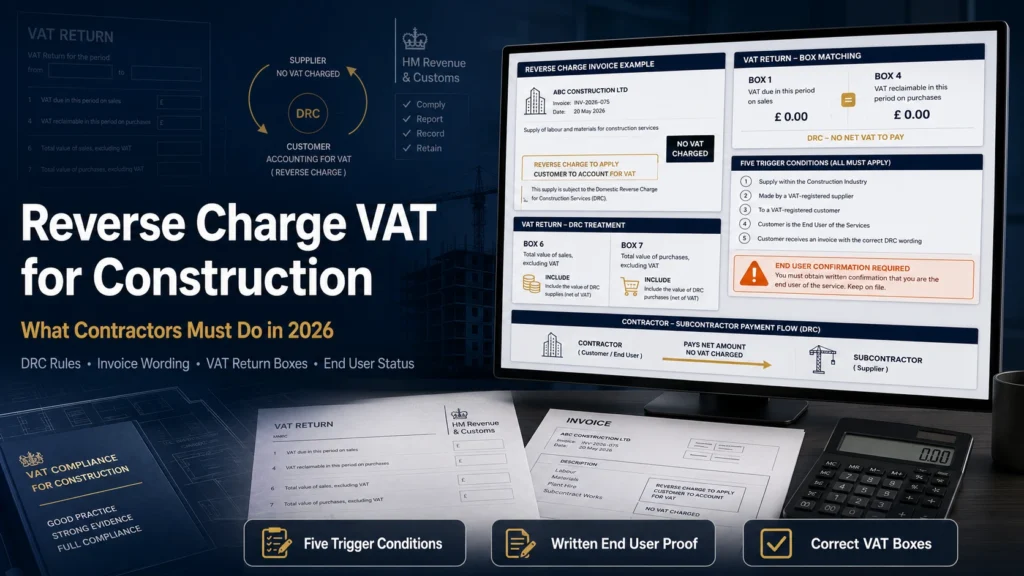
The VAT domestic reverse charge (DRC) for construction was introduced on 1 March 2021 to eliminate a fraud pattern called missing trader fraud, where subcontractors collected VAT from contractors and disappeared without remitting it to HMRC. Five years on, the rule is still frequently misapplied — and HMRC’s patience with errors has visibly run out. This guide from Muhammad Bilal FCCA covers the five trigger conditions, correct invoicing, VAT return box treatment for both contractor and subcontractor, the end user rule, and how the April 2026 GPS changes intersect with DRC compliance. See also our CIS Scheme UK 2026 guide and CIS Gross Payment Status guide.
What the Domestic Reverse Charge Does
Under standard VAT rules, a subcontractor charges VAT on their invoice, collects it from the contractor, and remits it to HMRC on their quarterly VAT return. Under the DRC, the subcontractor issues the invoice without adding VAT. The contractor accounts for the VAT themselves on their own VAT return — declaring it as both output tax and input tax on the same return. The net effect on the contractor’s VAT liability is usually zero. But VAT never passes through the subcontractor’s hands, which eliminates the fraud opportunity.
For subcontractors, the DRC removed a working capital buffer that many relied on. VAT collected used to sit in the subcontractor’s bank for up to three months before being paid to HMRC. That float is gone. Subcontractors whose work is predominantly reverse-charged are often in a net VAT repayment position — paying VAT on materials purchases without collecting VAT on labour sales — and should consider moving to monthly VAT returns to recover input VAT more quickly.
The Five Conditions That Trigger the DRC
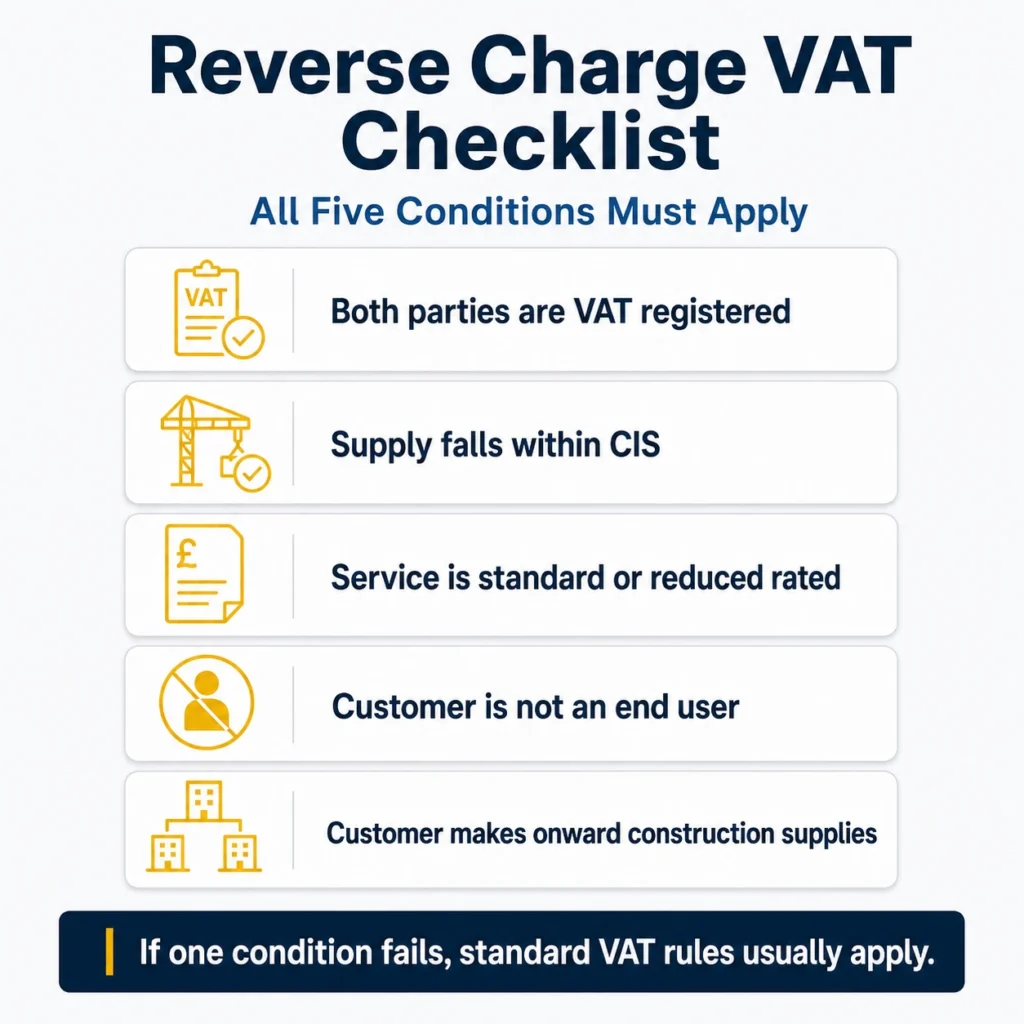
The reverse charge applies only when all five conditions are met simultaneously. If any single condition fails, standard VAT rules apply and the subcontractor charges VAT normally.
| Condition | Satisfied when | DRC applies if |
|---|---|---|
| 1. Both parties are VAT-registered | Customer holds a valid UK VAT number | Both are registered — if customer is not, standard VAT always applies |
| 2. Both parties CIS-registered | CIS registration confirmed for both | The supply must be within CIS scope — if CIS doesn’t apply, DRC doesn’t either |
| 3. Standard or reduced-rated supply | Service is not zero-rated | New-build residential construction is zero-rated and excluded from DRC |
| 4. Customer is not an end user | Customer does NOT occupy the building being constructed | Developer, owner-occupier, housing association building for own stock = end user |
| 5. Customer makes onward supplies | Customer sells the construction services on | Main contractors, tier-one subcontractors — they on-sell the work to others |
Practical test: if your customer will invoice someone else for the construction work you are doing, the DRC almost certainly applies. If they are the ultimate occupier or owner of the building, they are probably an end user, and you charge VAT normally — but only if they confirm that in writing.
What Work Is Covered?
The DRC applies to construction operations within the scope of CIS. In practice, this covers:
- Building, alteration, repair, extension, and demolition
- Site preparation and groundworks
- Installation of mechanical and electrical systems — heating, ventilation, air conditioning, lighting, drainage
- Painting, decorating, and internal finishing
- Civil engineering — roads, bridges, tunnels, harbours
The DRC does not cover architecture, quantity surveying, scaffolding hire without labour, carpet fitting, or off-site fabrication and manufacturing.
Important note on the 5% disregard: if a supply is predominantly non-DRC but contains a DRC element worth 5% or less of the total, both parties can agree to treat the whole supply under standard VAT rules. Both must actively agree to use the disregard, and the decision must be documented. This is not automatic.
How to Invoice as a Subcontractor
When the DRC applies, do not add VAT to your invoice totals. Your invoice must nonetheless state the VAT rate that would have applied and the amount the contractor must account for. It must include one of these phrases:
- “Reverse charge: VAT Act 1994 Section 55A applies”
- “Reverse charge: customer to pay the VAT to HMRC”
Either wording is acceptable. The words ‘reverse charge’ must appear. An invoice that simply shows £0 VAT without any statement is non-compliant and creates uncertainty for the contractor.
Worked Example: Correct Reverse Charge Invoice
A plastering subcontractor completes a commercial office fit-out and invoices the main contractor:
| Line | Amount |
|---|---|
| Plastering and skimming, floors 2–5 | |
| Labour and materials | £11,600.00 |
| VAT | £0.00 — Domestic reverse charge applies (VAT Act 1994 Section 55A) |
| Total payable | £11,600.00 |
| VAT rate that would have applied | 20% — £2,320.00 — Customer to self-account to HMRC |
VAT Return Treatment: Contractor Receiving the Invoice
When you receive a DRC invoice as a contractor, you account for the VAT yourself. Most construction accounting software (Xero, QuickBooks, Sage) handles this automatically with the correct DRC tax code — but you must use the right code.
| VAT return box | What to do | Why |
|---|---|---|
| Box 1 (VAT due on sales) | Include the VAT amount from the reverse charge invoice | You are deemed to have made a VAT supply to yourself |
| Box 4 (VAT reclaimed on purchases) | Include the same amount as input tax | You recover VAT on the corresponding purchase |
| Box 6 (total sales ex-VAT) | Do NOT include the value of this DRC supply | You are not the supplier of the construction service |
| Box 7 (total purchases ex-VAT) | Include the net value of the DRC purchase | Standard purchase recording |
The net VAT effect on your return is usually zero — Box 1 and Box 4 increase by the same amount and cancel out. But the figures in those boxes do increase, which affects partial exemption calculations if your business makes any exempt supplies. If you have a mixed business, take advice.
VAT Return Treatment: Subcontractor Making the Supply
| VAT return box | What to do | Why |
|---|---|---|
| Box 1 (VAT due on sales) | Do NOT include anything for DRC supplies | You did not charge VAT — there is no output tax |
| Box 6 (total sales ex-VAT) | Include the net value of the DRC supply | The turnover is still your sale even without VAT |
| Box 4 (VAT reclaimed on purchases) | Include input VAT on your materials in the normal way | VAT on your inputs is still recoverable |
Because Box 6 increases but Box 1 does not, subcontractors doing DRC work predominantly are typically in a repayment position — claiming input VAT on materials without collecting output VAT on sales. Monthly VAT returns significantly improve cash flow for subcontractors in this position. Apply to switch to monthly returns through your Government Gateway VAT account.
The End User Rule: Written Confirmation Is Non-Negotiable
If your customer is a genuine end user — they are occupying or developing the property for their own use and not making an onward supply of the construction service — you charge VAT normally, and the DRC does not apply.
But you cannot assume end-user status. You must obtain written confirmation from the customer before invoicing with VAT. Written confirmation can be a line in the contract, an email, or a letter. It does not need to follow a specific format. Without written confirmation in your records, you must apply the DRC regardless of what you believe about the customer’s position.
If HMRC challenges your VAT treatment and you cannot produce the written confirmation, you may be assessed for the output VAT that should have been charged. This is not a theoretical risk — HMRC is finding exactly this error in 2026 compliance reviews.
Local authority point: from 6 April 2026, local authorities are exempt from CIS as subcontractors. But if a local authority is your customer and they are acting commercially (for example, selling the construction service on), CIS and DRC may still apply to your supply to them. Get their written status confirmation before invoicing.
Flat Rate Scheme Considerations
Businesses on the VAT Flat Rate Scheme must exclude DRC supplies from their flat rate calculation entirely. When receiving a DRC invoice, flat rate scheme businesses must account for the VAT on the return and recover it at the same time — outside the flat rate mechanism.
The scheme’s advantage is retaining the difference between the flat rate and 20%. For DRC supplies, that mechanism does not apply. Most subcontractors doing DRC work predominantly find the Flat Rate Scheme no longer beneficial and should consider deregistering from the scheme. Review with your accountant.
HMRC Enforcement in 2026: What Has Changed
The DRC rules themselves are unchanged in 2026. The change is in enforcement. HMRC has moved from the educational, light-touch approach it took in 2021 to active identification of errors, issuing of assessments, and application of penalties.
The most common errors HMRC is finding in 2026:
- Subcontractors charging VAT on supplies that should be DRC — the contractor pays, and the subcontractor keeps the VAT without remitting it
- Contractors paying VAT were charged without querying whether DRC should have applied
- No written end-user confirmation in the records — so the standard VAT treatment cannot be defended
- Incorrect Box 1 treatment on the contractor’s VAT return
- Flat rate scheme subcontractors not excluding DRC values from their flat rate calculation
HMRC is cross-referencing CIS monthly returns against VAT returns systematically. Where a contractor’s CIS return shows subcontractor payments that look like DRC supplies but the VAT return shows input VAT claimed that suggests standard-rated invoices were received, flags are being raised and compliance checks are being opened.
How DRC Errors Affect CIS Gross Payment Status
From April 2026, HMRC’s new ‘should have known’ standard for GPS revocation means that supply chain VAT non-compliance is now a GPS risk as well as a VAT risk. A construction business that consistently applies the wrong VAT treatment — receiving standard-rated invoices for supplies that should be DRC — may be seen as part of a supply chain that HMRC considers fraudulent or non-compliant, triggering a GPS review.
GPS holders in the construction sector should treat DRC compliance as inseparable from CIS compliance. See our CIS Gross Payment Status guide for full details on the April 2026 revocation powers.
Protax Consultants: Construction VAT and CIS Compliance in London
Muhammad Bilal FCCA and the Protax team advise London construction contractors and subcontractors on domestic reverse charge compliance, CIS returns, GPS applications, and VAT return accuracy. We review VAT treatment across existing contracts, check Box 1/Box 4/Box 6/Box 7 treatment, advise on Flat Rate Scheme suitability, and represent clients in HMRC DRC compliance checks.
Based in Wimbledon, HMRC-authorised, ACCA-registered (5743262), serving clients across all London boroughs and the UK. Fixed fee. Visit our VAT returns service or our CIS returns service, or call 020 8545 7451.
Frequently Asked Questions
Does the reverse charge apply to every construction invoice?
No. It only applies when all five conditions are met: both parties are VAT-registered and CIS-registered, the supply is standard or reduced-rated, the customer is not an end user, and the customer makes onward supplies of construction services. Miss any one condition and standard VAT applies.
My customer says they are an end user but has not confirmed it in writing. Can I charge VAT?
No. Without written confirmation, you must apply the DRC. An email or a line in the contract counts as written confirmation — it does not need to be a formal document. But it must exist and be retained. Without it, HMRC will not accept the end-user argument if they challenge you.
What is the 5% disregard, and when does it apply?
If the DRC element of a supply is 5% or less of the total invoice value, both parties can agree to treat the whole supply under standard VAT rules. Both parties must agree, and the decision and rationale should be documented. It is not available to one party unilaterally.
We have been charging VAT incorrectly for the last year. What should we do?
Act quickly. Correct errors on your VAT return for amounts below HMRC’s error correction threshold (the greater of £10,000 or 1% of turnover, capped at £50,000). For amounts above the threshold, use form VAT652. We strongly recommend taking specialist advice before attempting self-correction on significant amounts — errors that have been running for a long time can involve complex cross-period adjustments and interaction with the other party’s VAT position. Contact us at protax.org.uk or call 020 8545 7451.
Should I switch to monthly VAT returns if I do mostly DRC work?
Yes, in most cases. If you are a subcontractor doing DRC work predominantly, you are paying VAT on materials inputs but not collecting VAT on labour outputs. Quarterly returns mean you wait up to three months to recover that input VAT. Monthly returns give you that cash back every four weeks, which makes a material difference to working capital.
Where can I get construction VAT advice in London?
Protax Consultants in Wimbledon advise construction businesses on DRC compliance, CIS returns, GPS applications, and VAT return accuracy. Muhammad Bilal FCCA, ACCA reg 5743262. Fixed fee, no obligation. Visit our VAT returns service or call 020 8545 7451.

Muhammad Bilal is a Fellow Chartered Certified Accountant (FCCA) and Director of Protax Consultants, a London-based accounting firm specialising in tax advisory, compliance, and business accounting services.
Bilal qualified with the Association of Chartered Certified Accountants (ACCA) in 2009 and later achieved FCCA status after gaining extensive professional experience. With more than 13 years of experience in accounting, taxation, and auditing, he advises SMEs, landlords, contractors, and charities on tax planning, compliance, and financial management.
As a registered HMRC agent, Bilal assists clients with Self Assessment tax returns, corporation tax planning, VAT compliance, payroll services, and HMRC enquiries.
Bilal holds a BSc (Hons) in Applied Accounting and leads the audit and compliance function at Protax Consultants.
Company Verification:
Protax Consultants Ltd – Company Number 14701253
View Companies House Record