
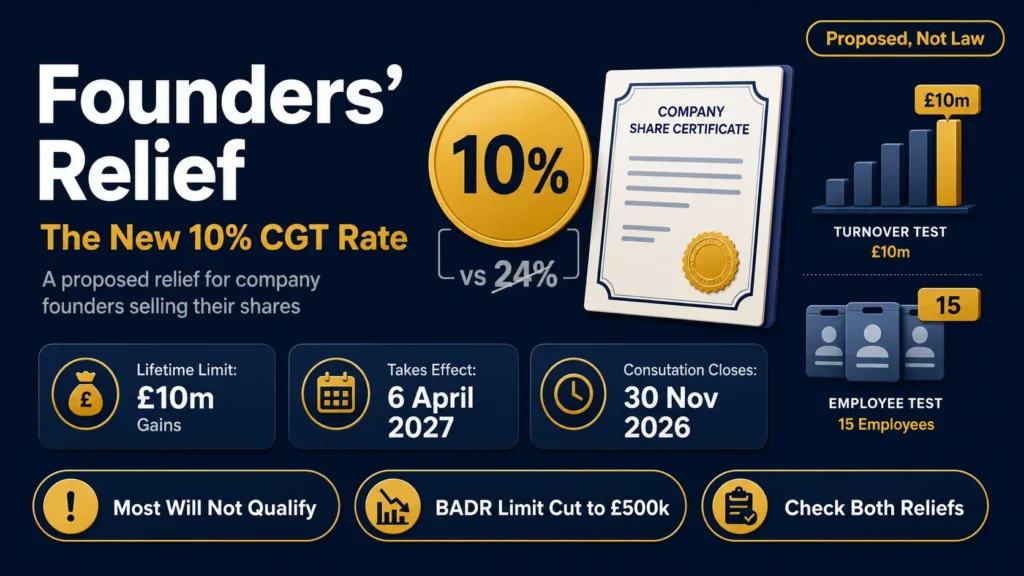
Founders’ Relief would charge Capital Gains Tax at 10% on up to £10 million of qualifying gains for founders selling shares in their own company, for disposals on or after 6 April 2027. Against the 24% main higher rate, that is worth up to £1.4 million.
The proposed conditions are strict. Your company would need turnover of at least £10 million and at least 15 qualifying full-time employees, and would have to pass two of three growth or research and development tests. Most owner-managed companies will not qualify, and it is better to know that now than after you have built an exit around it.
This article sets out what is proposed, who would actually qualify, and what the same Budget did to the relief most founders will rely on instead.
What is Founders’ Relief?
Founders’ Relief is a proposed new Capital Gains Tax relief aimed at founders of companies that have grown substantially. Where it applies, qualifying share disposals would be taxed at 10% rather than the main rate.
| Feature | Proposed |
| CGT rate | 10% |
| Lifetime limit | £10 million of qualifying gains |
| First applies to | Disposals on or after 6 April 2027 |
| Legislation route | Amendments to Finance Bill 2026-27 |
| How you claim | Through Self Assessment, possibly with an additional prescribed form |
| Status | Technical consultation, closing 30 November 2026 |
The £10 million is a lifetime allowance, and it would be reduced by amounts already used against the Business Asset Disposal Relief and Investors’ Relief lifetime limits from 6 April 2027 onwards.
On a £5 million qualifying gain, 10% gives roughly £500,000 of Capital Gains Tax, against about £1.2 million at 24%.
Will you qualify? The honest answer
Probably not, and that is the most useful thing this article can tell you.
The tests are built around companies that have scaled, not companies that are merely profitable. A successful consultancy, agency, trade business or professional practice turning over £1 million to £5 million with a handful of staff fails the turnover test and the employee test before any of the growth tests are reached.
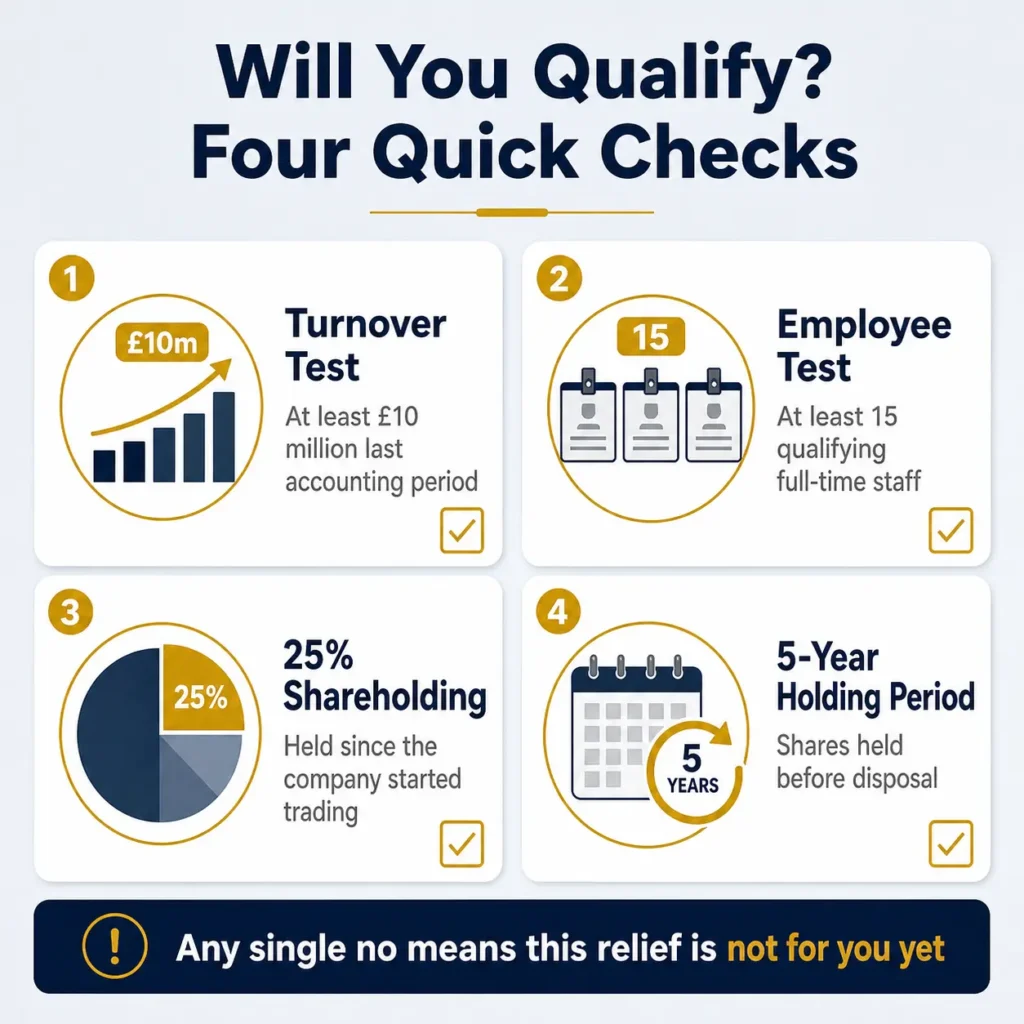
Run these four checks before reading further. If any one is a no, Founders’ Relief as proposed is not for you:
- Did your company turn over at least £10 million in its last accounting period?
- Does it have at least 15 qualifying full-time employees, not counting directors?
- Did you hold at least 25% of the ordinary share capital from the time the company started trading?
- Have you held the shares for at least five years?
The proposed conditions in full
What you must satisfy as an individual
| Condition | Proposed requirement |
| Shareholding | At least 25% of ordinary share capital, with matching voting and economic rights, at the time the company started trading or began preparing to trade |
| Holding period | Shares or securities held for at least five years before disposal |
| Residence | UK tax resident for at least five continuous tax years before disposal |
| Who can claim | Individuals only, though ownership through a holding company of a trading group may be permitted |
The shareholding test is the one that surprises people. It is measured at the outset, at the point the trade the company was formed for commenced or preparation for it began, not immediately before the sale. A founder who began with 10% and built up to 60% over a decade would appear to fail it, while one who started with 30% and was diluted to 12% could still meet it. The 25% test can also be met through the holding company of a trading group, and more than one individual can claim the relief on the same company.
What your company must satisfy
| Condition | Proposed requirement |
| Tax residence | Within the scope of UK Corporation Tax, with a substantial UK presence across the five accounting periods before disposal |
| Trading status | A qualifying trading company, or the holding company of a trading group, without substantial non-trading or excluded activities |
| Continuity | Still carrying on the trade it was set up for, with no major change in its nature |
| Turnover | At least £10 million in the accounting period before disposal |
| Employees | At least 15 qualifying full-time employees in the accounting period before disposal |
A qualifying employee means someone working at least 35 hours a week and paid at least the UK National Minimum Wage. Directors, contract workers and agency workers are all excluded from the count, which matters for founder-heavy businesses that rely on contractors.
The excluded trading activities mirror those used for EIS, so dealing in land, financial services and property development would take a company outside the relief regardless of its size or growth.
The growth and innovation tests: two of three
| Test | Proposed requirement |
| Turnover growth | Average annual compound growth of at least 25% over three consecutive accounting periods within the ten years before disposal, with turnover already at least £10 million in the period immediately before that growth period |
| Employee growth | Average annual compound growth of at least 25% in qualifying full-time equivalent employees over three consecutive periods within the same window, with at least 15 qualifying employees in the period immediately before it |
| Research and development | At least £1.5 million of qualifying R&D expenditure, with qualifying R&D tax relief claims for accounting periods ending within the three years before disposal |
One practical risk in the R&D route: if HMRC later successfully challenges an R&D claim, that could affect entitlement to the relief as well. A relief that depends on a claim being upheld years later is a weaker foundation than one that does not.
Record keeping will matter more than usual. A claim has to carry the information HMRC prescribes, including which accounting periods are relied on for each condition, and the consultation says HMRC would treat a claim lacking that information as unsatisfactory. The government is also considering giving individuals a statutory right to request information from companies they no longer control, which would matter to a founder who has exited and later needs evidence to support a claim.
What the same Budget did to Business Asset Disposal Relief
For most founders this is the more consequential change. Business Asset Disposal Relief keeps its 18% rate, but its lifetime limit falls from £1,000,000 to £500,000 for disposals on or after 6 April 2027. Relief already claimed counts towards the reduced limit, and an anti-forestalling rule applies to contracts signed before that date but completed afterwards. Our Business Asset Disposal Relief guide covers the mechanics in full.
So the Budget gave a generous relief to a small number of scaled companies and reduced the ordinary relief available to everyone else. If you are in the second group, your planning question is about timing, not eligibility.
If you will not qualify, here is what actually matters
For the great majority of company owners, the useful response to Founders’ Relief is to ignore it and look at the £500,000 Business Asset Disposal Relief limit instead.
- Model any exit on both sides of 6 April 2027. If a sale, share buyback or members’ voluntary liquidation was already on a two-year horizon, the reduced limit is a real cost on gains above £500,000.
- Check what lifetime limit you have left. Relief claimed on earlier disposals counts towards the new, lower figure.
- Take the anti-forestalling rule seriously. Signing before 6 April 2027 and completing afterwards is not a reliable way around the change.
- Do not accelerate a sale on tax alone. A worse price or worse terms will usually cost more than the relief saved.
- Keep the growth tests in view if you are genuinely scaling. A company heading towards £10 million of turnover and 15-plus employees should be documenting its growth and R&D position now, because the tests look back over three accounting periods.
We review individual positions, including which relief is realistically available and what the timing is worth, through our Capital Gains Tax service. Founders at an earlier stage may find our accountants for startups page more relevant, and anyone still choosing a structure should start with how to set up a limited company.
The Founders’ Relief consultation closes on 30 November 2026
HM Treasury published the technical consultation on 28 October 2026, and it closes on 30 November 2026. It asks about the definition of a qualifying founder, permitted ownership structures, company eligibility, the growth and innovation tests, and what evidence claimants should have to produce.
If your company is close to the thresholds, or the shareholding-at-outset test would exclude you on a technicality, responding is worth the time. The detail is still genuinely open, and the version that reaches the Finance Bill may differ from what is proposed now.
Once the consultation has closed, the proposals move towards legislation through Finance Bill 2026-27. Until that is enacted, nothing here is settled law, and any planning built on Founders’ Relief should assume the conditions can still move.
Frequently asked questions
What is Founders’ Relief?
A proposed Capital Gains Tax relief charging 10% on up to £10 million of qualifying gains when a founder sells shares in their own company, for disposals on or after 6 April 2027.
Is Founders’ Relief law yet?
No. It is a technical consultation published on 28 October 2026, closing on 30 November 2026, expected to be legislated through Finance Bill 2026-27. The conditions may change.
What is the Founders’ Relief consultation?
A technical consultation published by the government on 28 October 2026 setting out the proposed design of the relief, including every qualifying condition and the evidence a claimant would need to produce. It closes on 30 November 2026, and responses may change the final rules.
When would Founders’ Relief start?
It is intended to apply to qualifying disposals on or after 6 April 2027.
What is the Founders’ Relief lifetime limit?
£10 million of qualifying gains per individual, reduced by amounts already claimed against the Business Asset Disposal Relief and Investors’ Relief limits from 6 April 2027. More than one individual can claim on the same company.
Do I need to own 25% of my company?
As proposed, yes, with matching voting rights and rights to distributable profits and assets on winding up. It is measured at the point the trade commenced or preparation for it began, not immediately before the sale.
Does my company need 15 employees?
As proposed, at least 15 qualifying full-time employees in the accounting period before disposal, each working at least 35 hours a week and paid at least the National Minimum Wage. Directors, contract workers and agency workers do not count.
Can I claim both Founders’ Relief and Business Asset Disposal Relief?
They are separate reliefs, but the £10 million Founders’ Relief limit is reduced by what you have used against the BADR and Investors’ Relief lifetime limits from 6 April 2027.
My company turns over £2 million. Will I qualify?
No. As proposed, the turnover test requires at least £10 million in the accounting period before disposal. The Business Asset Disposal Relief position is the one to look at instead.
How do I claim it?
Through your Self Assessment return for the tax year of disposal, including the information HMRC prescribes and the accounting periods relied on for each condition. The consultation suggests a standard form may be required, and says HMRC would treat a claim without that information as unsatisfactory.
Find out which relief you can actually use
The practical question is not whether Founders’ Relief exists. It is which relief applies to your company, how much lifetime limit you have left, and whether 6 April 2027 changes your timing. That takes one conversation and your last set of accounts.
Protax Consultants is led by Muhammad Bilal FCCA and holds ACCA audit registration 5743262. We are based in Wimbledon and advise company owners across London and the UK. Fees are agreed before work begins.
This article is general information about proposed legislation, not advice on your own position. The rules are subject to change before enactment.
Sources (editorial, not for publication)
- GOV.UK, CGT Founders’ Relief technical consultation. The primary source. Every rate, limit, condition and test in this article was checked against this document, which is what the calendar note asked for
- GOV.UK, Founders’ Relief: technical consultation. The consultation page, and where responses go before 30 November 2026
- Alexander & Co, CGT Founders’ Relief. Used only as a cross-check against the primary document

Muhammad Bilal is a Fellow Chartered Certified Accountant (FCCA) and Director of Protax Consultants, a London-based accounting firm specialising in tax advisory, compliance, and business accounting services.
Bilal qualified with the Association of Chartered Certified Accountants (ACCA) in 2009 and later achieved FCCA status after gaining extensive professional experience. With more than 13 years of experience in accounting, taxation, and auditing, he advises SMEs, landlords, contractors, and charities on tax planning, compliance, and financial management.
As a registered HMRC agent, Bilal assists clients with Self Assessment tax returns, corporation tax planning, VAT compliance, payroll services, and HMRC enquiries.
Bilal holds a BSc (Hons) in Applied Accounting and leads the audit and compliance function at Protax Consultants.
Company Verification:
Protax Consultants Ltd – Company Number 14701253
View Companies House Record