
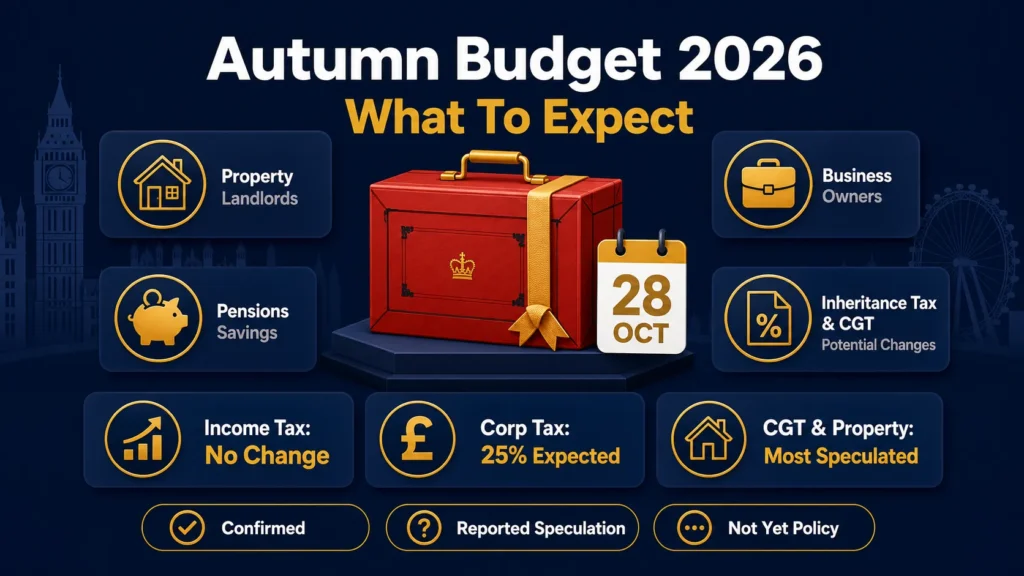
The Autumn Budget 2026 is scheduled for Wednesday 28 October. Ahead of the announcement, attention is focused on possible changes to Capital Gains Tax, property taxation, pensions, Inheritance Tax and business reliefs.
The Chancellor has reaffirmed a commitment not to increase the main rates of Income Tax, employee National Insurance or VAT. However, this does not rule out changes to allowances, reliefs or other taxes. Many of the proposals discussed in the media remain speculation, and no decision should be treated as confirmed until the Budget is announced and the relevant details are published.
This guide separates the reported possibilities from the current position and explains what business owners and landlords may want to consider before making financial decisions.
What Has Been Confirmed Ahead of the Autumn Budget?
Budgets are typically announced with limited advance detail. Based on the information available ahead of the announcement, the key points are:
- Budget date: Wednesday 28 October 2026.
- Main tax rates: The Chancellor has reaffirmed the commitment not to increase the main rates of Income Tax, employee National Insurance or VAT.
- Corporation Tax: The main rate is widely expected to remain at 25%, although this should not be treated as a formal guarantee of the final Budget position. See our Corporation Tax guide for the current position either way.
Other potential changes discussed below have not been confirmed. The distinction matters: reported proposals can help identify areas to monitor, but they are not a reliable basis for making irreversible financial decisions.
Autumn Budget 2026: What Could Change for Business Owners?
For business owners, the main areas to watch include employment costs, pension contributions, business rates, VAT and sector-specific taxes.
Employer National Insurance and Employment Allowance
Some commentary has raised the possibility of changes to employer National Insurance for businesses recruiting workers under 25, alongside a potential increase in the Employment Allowance available to eligible employers. See the current employer National Insurance rates as your baseline.
Neither proposal should be treated as confirmed. Employers should continue to budget using the current rules until any changes are formally announced and their eligibility conditions are clear.
Salary Sacrifice and Pension Contributions
Salary sacrifice arrangements can affect the tax and National Insurance treatment of certain pension contributions. Following previously announced changes expected from 2029, there has been speculation about whether the government could tighten the rules further or bring changes forward.
Business owners considering pension arrangements should review the rules currently applicable to them and avoid changing an established arrangement solely in response to unconfirmed reports. Our guide to director pension contributions covers how this currently works.
Dividend Tax
Dividend tax remains relevant to directors and shareholders who receive income from their companies. Although no specific major change was identified in the supplied Budget speculation, current dividend tax rates and allowances should be checked against the rules that apply to the relevant tax year.
If you draw income from a limited company, it is worth considering salary, dividends and pension contributions together rather than making a decision based on one tax rate in isolation. Our director salary and dividend service explains how these issues can be reviewed.
Business Rates
Further changes to business rates reliefs or how rates are applied have been discussed. Some commentary has also suggested that local authorities could receive greater flexibility in applying certain measures.
Businesses that rely on premises should wait for the published policy details before updating their forecasts. The practical effect of any change will depend on the property, the business and the final eligibility rules.
VAT Registration Threshold
The VAT registration threshold and the treatment of particular goods and services have also been mentioned in Budget speculation. The current threshold stated in the supplied material is £90,000, but any proposed change would need to be confirmed in the Budget documents.
Businesses should continue monitoring their taxable turnover and meeting their existing VAT obligations. Do not delay registration or alter pricing assumptions based on an unconfirmed threshold change. Read more about our VAT return services.
Working From Home Tax Relief
Working-from-home tax relief has reportedly resurfaced in Budget discussions. No change has been confirmed in the information available for this article.
Employers and employees should continue to follow the existing rules until any announcement clarifies whether relief will change, who would qualify, and when new rules would take effect.
Sector-Specific Taxes
Commentary has also highlighted possible tax changes affecting banks and gaming or machine duties on cash-prize machines. These proposals would have a more direct effect on particular sectors than on small businesses generally.
Businesses in affected industries should assess the published measures once available rather than assuming that sector-specific speculation signals a wider increase in business taxes.
Autumn Budget 2026: What Landlords and Property Owners Should Watch
Property taxation is one of the most widely discussed areas ahead of the Budget. Potential changes could affect landlords, investors and owners of property held through companies, but the proposals remain unconfirmed.
Capital Gains Tax
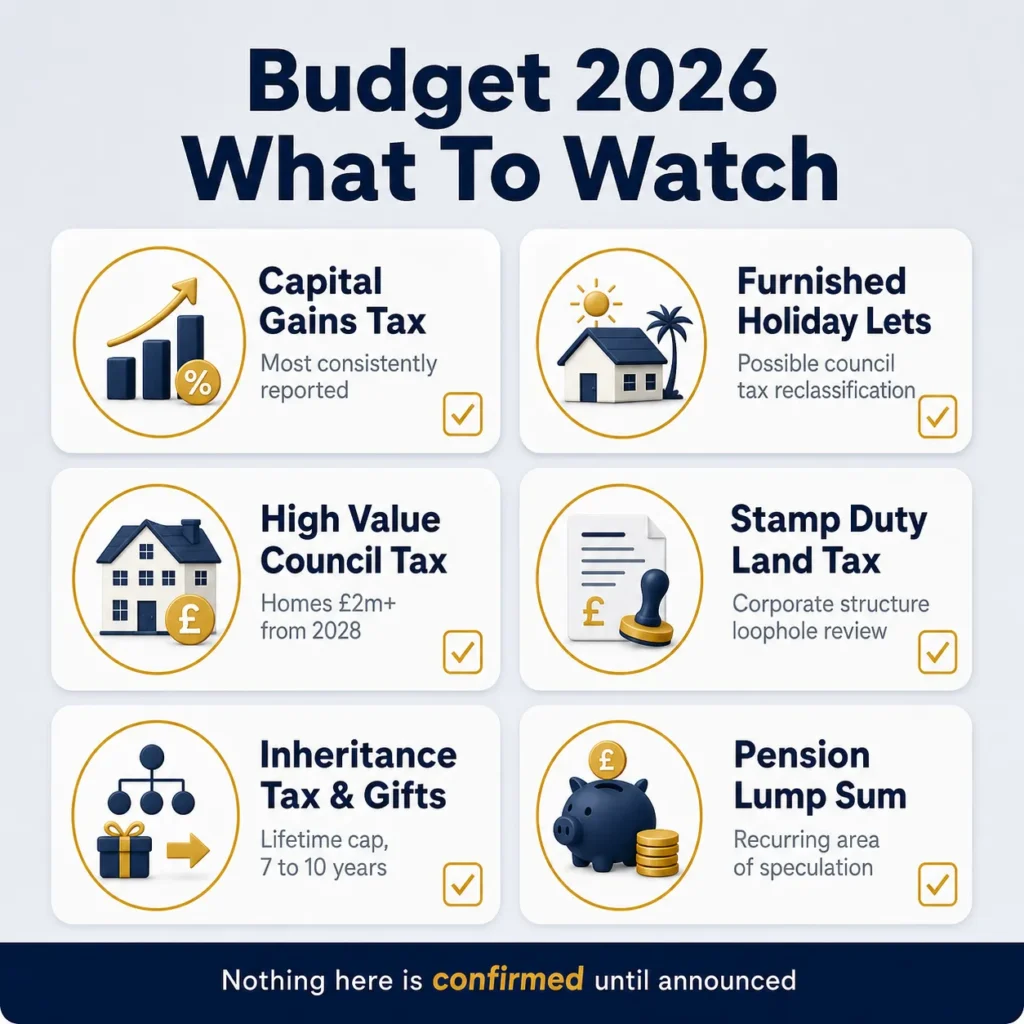
Capital Gains Tax (CGT) has been one of the most consistently reported areas of speculation. Reports have suggested that rates could increase or move closer to Income Tax rates. One widely circulated report mentioned a possible rate as high as 45%, reportedly in connection with a proposed increase in the tax-free Personal Allowance from £12,570 to £15,570.
These specific figures are unconfirmed and should be treated cautiously. Media reports do not establish the final rates, any exemptions, transitional arrangements or the date on which changes might apply.
If you are considering selling an asset or property, review the current tax position and the wider financial implications before deciding when to proceed. A sale should not be rushed solely because of Budget speculation. Our Capital Gains Tax service can help you understand the relevant considerations.
Furnished Holiday Lets
There has been speculation that furnished holiday lets could be treated as second homes for council tax purposes rather than businesses, potentially affecting eligibility for Small Business Rates Relief, building on last year’s furnished holiday let abolition.
Any change would need to be assessed against the final rules, the property’s use and the relevant local authority arrangements. Owners should not assume that their property classification or relief eligibility has changed before official guidance is available.
High Value Council Tax Surcharge
The High Value Council Tax Surcharge, often referred to as a mansion tax, was described in the supplied material as a measure announced in the previous Budget and due to take effect from April 2028 for homes worth £2 million or more. Reports have suggested that the initial design or level of the charge could be revisited.
Property owners should distinguish between an announced measure, its confirmed implementation details and any later speculation about changes. The final rules will determine who is affected and what the financial impact may be.
Stamp Duty Land Tax
Possible changes to Stamp Duty Land Tax (SDLT) have also been discussed, including the potential closure of a reported loophole involving commercial property held through corporate structures.
Until the government publishes the details, property buyers and companies should continue to assess transactions under the current rules and obtain advice before making decisions about ownership structures. See our Stamp Duty Land Tax guide for the current rules this would sit alongside.
Annual Tax on Enveloped Dwellings
Annual Tax on Enveloped Dwellings (ATED), which can apply to certain residential properties held through companies, has also been mentioned as a possible area for change.
Companies holding residential property should monitor the Budget announcement and check the applicable ATED requirements for their circumstances. A reported possibility is not confirmation that rates or obligations will change.
Wider Property Tax Reform
Longer-term proposals involving land value tax or a more fundamental reform of property taxation have appeared in wider policy discussions. These ideas have been presented as possible directions for future reform rather than confirmed measures for this Budget.
For landlords, any eventual changes need to be considered alongside existing rules affecting rental income, property disposals and mortgage interest relief, and our buy-to-let tax guide covers the current position. Our landlord and property tax service can help you review the current position.
Inheritance Tax and Pensions: Other Areas to Monitor
Business owners and landlords may also be affected by changes to Inheritance Tax and pension rules, particularly when planning retirement or the transfer of business and family assets.
Business Property Relief and Agricultural Property Relief
Further changes to Business Property Relief and Agricultural Property Relief have been discussed following previously announced reforms. The effect of any additional measure would depend on the final eligibility conditions, thresholds and transitional provisions.
Lifetime Gifts and Inheritance Tax
Speculation has included a possible lifetime cap on tax-free gifts or extending the period relevant to potentially exempt transfers from seven years to ten. These possibilities have not been confirmed in the supplied material.
Anyone considering gifts or succession planning should avoid making decisions based on a rumoured change alone. The appropriate approach depends on the current law, the assets involved and the individual’s circumstances.
Pension Tax-Free Lump Sum
The tax-free pension lump sum has been mentioned again in Budget commentary. Similar speculation has appeared before previous Budgets without necessarily leading to a change.
People approaching retirement should review their existing pension arrangements and rely on confirmed rules when making decisions about withdrawals.
Possible Wider Inheritance Tax Reform
Some commentary has raised the possibility of a more fundamental change to Inheritance Tax, potentially moving towards a different form of estates-based levy. This has been discussed as a longer-term idea rather than a confirmed measure for 28 October.
What Should Business Owners and Landlords Do Before Budget Day?
For most people, there is no need to make an urgent financial decision based solely on unconfirmed Budget speculation. A measured review of your current position is generally more useful than rushing to act.
- If you are planning to sell an asset: Review the current Capital Gains Tax position and consider the wider financial consequences. Do not rush a disposal solely because of reports about a possible rate increase.
- If you are planning pension contributions: Check the rules that currently apply to your circumstances and follow your existing financial plan unless there is a clear, informed reason to change it.
- If you employ staff: Continue budgeting for current employer National Insurance and other employment costs until any changes are confirmed.
- If you own rental property: Keep your records up to date and monitor official announcements relating to property taxes and reliefs.
- If you run a limited company: Review your current accounting and tax position before making changes to salary, dividends or business expenditure.
This article provides general information, not advice tailored to your circumstances. If a potential change could materially affect a planned transaction, seek professional advice before acting.
How Protax Consultants Can Help
Once the Budget has been delivered and the official details are available, the practical effect of any confirmed measures can be assessed more clearly.
Protax Consultants can discuss your current accounting and tax position, including relevant concerns about Capital Gains Tax, business accounting and landlord taxation. The appropriate support will depend on your circumstances and the service required.
To discuss your requirements, request a quote or contact Protax Consultants on +44 20 8545 7451 or [email protected].
Frequently Asked Questions
When is the Autumn Budget 2026?
The Autumn Budget 2026 is scheduled for Wednesday 28 October 2026.
Will Capital Gains Tax increase in the Autumn Budget 2026?
No increase has been confirmed in the information available ahead of the Budget. Capital Gains Tax has been a prominent area of speculation, but reported rates and proposals should not be treated as government policy until officially announced.
Will Income Tax or VAT rates change?
The Chancellor has reaffirmed a commitment not to increase the main rates of Income Tax, employee National Insurance or VAT. Other aspects of the tax system, including allowances and reliefs, may still be discussed. The final position should be checked against the Budget announcement.
What could the Autumn Budget mean for landlords?
Areas of speculation include Capital Gains Tax, the treatment of furnished holiday lets, the High Value Council Tax Surcharge and other property-related taxes. None of these potential changes should be treated as confirmed before the official announcement and supporting guidance.
Should I sell a property before the Budget to avoid a possible Capital Gains Tax increase?
Do not make a decision based on speculation alone. Consider your current tax position, commercial objectives and the wider financial consequences of selling. An accountant can help you understand the relevant tax considerations, but the right decision depends on your circumstances.

Muhammad Bilal is a Fellow Chartered Certified Accountant (FCCA) and Director of Protax Consultants, a London-based accounting firm specialising in tax advisory, compliance, and business accounting services.
Bilal qualified with the Association of Chartered Certified Accountants (ACCA) in 2009 and later achieved FCCA status after gaining extensive professional experience. With more than 13 years of experience in accounting, taxation, and auditing, he advises SMEs, landlords, contractors, and charities on tax planning, compliance, and financial management.
As a registered HMRC agent, Bilal assists clients with Self Assessment tax returns, corporation tax planning, VAT compliance, payroll services, and HMRC enquiries.
Bilal holds a BSc (Hons) in Applied Accounting and leads the audit and compliance function at Protax Consultants.
Company Verification:
Protax Consultants Ltd – Company Number 14701253
View Companies House Record